

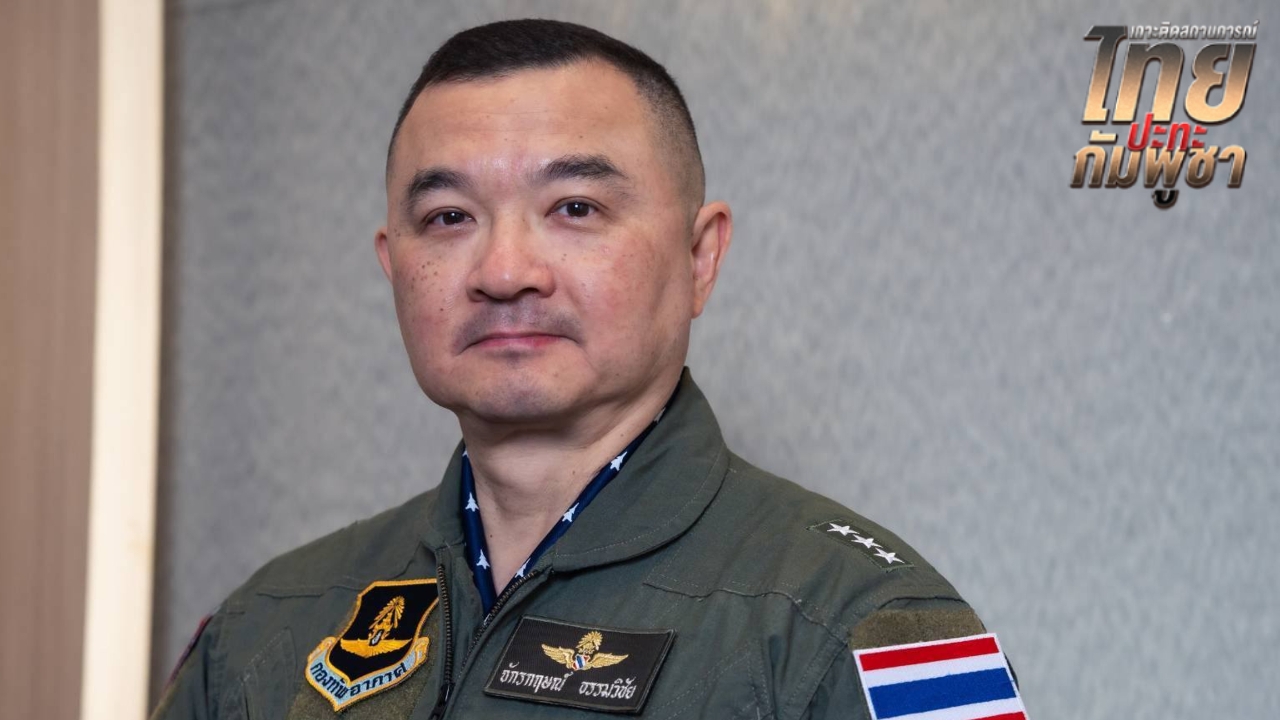
The Air Force spokesperson revealed a joint land and air operation to control Ban Nong Jan, identifying it as a Cambodian military stronghold. The Fine Arts Department urges the public to trust in the restoration of Ta Kwai Castle and disclosed plans to survey no fewer than 30 archaeological sites in the Northeast region.
At 14:30 on 26 December 2025 GMT+7, at the joint Thai-Cambodian border situation briefing center at Channel 5, Air Force Lieutenant General Jakkrit Thamvichai, Air Force spokesperson, stated the morning's objective was a joint land and air operation to control Ban Nong Jan in Sa Kaeo Province. This area overlaps with territory Cambodia had modified into a strong military base with significant strength. The Thai military observed the area for several days and confirmed no civilians remained, as they had all evacuated. Consequently, the target was attacked this morning with effective execution, achieving the set objectives. The area is approximately 25 kilometers from Poipet city. The joint operation between the two military branches aims to control Ban Nong Jan currently.
"I want to address the Cambodian side, which has not shown sincerity in ceasefire efforts. Peace cannot be achieved unless they do so. The Thai military has no choice but to continue serious, ongoing, and full-capacity military operations to protect sovereignty, uphold national interests, and safeguard the lives and property of the Thai people."
Mr. Phanombut Chantrachot, Director-General of the Fine Arts Department, reaffirmed that no ancient site in the world should be destroyed by war. For this reason, many civilized countries have agreed not to use ancient sites as military bases, a rule Cambodia clearly violated by using Ta Kwai Castle as a military operations area, storing weapons, and laying landmines.
In reality, everything happens with cause and effect. For me, the war caused damage to the castle, but the cause was Cambodia using it as a military base and weapons and personnel stockpile. Therefore, cause precedes effect. Please trust that the Fine Arts Department has the capability to restore ancient sites damaged by human actions or nature. Fifty years ago, natural disasters caused the Phra That Phanom stupa to collapse. At that time, technology was not advanced, yet the Department demonstrated that it could restore Phra That Phanom to stability, strength, and beauty. So, there is no doubt we can restore Ta Kwai Castle.
"However, there is a limitation: the Fine Arts Department has no authority to restore Ta Kwai Castle outside Thailand. Restoration can only occur if the castle is within Thai territory, which requires our soldiers to sacrifice to plant the tricolor flag at the castle. Once the flag is planted, the Department is ready to begin restoration. We have the technology to restore damaged structures to their original state, but we do not have the technology to revive lives. Thus, I urge the public to distinguish between losses we can recover, such as ancient sites, and those we cannot, like the lives of fallen soldiers. We must work to end this situation quickly. When military operations conclude, the Department's restoration work will commence."
The Director-General also stated that the Minister of Culture's policy requests the Fine Arts Department to survey all border archaeological sites, numbering no fewer than 30 in the Northeast. This situation has raised awareness about preserving and restoring the nation's heritage sites. He assured that the Department has sufficient capability to restore sites damaged by this war and hopes the conflict ends soon. After restoring Ta Kwai Castle, it will remind us that war brings no benefits but destroys lives and heritage that belong to all humanity.
"Thailand and its people will not surrender, nor be defeated as long as we endure. Everything can be repaired. The beauty of ancient sites does not depend on complete preservation; for example, Sukhothai and Ayutthaya were damaged by war but are recognized as World Heritage Sites. I have never incited destruction of any ancient sites. I trust our military to minimize damage as necessary. If heavier weapons were used, Ta Kwai Castle would have suffered more destruction, complicating restoration. Nonetheless, I wish all soldiers safety and well-being, hope this situation ends soon, and assure that the Fine Arts Department will perform its duty to protect, not destroy."
Meanwhile, Navy Assistant Spokesperson Commander Nara Khuntodom reported on Cambodia's progress dismantling the breakwater near boundary marker 73 at the border in Hat Lek, Trat Province, saying the process is ongoing but declined to provide details. When asked if it remains in the same form, merely opening a water channel, he confirmed, "As far as I know, yes." Regarding rumors that Cambodian Senate President Hun Sen ordered a halt to dismantling the breakwater, the Navy spokesperson replied, "I do not know about that."