

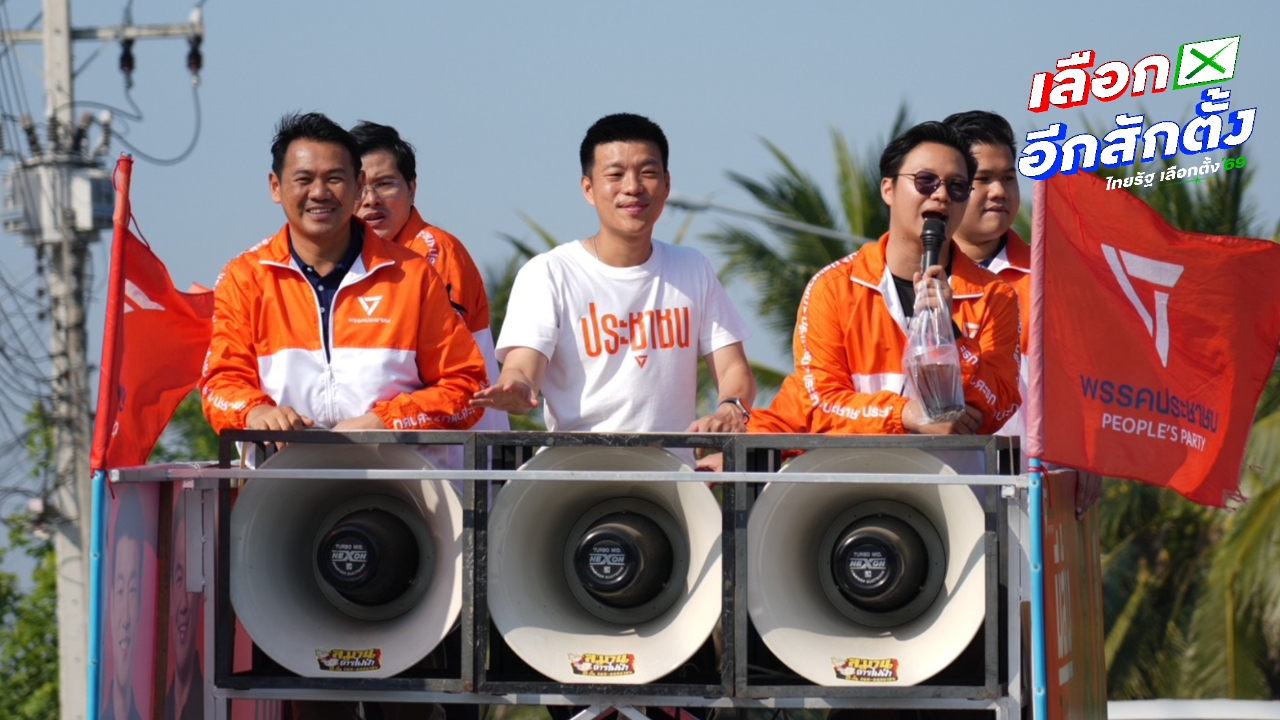
The leader of the People's Party agrees that the pivotal vote raising Anutin as Prime Minister is a key to unlocking solutions for the country. He thanked the media for giving parliament a nickname that reflects the widespread grayness across all circles. While campaigning, he encountered market vendors who greeted him with kisses on the cheek.
29 Dec 2025 GMT+7 Mr. Natthapong Ruangpanyawut, leader of the People's Party and prime ministerial candidate, commented on the nickname for the House of Representatives as the “Gray Cocoon Nest,” saying it reflects what is seen in the media. However, he believes the real danger now is the gray capital networks that not only control the stock market but also involve political circles and those in power. If the House of Representatives, the center of Thai people's power, is captured by these gray capital networks, it could lead Thailand to a dead end. He affirmed that their campaign has no gray areas and called for all political parties to make this an agenda, not just having orange but no gray.
When asked if he agreed with this nickname, Mr. Natthapong declined to comment but expressed gratitude to those who coined it. He said everyone has the right to express their views on this parliament ahead of the election. Regarding the year’s notable phrase, “We elected Anutin not to run the country but to dissolve parliament,” he explained that the People's Party signed an MOA with two conditions: the dissolution of parliament and moving forward with drafting a new constitution. Although it did not fully meet expectations under the agreement, at least one referendum question will proceed alongside the election. They are campaigning for public approval of the referendum to advance the new constitution drafting.(Additional reading: Parliament 2025 nicknamed “Gray Cocoon Nest,” Senate called “Rat’s Den,” and the memorable phrase “Elected Anutin to dissolve parliament”))


Asked whether he agreed with the event of the year, when the People's Party voted for Mr. Anutin Charnvirakul as prime minister, Mr. Natthapong said it was a significant moment in Thai political history. The People's Party’s aim was to unlock the country’s constraints, and at least in the next election, the first referendum question held alongside the vote is crucial. It will truly be a key to opening the door to solutions for Thailand. Indeed, it is a major event of the year.
Reporters added that during campaigning at Mahachai Market in Samut Sakhon province, Mr. Natthapong led the team and introduced the People's Party candidates and their party number 46. The atmosphere was lively, and the local people responded warmly. Many asked to take photos and inquired about the party’s election policies. At one point, a market vendor shyly asked to take a photo and gave Mr. Natthapong a big kiss on the cheek, prompting other vendors to cheer, “You came and got a kiss—if you become prime minister, you won’t get one anymore.” Later, Mr. Natthapong said he was confident of maintaining political support here, noting that earlier in the day he campaigned in Ban Phaeo district with candidates and received positive responses from the public.


On the same day, Mr. Natthapong attended a meeting with the Samut Sakhon Fishing Association to listen to problems and proposals regarding the fishing sector, a major issue in Samut Sakhon and 22 other coastal provinces nationwide. He said the fishing industry faces complex legal, economic, and regulatory challenges. The People's Party has closely monitored and gathered broad opinions about the Fisheries Act, whose key point is to reduce unfair penalties on fishermen to more appropriate levels. Nonetheless, many issues still require continuous cooperation.
One key proposal is to consolidate the currently scattered fishing laws, which are under multiple agencies, into a single Fisheries Code. This would enable integrated problem-solving, reduce redundancy, and improve enforcement efficiency. Regarding longstanding conflicts among commercial fishing, local fishermen, and environmental groups, the crucial factor is having accurate, current academic data and research accepted by all sides. This would form the basis for policymaking and sustainable fishing practices. The commercial fishing sector supports this approach and has proposed establishing a dedicated research agency, especially for marine fisheries, which the People's Party is considering further.


When asked about the spread of black-barbel fish disease affecting fishermen, Mr. Natthapong stated that this problem impacts not only Samut Sakhon fishermen but also fish farmers in many regions. The issue highlights gaps in law enforcement against those directly involved in the outbreak. Meeting participants noted that authorities often strictly enforce laws against law-abiding fishermen and operators, while those causing societal costs face little prosecution or compensation claims. He emphasized that if the People's Party forms the government, it will enforce laws fairly and thoroughly, investigating offenders regardless of their political affiliation.
Mr. Mongkhon Mongkoltriluck, president of the Samut Sakhon Fishing Association, expressed gratitude to the People's Party for visiting to listen and discuss policies with fishermen. He noted that the marine fishing sector has faced ongoing impacts for over 10 years. Although some legal amendments have been made, many related laws still need reform for systematic fishery recovery. Future policies should shift from control to promotion and support of sustainable fishing for both commercial and local fishermen. Decentralization should align with the specific contexts of each area, given the geographic, lifestyle, and fishing practice differences across regions. The Samut Sakhon Fishing Association is ready to engage with all political parties to push for effective people-centered policy changes in the future.


