

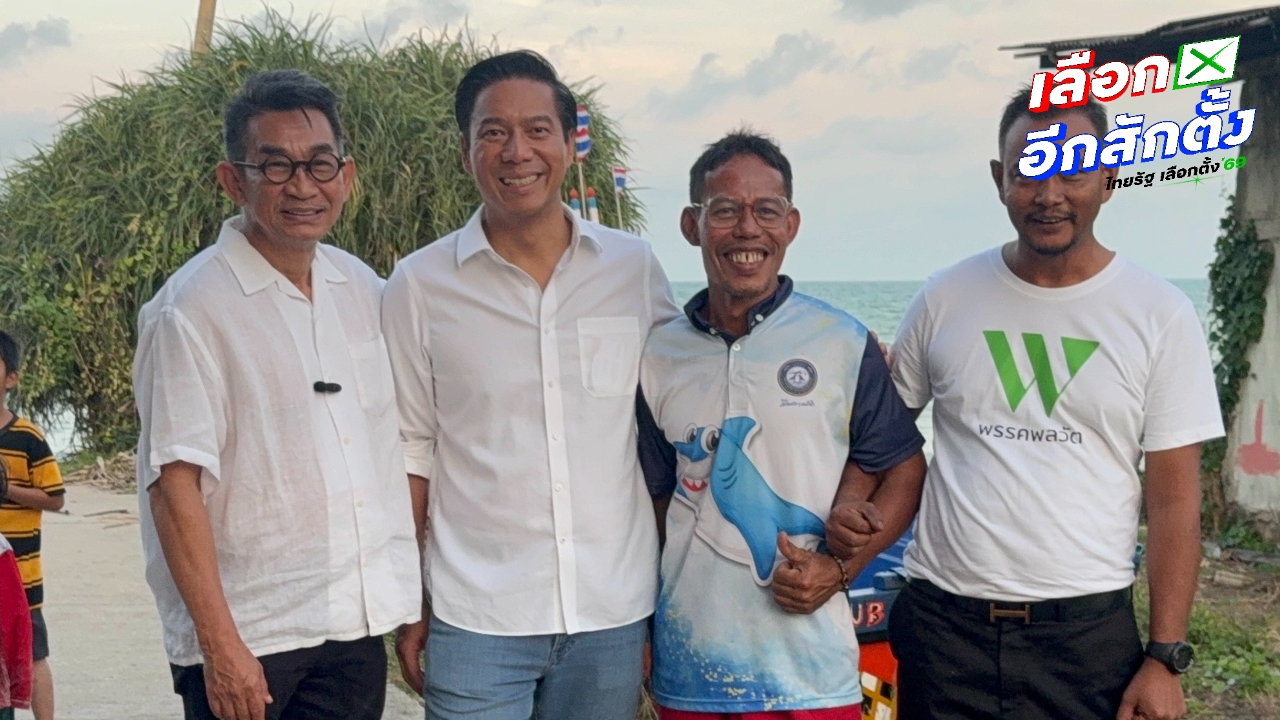
Kanweer and Apisit campaigned in Chana district, Songkhla province, promoting the Pallawat Party's model of community economy and declaring that any government pushing the Chana industrial estate without adhering to the Strategic Environmental Assessment (SEA) will face full opposition.
On 1 Jan 2026 GMT+7, Mr. Kanweer Suebsang, leader of the Pallawat Party, revealed that he and Mr. Apisit Lai Satru Klai, Chairman of Strategy and Policy of the Pallawat Party, visited Natap village, Chana district, Songkhla province, to meet the Chana Rak Thin network and the Tao Khai group, producers of dried fish strips and knitted yarn shoes, exemplifying community economy.
Mr. Kanweer disclosed that the Pallawat Party's policy promotes community economy. He brought Mr. Apisit, an expert in creative economy, to observe community economic examples presented by the Chana Rak Thin network, who demonstrated making dried fish strips and knitted yarn shoes that generate income for local housewives, becoming an additional livelihood.
Mr. Apisit stated that, after hearing from Mr. Rungreung Rhamanya of the Chana Rak Thin network and his wife, a housewife in the Tao Khai group, it was proven that the creative economy, which builds careers and income through environmental work and marine care, yields products like dried fish and processed fish strips. This generates income for families and the community. They also produce knitted yarn shoes, training villagers since the opposition to the Chana industrial estate, including during COVID-19 downtime, and have even exported to Colombia.
"The products of the Chana community demonstrate that environment and creativity, when developed and marketed properly, can generate income. People can work from home, maintain family life, and care for their households. We understand the income is sufficient for a comfortable living. Previously, selling at markets provided more stable income. This is a small community economy, and with genuine commitment, it can succeed as seen. However, some aspects require knowledge, such as new technology like sanitary dryers for drying fish strips," he explained.
Mr. Apisit revealed that Chana is a model of community economy that surprised him by its success. It can incorporate technology to reduce costs, representing a design thinking approach that opens new ways of thinking. As often said, one may not see fish just as fish but as something else, adding value.
Mr. Kanweer said that the Chana Rak Thin network and local people symbolize the fight against the Chana industrial estate. Events here have historical significance: dried fish strips, salted fish buried in sand, and shoes carry the history of sarong warriors who protested at the government house. This is an emotional and historical value for the community.
Mr. Rungreung added that they oppose building the Chana industrial estate because such industries do not just consume local products but also the spirit of the people here. If the estate is built on 20,000 rai of filled land, Hat Yai will face worse flooding, and Chana experienced severe floods this year. With the estate downstream, Chana town might be submerged under floodwaters as disasters are interconnected.
"We currently distrust the SEA, which has concluded that the Chana area is unsuitable for an industrial estate, even though it is part of the 15+1 strategy covering Songkhla and Pattani. Although the National Economic and Social Development Council has finalized this, we cannot yet trust it. We are wary of the new minister. Whoever forms the government, we ask them to consider this carefully," Mr. Rungreung emphasized.

Mr. Kanweer reiterated that the Pallawat Party will fully oppose any new government that does not use the SEA study results as a guideline for developing the Chana area, as the participatory process must be respected. Without adherence to this, what is the point of the study?
"If any government pushes forward, I will fight fully because the SEA mechanism provides valid reasons for decision-making. If establishment is deemed impossible due to environmental, cultural, and lifestyle impacts, these must be considered based on the study. Anyone who insists on disregarding this will face our full resistance," he declared.
Mr. Kanweer affirmed that the Pallawat Party supports community economy using creative economy principles as knowledge to generate income for communities. He believes that if communities can leverage their resource base to create income, it will form a critical economic foundation and a significant economic dynamic for Thailand.
