

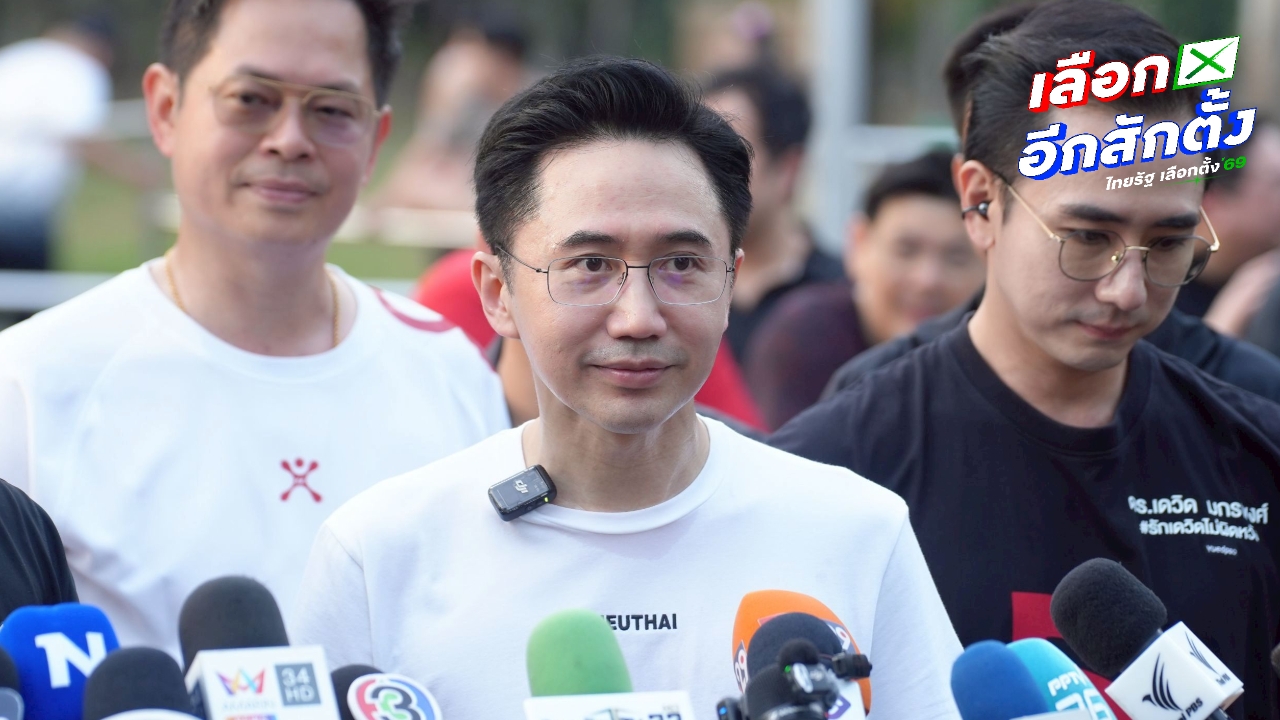
Pheu Thai does not rule out alliances with any political party and declines to accept being viewed as the third largest party. Citing positive public response from field visits, Yoschanan and Julpan are ready to continue pushing the Clean Air Act if they return to government.
At 07:20 on 2 Jan 2026 GMT+7 at Lumphini Park, Mr. Yoschanan Wongsawat, Pheu Thai Party prime ministerial candidate, spoke after leading the party team on a jog in Lumphini Park. Regarding signals from various parties about forming political alliances, he said the public seems to see that forming alliances now might be premature. What is most important is focusing on the people. They strive to talk with citizens about their hardships to inform policies that reach the public. Since each party has different policies, alliances can be formed with any party whose policies do not conflict.

When asked if Pheu Thai is open to alliances with any party that implements its policies, Mr. Yoschanan said yes. He added that many say Pheu Thai is the third largest party, but the party is reluctant to accept this because their field visits receive strong public support. He said policy will be the foundation of politics, and they will consider which parties can align with Pheu Thai’s policies. The party is open to cooperating with others with good, compatible policies.
Asked whether Pheu Thai’s conditions for alliances regarding Section 112 remain unchanged, Mr. Julpan Amornwiwat, Pheu Thai leader and prime ministerial candidate, added that alliance conditions depend on policies. Everything is included in the policy framework, including that specific issue.

Mr. Yoschanan also spoke about policies on parks and health, emphasizing the need to reduce expenses first. Nearly 10% of GDP is spent on poor health. Healthcare costs are an endpoint issue; they aim to solve problems at the source. About 64% of diseases can be prevented, so he invited everyone to exercise to maintain health.
Regarding parks and air quality, Pheu Thai has pushed the Clean Air Act, currently with the Senate members but not finalized. They will continue to promote this and related laws because clean air is vital for Thai people's health and the economy. Poor air quality disrupts outdoor life, so clean air will improve the economy. The solution involves multiple sectors, including making public transport affordable—10 baht for buses and 20 baht for electric trains—to reduce costs and support environmental issues.
When asked about public feedback during the run, Mr. Yoschanan said the most important issue is livelihoods, which aligns with Pheu Thai’s policy. At parks, people discuss daily life; elders and younger generations exchange advice. Parks have been social hubs since England's Industrial Revolution, serving as places where stressed people gather. Improving parks in provinces will foster community and economic circulation. Also, promoting street food vendors by providing selling spaces is a Pheu Thai policy, applicable not only in Bangkok but also in other provinces if Bangkok succeeds.

Mr. Julpan spoke about tackling PM 2.5 dust pollution, noting that when they were previously in government, they pushed the Clean Air Act. However, the parliamentary committee process took about two years with revisions. Even as a majority government, it took months to pass the bill to the Senate. The law was stalled after parliament was dissolved. The new government’s commitment will determine progress, but Pheu Thai affirms that if re-elected, it will complete the Clean Air Act in the next term as a fundamental right to clean air for citizens.
Mr. Julpan added that PM 2.5 levels are currently high. Pheu Thai’s approach has been clear, but it is insufficient alone to stop domestic burning. Discussions with neighboring countries are necessary since cross-border burning contributes to pollution in Thailand. Agricultural and industrial burning also occur domestically. The law will require those who burn to pay compensation and address damages to affected people. Pheu Thai is committed to continuing to push this legislation forward.