

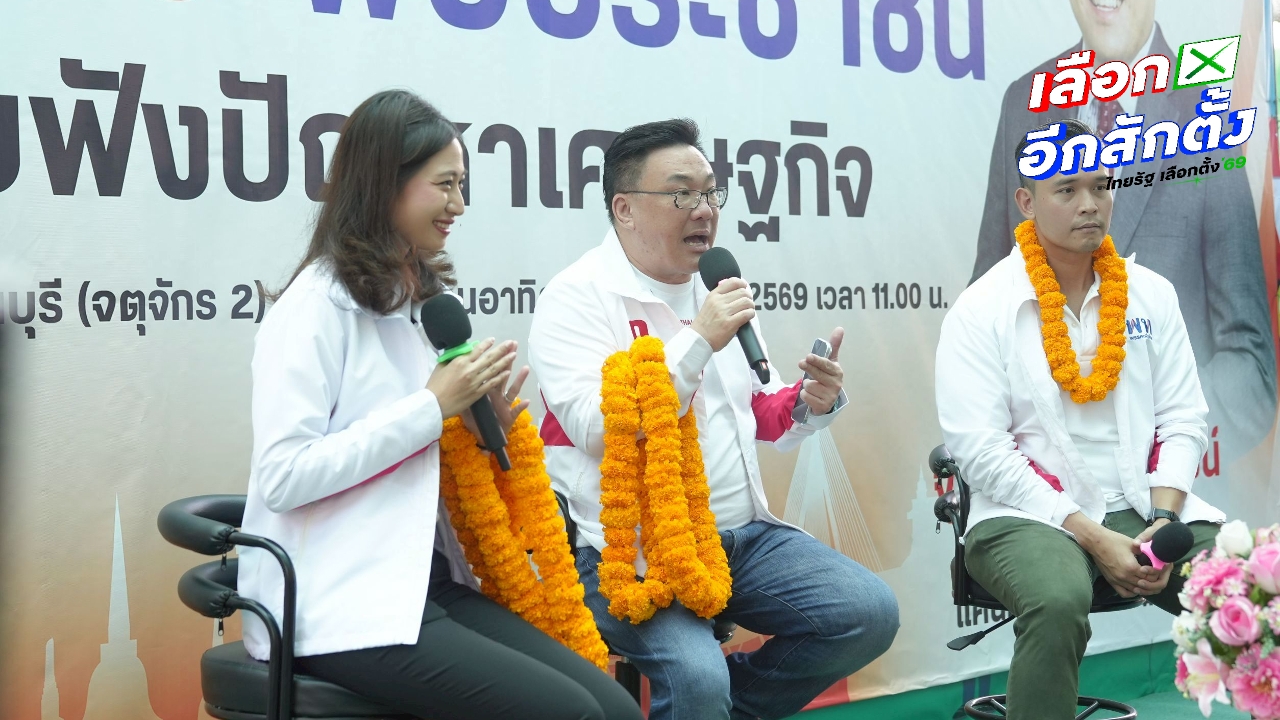
Chulapan leads a team supporting Khwanjira's campaign in Minburi, declaring that only Pheu Thai can achieve this, promoting a public transport policy capped at 60 baht per day.
At 10:00 a.m. on 4 Jan 2026 GMT+7, at the Rom Sai Foundation in Bangkok, Mr. Chulapan Amornwiwat, leader and prime ministerial candidate of the Pheu Thai Party, along with Mr. Pongkawin Jangroongruangkit, party list MP candidate and deputy party leader, and Mr. Wichan Meenchainan, former Deputy Minister of Public Health, visited to support Ms. Khwanjira Meenchainan, candidate for Bangkok MP in constituency 19, number 1, in her campaign. They listened to local residents and rescue volunteer foundation staff about their issues. At 10:30 a.m., Chulapan and his team went to Chatuchak 2 Market (Minburi) to greet residents and vendors, receiving a warm welcome with many people requesting photos for keepsakes.
Promoting a public transport policy capped at 60 baht per day.
Mr. Chulapan stated that he arrived with candidates who represent new blood in the Pheu Thai Party and are committed to development. Ms. Khwanjira will help push their policies, including the electric train policy priced at 20 baht per trip along the entire line. Over the past two years, the Pheu Thai government successfully passed related legislation, but the government under Prime Minister Anutin Charnvirakul chose not to continue, instead proposing a 40 baht daily cap with a different approach. We want to lower the cost of living in Bangkok by making public transport accessible with a fixed fare of 20 baht per trip. Another ongoing project is to make buses air-conditioned with a 10 baht fare per trip. In the future, if Bangkok residents travel from home by bus and transfer to the electric train, daily travel will cost no more than 60 baht, leaving money to support their families. Additionally, there are policies to reduce living costs, including affordable housing projects for Thai people, enabling residents to live at 4,000 baht per month.

Saying only Pheu Thai can deliver.
Mr. Chulapan added that they also have policies to relieve citizens' debt burdens and create new opportunities, whether by enabling youth to study within the system or through funded programs that lead to employment. They aim to develop the potential of the younger generation to prepare for advancing technology. They will focus on tackling drug problems and scammers. Pheu Thai has done this before; though not victorious, they persist. Additionally, they plan to use AI to alleviate traffic congestion and urge voters to elect Pheu Thai representatives to parliament to push the Rescue Volunteer Act, enabling volunteers to dedicate themselves to the public with pride. Lastly, they seek to address flooding by tackling water management comprehensively to end recurring floods. Pheu Thai is the only party to seriously act on these issues. Their core principle is to drive economic growth so everyone has more money. Only Pheu Thai can do this. They urge voters to vote for both the candidates and the party on 8 Feb.
Pushing the Rescue Volunteer Act to ensure welfare and benefits for volunteers.
Subsequently, Mr. Chulapan spoke about promoting the Rescue Volunteer Act, stating that they received a letter from volunteer rescue groups nationwide regarding the National Volunteer Rescue Act. They will push this legislation for the benefit of over 200,000 rescue volunteers across the country who have never received subsidies.
When asked how Pheu Thai would advance this if elected, Mr. Chulapan said the first step is to enact laws that protect volunteers' welfare and benefits. The law will define the forms and responsibilities the state must undertake. Volunteers do not seek financial aid or state subsidies but only welfare and protections, such as designating them as state officials. This is important because in some areas, volunteers face obstacles due to lacking official authority, for example, when providing assistance. Clear guidelines and official registration will enhance their efficiency and ability to assist the public.

