

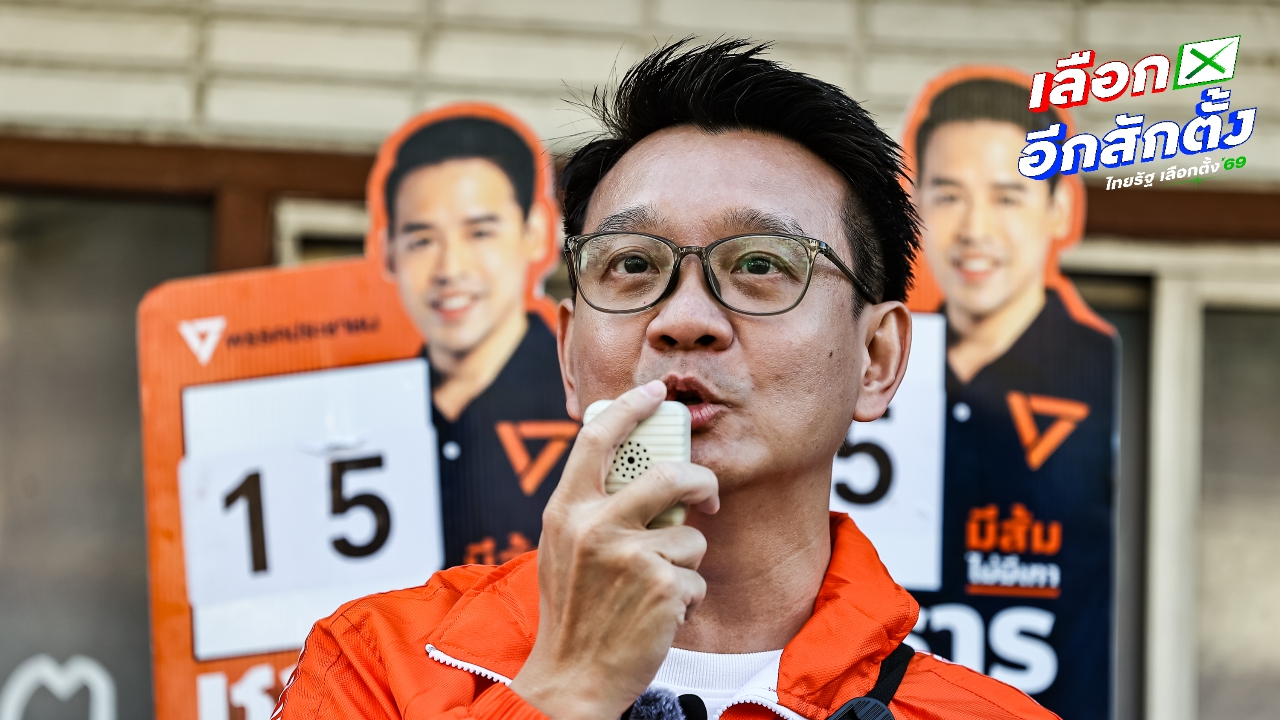
People’s Party prime minister candidate Weerayut Kanchuchat points out that in this election, the party must fight against 'gray capital' that is more exhausting and intense, using money in the campaign. He acknowledges that the People’s Party may no longer be a dark horse because major local powers have joined forces.
Thairath Politics went on the campaign trail with Associate Professor Weerayut Kanchuchat, prime minister candidate and deputy leader of the People’s Party, who revealed that popularity ratings fluctuate. He admitted that this election the Orange Party may no longer be a dark horse and must still contend with 'gray capital' that is more intense and uses large sums of money in elections. He emphasized the People’s Party has no policy to amend Section 112 and if this issue is raised, it is deliberately used as a political game, citing some clips are shortened to misrepresent the party’s context. Regarding reports of him being the real prime minister candidate of the party, he said there are still many steps before he could become prime minister, but as one of the top three candidates, everyone must be ready at all times. He said he is preparing but prefers "Teng Natthapong Ruangpanyawut" to follow normal party mechanisms.
"This time, we may no longer be a dark horse because in many provinces, major local powers have united. Last time, they may have underestimated us, but this time the major local powers are ready to compete and are deploying heavy resources. So, this time we may no longer be a dark horse, but we still work like one and must accept that 'gray capital' has come in large amounts. 'Gray capital' easily operates through elections, so we have to fight. It’s heavier and more exhausting than before," said Associate Professor Weerayut.

Associate Professor Weerayut also said that a concern this election is the political atmosphere, especially voter turnout, but the party will continue to explain to the public. In major cities like Bangkok, where the contest may be between the People’s Party and the Democrat Party, the party believes no one owns the voters. Every election, the public has the opportunity to decide by looking at new policies and candidates. This time, they hope to gain trust. For two and a half years, the People’s Party has worked fully as the opposition, scrutinizing issues like social security, cutting off utilities to call centers, and budget oversight in parliament. However, as the opposition, they cannot manage budgets or policies.
"Therefore, this time we ask the public to give us another chance. We have seen blue, green, navy, and red governments many times over more than 10 years. We want to ask for a chance for the Orange Party government to become a new dawn to come and change the country," said Associate Professor Weerayut.

Regarding the People’s Party announcing its cabinet lineup, Associate Professor Weerayut said this is because they do not want Thai politics to proceed by quota systems and want every party to clearly state who will hold which positions. This time, the party proposes change to make Thai politics straightforward, to have capable and effective people as the core. The party’s deputy prime minister will not simultaneously hold a ministry; instead, ministers will handle their portfolios, while one deputy prime minister will oversee the overall agenda. He believes this method will be more effective.
On policy matters, Associate Professor Weerayut confirmed that the receipt lottery policy sustainably addresses purchasing power and longevity, with careful fiscal budget calculations. Many parties do not even consider how much money will remain if they become government in 2026, but the People’s Party examines how much will remain in 2026 and 2027.
"We therefore propose realistic measures, starting the elderly allowance at 1,000 baht, then gradually increasing according to fiscal space available. We emphasize realism, using remaining funds and the budget as the basis, and try to communicate this clearly to the public," he said.
Watch the full interview at: https://www.youtube.com/watch?v=LANv7phpGKs


Photo: Thanat Chayaphattharuthee