

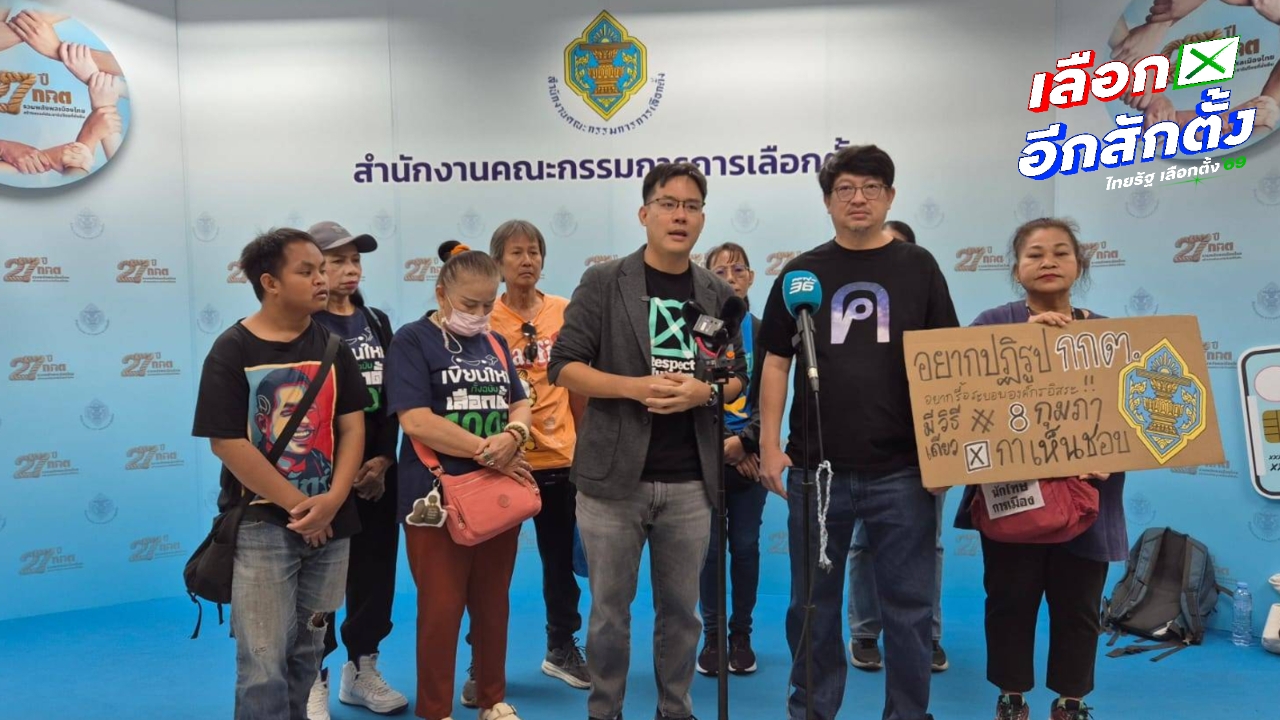
Yingcheep and Sombat visited the Election Commission and spoke for 7 minutes to raise questions about election and referendum concerns. The EC Secretary confirmed that political parties and politicians are permitted to campaign for the referendum.
On 6 Jan 2026 GMT+7, at the Election Commission (EC) office, Mr. Yingcheep Atchanon, manager of the Internet for People's Law (iLaw) project, and Mr. Sombat Boonngamanong, known as Bok Lai Jud, came to ask Mr. Sa-wang Boonmee, EC Secretary, about questions regarding the election and referendum. Bok Lai Jud wore a black T-shirt with the initial K. printed on it.

While Mr. Sa-wang was giving a media interview, Mr. Sombat joined the group and asked, “Does the EC have responsibility for both elections and referendums?” Mr. Sa-wang answered, “Yes.” Mr. Sombat then asked, “Earlier you said political parties and politicians should not campaign to express their stance on accepting or rejecting the constitution. Is that correct?” Mr. Sa-wang replied, “Yes.” Mr. Sombat pressed further, “So, can they do it or not?”
Mr. Sa-wang responded that he had already stated in a press conference that it is allowed. According to Section 17 of the law, the EC is tasked with setting rules for orderliness, but after review, it considers this a constitutional freedom. Therefore, the EC has not issued any regulations. However, political parties have greater responsibilities because their actions must comply with party law, referendum law, and MP laws. Mr. Sombat added that Mr. Sa-wang's statements caused public confusion and requested a clear written clarification. He also asked about some politicians’ uncertainty regarding which expense category referendum campaign costs fall under. Mr. Sa-wang replied that political parties have finance officers familiar with the law. He emphasized that political parties must observe three laws and that every baht spent must comply with party law. There are no referendum expenses, but elections for MPs involve party and constituency expenses, so speakers must be cautious about their content.

Afterward, Mr. Sa-wang, Mr. Sombat, and Mr. Yingcheep discussed details together for 7 minutes before Mr. Yingcheep and Mr. Sombat spoke to the media.
Mr. Sombat said that earlier Mr. Sa-wang asked about the meaning of the K. on his T-shirt. He replied it stands for 'K. Khwai,' a play on the word 'think.' He wore it hoping Mr. Sa-wang would think carefully. Mr. Sa-wang confirmed that political parties and politicians can express opinions either supporting or opposing the referendum. Mr. Sombat and Mr. Sa-wang agreed that public interest in the referendum is low, possibly because MPs talk about elections but not the referendum, so they need to help campaign for it.
Mr. Yingcheep said that after speaking with Mr. Sa-wang in the reception room for 7 minutes, the first issue raised was a repeated request to extend the registration period for early voting and out-of-area referendum registration by about 3 days. Legally, this could be extended until 8 Jan, and adding one more day could preserve voting rights for several hundred thousand people. Mr. Sa-wang confirmed there has been no extension, and registration closed last night. If people missed registration, they cannot register now and must vote at their registered address on 8 Feb only.
Another question was how many people registered for early voting outside their district but did not register for the out-of-area referendum vote, since these require two separate registrations. Official numbers have not yet been released, but Mr. Sa-wang said about 600,000 people (over 3 days) are in this category, meaning they cannot vote in the referendum. This is unfortunate but not as severe as expected. He thanked the media and others for helping publicize this issue.