

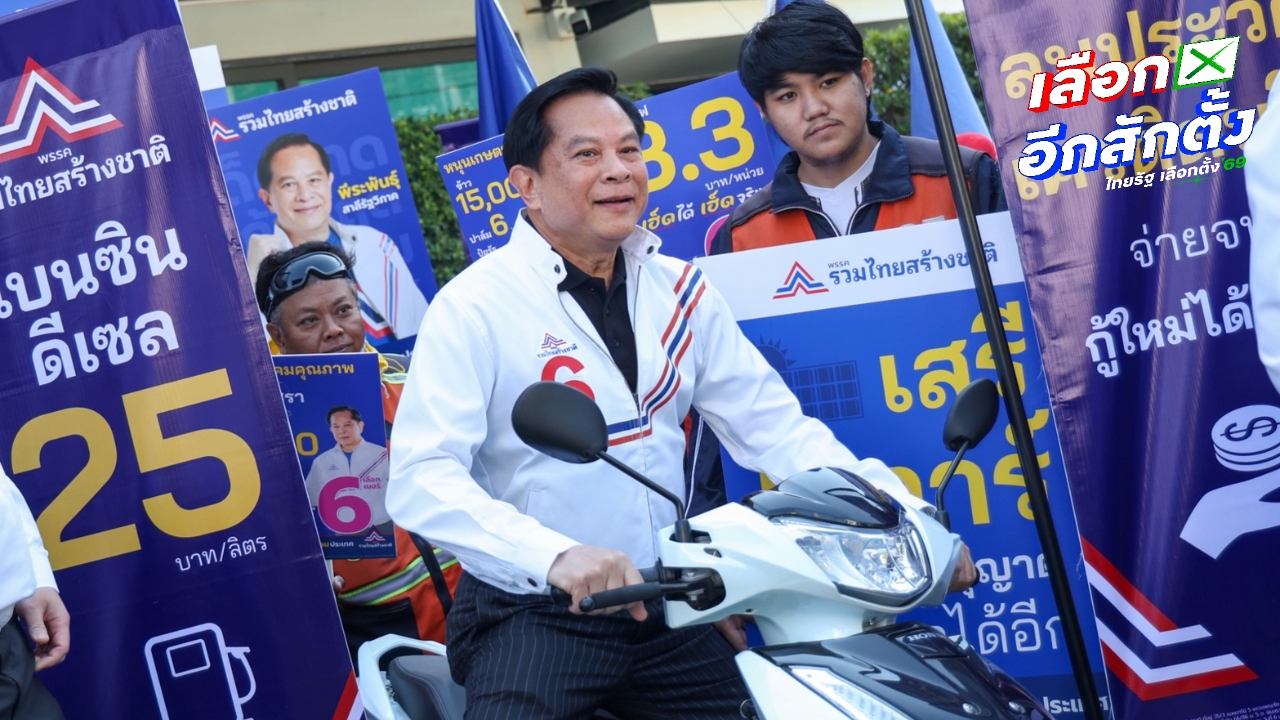
The Ruam Thai Sang Chart Party launched a caravan campaign to deliver hope to their southern hometowns with the slogan "Isan Must Be Better." Peerapun set a target of winning 69 MPs, condemned corruption with calls for tough measures, and questioned the purpose of retaining MOUs 43-44, stating Thailand gains no benefits from them.
7 Jan 2026 GMT+7 Mr. Peerapun Salirathviphak, leader of the Ruam Thai Sang Chart Party and prime ministerial candidate, along with two other prime ministerial candidates, Mr. Attawit Suwanpakdee and Mr. Naraphat Kaewthong, as well as Mr. Witthaya Kaewparadai, Mr. Samart Maluleem, and Colonel Fuangwitch Aniruttawa, deputy leaders of Ruam Thai Sang Chart, announced their readiness to proactively drive political work. They assigned Mr. Kriangkraimas Pojanasunthorn, or Kendo, the party's deputy spokesperson, to lead a caravan to campaign in the Northeast (Isan) region to present policies and engage closely with local people under the "Isan Must Be Better" campaign.
Mr. Peerapun said today he tasked Mr. Kriangkraimas to convey the party's key energy policies aimed at reducing expenses and alleviating the cost of living burdens to the Isan people. "Our urgent mission is to restructure the energy sector to lower costs and ease living expenses so that people have more money in their pockets." The key highlights include a policy to reduce electricity rates to 3.30 baht per unit and fuel prices for both gasoline and diesel to 25 baht per liter, focusing on sustainable solutions. This received overwhelming support from attendees at the event.


Mr. Kriangkraimas emphasized that this policy is a heartfelt promise from Mr. Peerapun to all Thais to bring real change, reduce expenses, and significantly improve quality of life. "Mr. Peerapun often tells me that the people of Isan deserve cheaper electricity and fuel, and their lives must improve. Today, I bring you the sincere commitment of Ruam Thai Sang Chart: we mean what we say and will fulfill our promises."
The caravan launch was lively. Mr. Peerapun greeted participants from various energy-dependent professions, including motorcycle taxi drivers, taxi drivers, tuk-tuk drivers, parade vehicle drivers, and security guards. They all expressed a shared desire for economic improvement. Mr. Peerapun even tried roles as a motorcycle taxi, taxi, and tuk-tuk driver before saying, "The key to economic improvement lies in lowering energy costs, which our party's policies can achieve. One important policy is supporting those who rely on gas. While I was Minister of Energy, I consistently implemented policies to cap cooking gas prices to avoid burdening people's living costs."


At 11:30 a.m., Mr. Peerapun gave an interview at Ruam Thai Sang Chart Party headquarters about the campaign atmosphere. He said the party is working and preparing for the election by sending representatives across all regions to listen to local feedback. He confirmed that issues in Bangkok and provinces alike include the Thai-Cambodian border and energy problems, both aligning with party policies and his work over the past two years. He believes that if voters trust the party and its candidates to govern, these issues will be resolved.
Mr. Peerapun added that these issues have long existed, especially the Thai-Cambodian border problem, which has never been definitively resolved due to a lack of decisive solutions. Regarding energy issues, during his tenure as Minister of Energy, he tackled problems seriously and effectively, achieving solutions. This reflects the essence of Ruam Thai Sang Chart. Thus, if the people trust them, he is confident they can decisively transform the country. Therefore, candidate number 6 does not lie.


Asked whether the strict anti-corruption policy, including the death penalty, is suitable for Thai society now, Mr. Peerapun responded: "It's like a human body with cancer spreading everywhere. Would a doctor not cut it out? If not, the patient dies. So, do we acknowledge that corruption in our country is worsening daily like spreading cancer? Yet, we keep using mild treatments. Will the disease ever end? Now is the time to be serious, decisive, and resolute. This is not a new idea; I've thought this since I was Minister of Justice."
Regarding concerns about vote-buying, Mr. Peerapun said he does not need to speak on this because everyone knows except the Election Commission (EC). When asked if the party would publicly name ministerial candidates to build public confidence, he said their party is fully prepared and boldly declares it has no corruption or misconduct, focusing solely on genuinely helping the people. No other party dares to make such a claim.


When asked if there are any concerns during the campaign, Mr. Peerapun said none. He has campaigned normally for 30 years and never lied to the public. Whatever he says during campaigns, he intends to fulfill. Now as party leader, all ideas are policies, not just campaign promises, and he asks the public for a chance to work. Regarding early locking-in of prime ministerial votes or vote-buying, he said such practices have always happened, but he and his party will not engage in them. Anyone who does cannot stay with him.
Asked about the target number of MPs, Mr. Peerapun said he aims to win all seats because without full support, his plans cannot succeed. If voters don’t choose them, the energy solutions he proposes won’t happen. He asks for the opportunity to work and is not regretful about losing his former position but regrets losing the chance to succeed. He aims to complete everything in 2026 if he remains in office. When asked if he expects to win 69 seats, he said that is likely because his six core policies align with the party’s number 6.


Meanwhile, Mr. Peerapun also commented on resolving unrest along the Thai-Cambodian border with fence construction. He said the main obstacle is MOU 2543, which causes many problems. The question is what Thailand gains from MOU 2543. If it brings nothing, why keep it? Some say without MOU 2543, talks cannot proceed. If so, should Thailand have MOUs with every country? That’s untrue because diplomatic negotiations have established methods that do not require MOUs. Additionally, the Thai-Cambodian border is clearly defined by the Thai-French treaty, so there is no need for further negotiation. Any renegotiation that changes this boundary would cause loss of Thai territory, which is a criminal offense of treason. Therefore, MOU 2543 is unnecessary.
"The international standard today uses a 1:50,000 scale map, used by both Thai and Cambodian soldiers. Only their government uses the 1:200,000 scale because it benefits them. So why did we accept the 1:200,000 scale in MOU 2543? If we cancel MOU 43, what damage would occur? If they say it’s necessary, we can sign a new one and remove anything disadvantageous."
Mr. Peerapun also said MOU 2544 concerns maritime issues. The problem arises because Thailand draws maritime boundaries by international standards from marker 73, but Cambodia draws them arbitrarily. Thailand has tolerated this since 1973 until 2025—52 years—due to a lack of decisive action. Cambodia has been uncooperative for 52 years. To access energy resources there, an agreement was made to negotiate, but how can we negotiate what belongs to us?

The offshore energy resources are rightfully ours by international law, which all countries accept. So why must we abide by MOU 2544? We gain nothing and only lose. Why keep it? Importantly, marker 73 has been the subject of attempted changes, which failed, so Cambodia reclaimed land, causing ongoing issues. They claim land reclamation is for soil erosion control, but international law states any land extending into the sea is part of a country’s territory. If Cambodia later claims this land, marker 73 shifts, and maritime boundaries change immediately. How have we tolerated this since 1997? They have reclaimed 1-2 meters initially, now 300-400 meters, and we have done nothing but protest. Thailand solves sovereignty issues with protests.
"While they plan to grab land, we protest but achieve nothing, so we keep protesting. This reflects a lack of decisiveness and seriousness. If Thai land is lost, who is responsible? This is more important than land borders onshore because maritime boundaries affect Thailand’s resources, income, and wealth. How can we accept this?"
When asked why constitutional amendments proceed quickly but MOU 2543, a territorial matter, moves slowly, Mr. Peerapun said he was also surprised. When signing, no one questioned; when canceling, questions arise, though it is a government matter. If canceling is necessary, a new agreement can be made, removing problematic parts. If sincere, they can cancel. If not, what happens? Even after a peace agreement, shootings continue, including after a 72-hour ceasefire."