

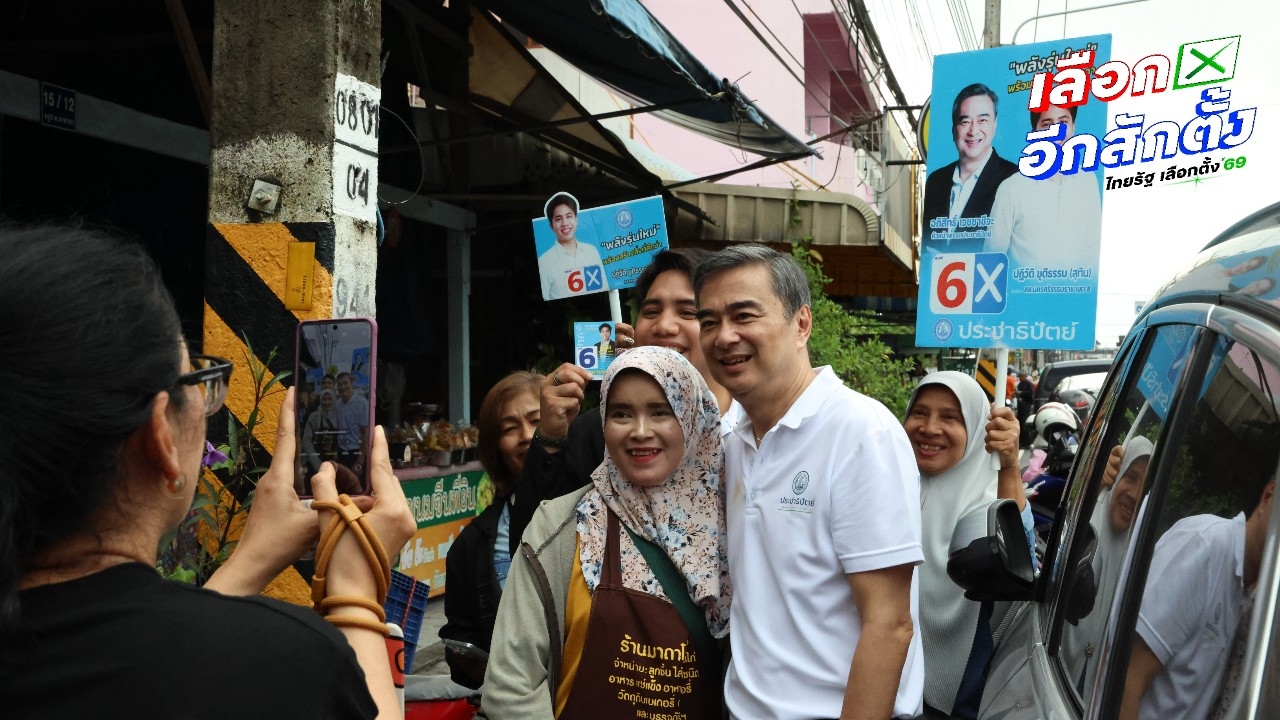
“Abhisit” campaigns in Nakhon Si Thammarat, greeted by a grandmother who embraces and kisses him, blessing him to become prime minister again. He admits being concerned about the rampant vote-buying in the southern region and vows to put an end to politics decided by money. ,
On 7 January 2026, Mr. Abhisit Vejjajiva, leader of the Democrat Party and prime ministerial candidate, greeted residents at the Tha Wang community in Mueang district, Nakhon Si Thammarat province, to support Mr. Songsak Musikhong, candidate for MP in Constituency 1, number 2. The atmosphere along Ratchadamnoen Road was lively, with many people and local shops coming out to welcome and take photos with him.


A key moment occurred during the greetings when the grandchildren of an elderly woman, who was sitting in a car and had difficulty walking, shouted to Mr. Abhisit that the grandmother wanted to see him in person. Upon hearing this, Mr. Abhisit immediately ran straight to the car. The grandmother then tried to get out and embraced and kissed Mr. Abhisit on the cheek with joy, even tearing up. She blessed him, wishing for him to return as prime minister to take care of the people.
Earlier, Mr. Abhisit also greeted civil servants and municipal employees of Nakhon Si Thammarat municipality in a warm and friendly atmosphere. Along the route, people continuously waved and called him over for commemorative photos.


Mr. Abhisit invited residents of Nakhon Si Thammarat to attend the Democrat Party’s major rally on 1 February 2026 at the city square in Mueang district. He affirmed that on that day, he would take the stage to debate and explain the details of various policies fully so that the public can be well-informed, aiming to build confidence ahead of the upcoming election.
Admits concern over rampant vote-buying in the southern region.
On the same day, at Tha Sala Prasit Suksa School in Tha Sala district, Nakhon Si Thammarat, Mr. Abhisit spoke to the media about the increasingly intense political competition in the southern region. He said the most worrisome issue is vote-buying, which has been widely reported. However, he is encouraged by signs of change as the public begins to speak out themselves, saying “enough” to politics determined by money.
“To be honest, I am concerned. The problem of vote-buying is still widespread. But this time, we are trying to communicate with all parties, and I’m glad the people are starting to say themselves that it’s time to stop politics that rely on money to decide power,” he said.

In response to questions about infrastructure achievements, Mr. Abhisit candidly explained that the Democrat Party has had little opportunity to manage ministries responsible for infrastructure, as it has mostly been in opposition. When in government, it was often assigned social ministries, focusing on building social welfare foundations, such as policies for senior citizen allowances and 15 years of free education, which are tangible benefits for the people.

At the end, Mr. Abhisit conveyed a message to southern residents, expressing concern about livelihood issues, particularly the falling prices of rubber and agricultural products over the years. He declared that the Democrat Party is ready to return as a reliable representative to address these problems with concrete results once again.