

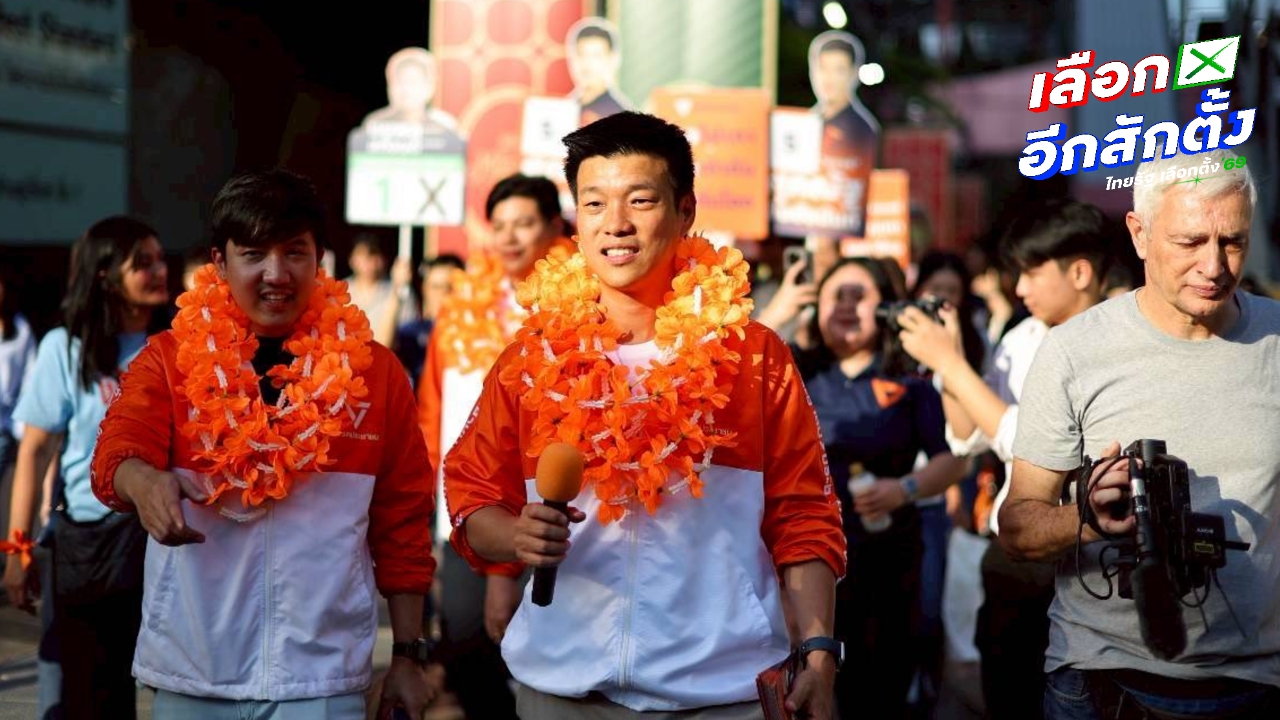
Nattapong declared, “See you at the Government House on 8 Feb.” He appealed to residents of Chatuchak and Laksi to choose the People’s Party to form the government and urged them not to lose hope. The crowd shouted, asking for “Teng” to be the next prime minister before he proceeded to Benjasiri Park to discuss Children’s Day policies and announced three educational reform goals.
On 10 Jan 2026 at BTS Phahon Yothin station, Nattapong Ruangpanyawut, leader of the People’s Party, campaigned with candidates Suphanat Meenachainan for Bangkok’s 9th constituency and Chayapon Sathondee for the 8th constituency. Suphanat’s brother, Boss Meenachainan, also joined. The campaign atmosphere was lively with party supporters presenting orange garlands to Nattapong and the candidates, wishing him to become the next prime minister amid cheers and applause.

Nattapong invited the public to join the party’s event at Samyan Midtown on 11 January. He stressed that this election poses a crucial challenge for the country—not just to win, but to establish a people’s government. The People’s Party will unveil a professional management team ready to start working immediately if elected.
“We have many policies to advance Thai society, but we cannot succeed if we do not remove the gray areas from politics. Without honest politicians like Goody Chayapon, Bank-Suphanat Meenachainan who reject illicit funding and large capital, and serve only the people, real change in parliament is impossible,” Nattapong said.
Then the party leader shouted, “Who will choose the People’s Party on 8 February? Choose both ballots! Who wants Teng to be prime minister?” The crowd cheered and waved in response. Nattapong thanked them and urged them not to lose hope and to be the driving force in this election.
“This election is marked by an information war, and many may feel discouraged. Last time people voted for Move Forward Party, but P'Tim didn’t become prime minister. That’s what those in power want. The few elites in this country, the Senate, have no meaning and never listen to the people. This time, every vote really counts because the Senate no longer votes for prime minister. Please tell your friends, relatives, and everyone nationwide to help establish a people’s government.”
He concluded, “See you at the Government House on 8 February.”
Afterwards, Nattapong traveled by BTS to Benjasiri Park for Children’s Day activities. Along the way, citizens and schoolchildren requested selfies and offered him encouragement.

At 16:30 at Benjasiri Park, the People’s Party held a forum titled “Children Thrive with Good Welfare, Laws, Curriculum, and Teachers,” focusing on children and youth policies for Children’s Day 2026. Party leaders and education team members attended, including Nattapong Ruangpanyawut, party leader; Decharat Sukkamnerd, deputy prime minister candidate for quality of life; spokesperson Parit Watcharasin; candidate Nattaya Boonpakdee for party list focused on children, youth, family, and learning; candidate Teerasak Jiratrasu; Paramee Waichongcharoen; and Tamahathai Chanaboonasak, all party list candidates.
Nattapong said Children’s Day should not be just adults setting slogans with expectations for children, but a day adults listen to children’s needs and how they want the education system improved, envisioning their own future. The party’s education policy goals focus on three areas: making education meaningful, making education enjoyable, and fostering lifelong learning.

The first goal is to make education meaningful—children and youth learn what equips them with life and career skills.
(1) Develop a new curriculum under a People’s Party government, shifting from content-heavy volume to cultivating essential competencies for future careers and life. Every child will learn to think critically, perform skills, and communicate effectively, with integrated subjects and flexible frameworks allowing schools to tailor teaching methods.
(2) Teachers will have time, skills, motivation, and welfare to support children’s learning development.
Restore teachers’ time and focus to classrooms: teachers who want to teach will teach. Within the first 100 days, administrative tasks unrelated to teaching will be reduced or eliminated. Schools and teachers will choose whether to participate in useful projects. Administrative duties like accounting and procurement can be supported by technology or dedicated staff, and processes accelerated, such as amending laws to allow digital signatures in government procurement.
Skills: Teachers will be equipped to handle new learning methods, shifting from “front-of-class” knowledge transmitters to “back-of-class” observers identifying individual student skill gaps and addressing them. Teacher training will decentralize from central authorities to schools, with budgets of no less than 5,000 baht per teacher allocated as grants allowing schools and teachers to select relevant training.
Motivation: Teachers who effectively help students develop will advance professionally. Evaluation and promotion will link more closely to student achievement and growth, including 360-degree evaluations by students.
Welfare: Starting salaries for new teachers will increase to 22,000 baht, with additional pay for those in risky, remote, or hard-to-access areas. Support staff welfare will improve, shifting from contract-based to at least temporary employee status with fair wages and benefits.
(3) Utilize technology to enhance teaching quality by providing all children access to content through a national learning platform. Data and AI will analyze and personalize learning paths according to each child’s strengths and weaknesses.

The second goal is to make education enjoyable—parents should not suffer from hidden educational expenses, and students receive care for both physical and mental health.
(1) True 100% free education across all areas with quality, adjusting resource allocation including teacher ratios and budgets for small schools to ensure adequacy, and revising regulations to prohibit schools from charging extra fees for items that should be covered by free education, such as computer lessons.
(2) Every student will have good physical health, with at least a 50% increase in school meal budgets.
(3) Students will have good mental health, with teachers trained to screen for early problems and more psychologists assigned to schools.
(4) Students will have opportunities to participate in setting school rules that respect human rights and dignity, making schools safe spaces free from authoritarianism.
(5) Decentralize authority, allowing schools more autonomy over curriculum, budgets, and involvement in selecting staff.
The third goal is lifelong learning—learning should not be confined to formal education but should promote learning beyond the classroom.
(1) A 2,000 baht “World Opening Coupon” per youth per year to access out-of-classroom learning.
(2) A “Skills Training Coupon” allowing working-age people to choose development areas, supported by government funding and job matching.

During the event, Nattapong told the media about the education development goals: meaningful learning, joyful learning, and lifelong learning to create happiness for children, students, and parents and holistically improve children’s quality of life.
Nattapong cited the 2,000 baht learning opportunity coupon allowing students to select courses themselves. He sees this as shifting the state’s role from dictating and enforcing education to financially supporting and creating a space between instructors and learners, enabling learners to study subjects of interest benefiting all parties.
He added that National Children’s Day has no special slogan but is a day for adults to genuinely listen to children’s voices about what they want, how they want the education system improved, and how they envision their futures. He emphasized that today’s forum was designed for true listening.
When asked if the party’s executive team resembles a technocratic style, Nattapong stressed that political will is paramount alongside having a professional management team. He noted that Thai politics has faced many constraints, including bureaucratic silos and political quota appointments that sometimes place unqualified people in positions, limiting policy implementation.
Nattapong said the party’s goal is not just to win the election but to form a “people’s government” that overcomes these constraints by integrating cross-ministry work and ending political quota minister appointments. This led to designing a deputy prime minister team overseeing multiple dimensions—new quality of life, new economic management, civil administration, and democratic security. Deputy prime ministers will supervise overall ministry work, while ministers are selected for expertise matching their ministry’s tasks.
Regarding the political situation after 8 February, if the People’s Party wins first place but cannot form a government, Nattapong stated that under global parliamentary principles, the leading party should lead government formation first. He emphasized that this election has no Senate votes for prime minister, increasing the prime minister’s accountability to the people. Nonetheless, political outcomes depend on voters’ decisions. He underscored the party’s main challenge is not just victory but having enough parliamentary seats to advance people-centered agendas effectively.
On Pita Limjaroenrat’s apology concerning military communication, Nattapong said the People’s Party has never opposed the military but supports a modern military that defends the country, stays out of politics, and is subordinate to civilian government. He confirmed the party does not oppose military procurement if necessary and appropriate for the times.
Nattapong viewed Pita’s apology as a sincere effort to communicate amid political misinformation. He said it is the party’s and candidates’ duty to meet people, listen sincerely, and communicate honestly. He reaffirmed the party has broad support and over 200 policies, not limited to military or constitutional reform, and is not concerned about impact on votes.
Finally, regarding the Justice Ministry’s disclosure of politicians from multiple parties involved with illicit funding, scammers, and drugs, Nattapong said that if there is clear evidence, authorities should act transparently and immediately disclose names, as this is what the public most wants to see.


