

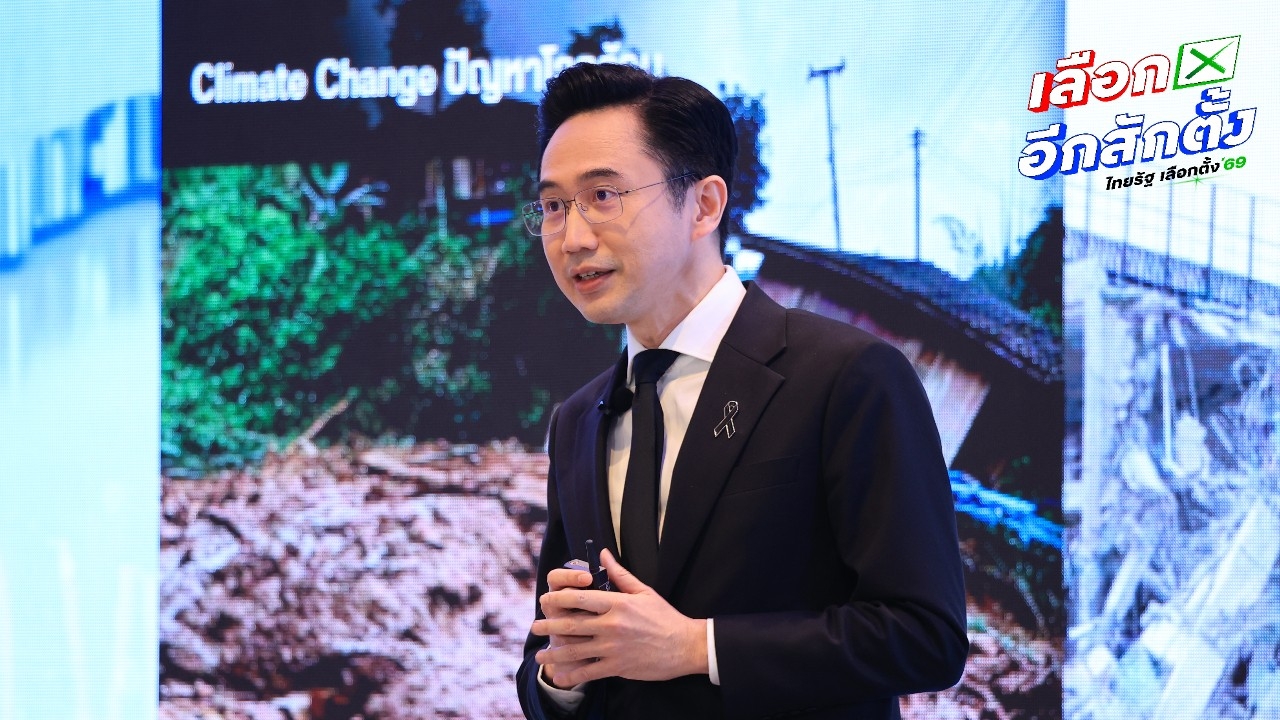
Yotsanan presented Pheu Thai's vision, championing the goal of leading Thailand to become a high-income country by reforming economic and social structures with technology. He said that if a coalition government is necessary, he does not wish to pick a ministry but asks for a single seat: the highest position.
12 Jan 2026 GMT+7 Mr. Yotsanan Wongsawat, Pheu Thai's prime ministerial candidate, participated in presenting his vision on the special program “Global Direction, Thailand Direction: Thailand Vision 2035,” organized by Thairath family news. The forum featured prime ministerial candidates from three major parties: Mr. Anutin Charnvirakul, leader of Bhumjaithai Party and candidate; and Mr. Natthapong Rueangpanyawut, leader of the Prachachon Party and candidate, also participated.
Mr. Yotsanan outlined Thailand's direction for the next decade, aiming for 2035, declaring the main goal to transform Thailand into a “high-income economy.” He noted that today’s economic crisis context is far more complex than in the past, unlike the 1997 Asian financial crisis, which was a localized economic issue. Currently, the world faces challenges from geopolitics, technological disruption, and climate change, requiring unity and synergy among all sectors to overcome this crisis.

he compared Thailand to standing at a crucial crossroads, needing to choose between a dark or bright path—an opportunity to decide the way forward. He emphasized that the high-income goal must link GDP per capita with the country's happiness index. The urgent strategy focuses on solving debt problems, likened to helping drowning people breathe again, so citizens can recover and resume spending, revitalizing the grassroots economy and enabling merchants to continue business, alongside maintaining fiscal and financial stability.
Regarding upgrading the main economic structure, he proposed increasing productivity in three key sectors: agriculture, which should adopt biotechnology and domestically produced agricultural machinery to support an aging society with a shrinking workforce; industry, where the government must encourage demand for Made in Thailand products; and the service and tourism sector, shifting from selling main tourist cities toward “cluster tourism” that connects secondary cities, adds value through museums and local stories, and attracts tourists with new experiences.
For infrastructure and connectivity, Pheu Thai plans to expand Suvarnabhumi Airport, build an Andaman airport to link Phuket, and a Lanna airport in Chiang Mai. In Bangkok, they will clarify feeder system organization, promote a 20-baht flat fare for the electric train by negotiating unified concessions and management, connecting with feeder systems charging 10 baht using standard EV buses or songthaews. They also aim to link rail systems nationwide from north to south and east to west, continue the high-speed rail connecting China-Laos-Thailand-Malaysia, and use soft power strategies to support overseas Thai entrepreneurs opening restaurants or supermarkets as gateways for Thai products to global markets.

the Pheu Thai candidate added that a key part of the vision is to develop new growth engines focusing on Health & Wellness and becoming a global Medical Hub. This includes upgrading herbs and food into medicine, transitioning from food security to “food and nutrition security,” developing advanced genomics and synthetic biology technologies to support precision medicine, and promoting medical device production, especially tropical disease test kits where Thailand has expertise.
To foster real innovation, Yotsanan emphasized building an Innovation Ecosystem to address brain drain by establishing an Angel Fund and attracting venture capital investment. They plan to create GMP-standard prototype factories and pre-clinical testing centers within universities to position Thailand as a global standard testing hub. Additionally, they aim to integrate Thailand into global supply chains in future industries such as semiconductors, electric vehicles (EV), and artificial intelligence (AI).
On governance and confidence, the policy promotes creating a digital government by integrating public sector databases (Big Data), establishing a Single ID and Digital Wallet to reduce officials’ discretionary power, a common channel for corruption. They reaffirm the use of the rule of law, combat corruption with technology, and facilitate one-stop services for licenses to ensure fair competition, while maintaining food, cyber, and environmental security, aiming for net zero emissions by 2050.
In social and education sectors, there are plans to reform education by creating world-class research-oriented universities and establishing quality provincial schools (“Champion Schools”) to reduce inequality and Bangkok centralization. In healthcare, they will upgrade the 30-baht universal healthcare scheme by linking health data and providing targeted welfare for vulnerable groups using accurate data. Water management will be comprehensive, including restoring northern watershed forests, building floodways in central regions, dredging rivers, and employing Digital Twin of Ocean technology with SAR satellites to manage downstream water and forecast disasters.
Mr. Yotsanan also called for cooperation from all sectors, stating that transforming Thailand, building a new economy, and restoring investor confidence is not the task of any single political party but a national agenda requiring all Thais to work together for the country’s future.

A reporter asked Mr. Yotsanan during the program that if there is a coalition government, which ministries would he refuse to join? He replied, “This is important. We try to communicate the vision. We need to do many things at once because there are many problems now. Choosing only one is insufficient. We must work with every party, as everyone shares the goal of making Thailand a high-income country. It does not matter which ministry we are in if we share the same goal. I ask for only one seat: the highest position.”
When asked which party's policies align most closely with Pheu Thai’s, Mr. Yotsanan said every party has issues of livelihood and economy, so he is confident choosing people or parties is not difficult, but they must be incorruptible if appointed.

