

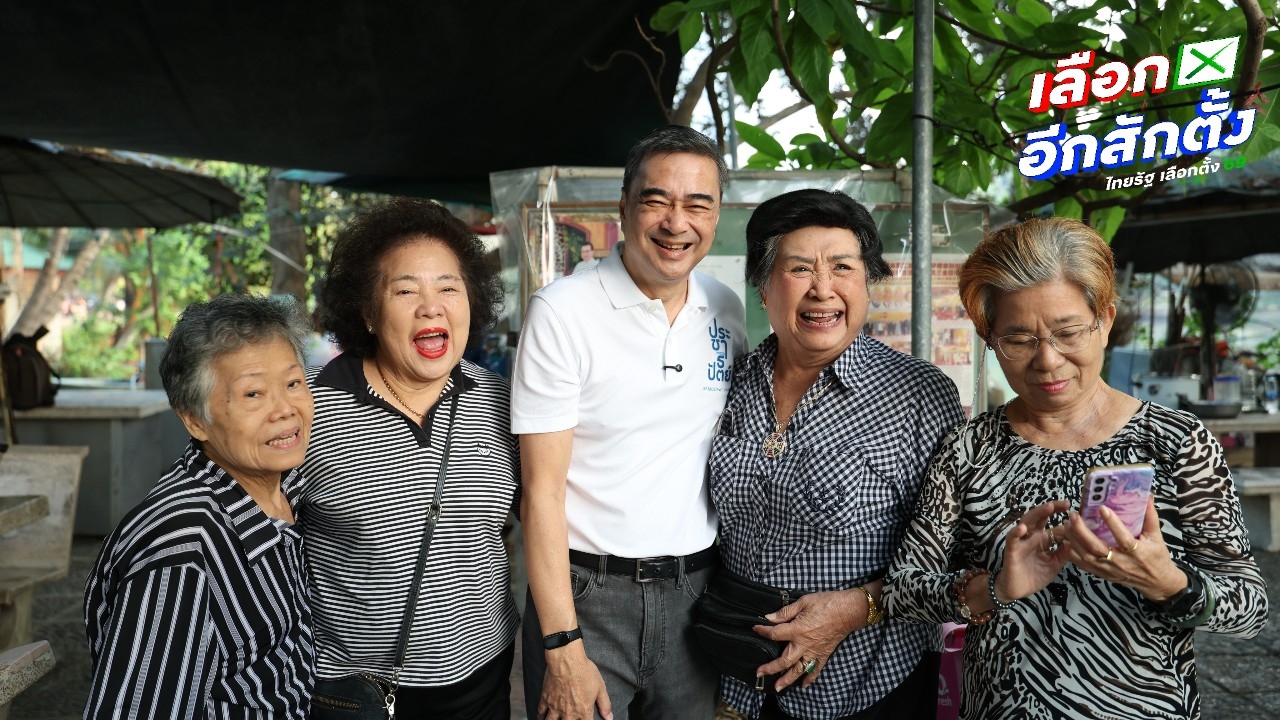
Abhisit led the Democrat Party team in Bangkok to seek votes for "Jump-Jessada" at Lumphini Park, highlighting three approaches to solving PM 2.5 dust. Elderly supporters sweetly called him the "Prime Minister-elect." He clarified that on January 17, the Democrat Party will hold a fundraiser supporting clean politics, emphasizing there will be no banquets organized.
At 07:00 on 14 January 2026 at Lumphini Park, Pathumwan District, Bangkok, Abhisit Vejjajiva, leader of the Democrat Party, along with candidate Kadee Liaopairoj, one of the party's two prime ministerial candidates, and Sakolthee Phatthiyakul, deputy party leader overseeing Bangkok, campaigned for votes to support Jessada Lertthanasan, or Jump, candidate for Bangkok MP in constituency 2 (Ratchathewi, Pathumwan, and Sathorn) number 11, and Peerawut Pimsomrudee, candidate for Bangkok MP in constituency 1 (Phra Nakhon, Pom Prap, Samphanthawong). They engaged with health-conscious citizens and elderly people exercising in the park. Along the way, people of all ages shook hands, expressed encouragement, and asked for photos, saying they are fans and have voted for the Democrat Party across their families for years. They were pleased that Abhisit had returned to care for Bangkok residents and wished him success as prime minister again, calling him the "Prime Minister-elect" and referring to Kadee and Sakolthee as "Deputy Prime Minister-elects." This occurred amid heavy PM 2.5 dust haze this morning, with measurements in Bangkok showing a red alert level at 84.6 micrograms per cubic meter.

Abhisit explained the party's policy on tackling PM 2.5 dust, noting that levels are currently very high. The party proposes three solutions: accelerating the passage of three key laws—Clean Air Act, Circular Economy Act, and Climate Change Act; reducing dust-generating activities through incentives and penalties; and supporting public transport systems by lowering fares, for example, bus fares reduced to 5–30 baht to encourage public transit use. Regarding crop residue burning linked to supply chains, measures must be in place to prevent burning and assist farmers with alternatives to avoid pollution. Crucially, cooperation with neighboring countries is needed. As Thailand will chair ASEAN next year, the Democrat Party plans to propose this issue as a regional agenda since dust often originates from neighboring countries and is carried by winds. These are the strategies prepared by the Democrat Party.
When asked about the Democrat Party's fundraising event on 17 January and whether banquets will be held, Abhisit said the event is to meet supporters and promote honest politics. He emphasized that political funding should come from the people and be "white funds." As this period coincides with annual tax filing, citizens can donate tax contributions to the Democrat Party. Unlike previous years, there will be no sale of dining tables since this is an election period. The event will only include meetings with party members and the party’s three prime ministerial candidates. It will be held at Siam Pikanet, Siam Square on 17 January. Additionally, on Friday 16 January, the party will announce a 90-day action plan on how to create a new economic engine and help Thailand recover from poverty following the party’s approach.
Regarding the Democrat Party’s policy toward southern farmers growing key economic crops like rubber and oil palm, whose prices have fallen, Abhisit said the party has a strategy to boost rubber prices by guaranteeing a minimum income above the current floor price of 60 baht. They are confident of pushing the price to 80 baht per kilogram through value-added processing. In the past, the party successfully negotiated with major producing countries to raise prices. For palm oil prices, a full supply chain review is needed to ensure fairness for palm farmers. This is a key policy of the party.
“Additionally, the development policy includes building infrastructure such as motorways and rail systems to improve connectivity in the southern region and leveraging port development by linking the Gulf of Thailand side to the Andaman Sea side. Studies on the land bridge project showed it is not economically viable, saving little time relative to the investment cost. The Thai Canal project also faces security issues and could bring regional conflicts. Therefore, practical measures include connecting Penang port on the Andaman side with improved infrastructure to create useful connectivity,” Abhisit said.


