

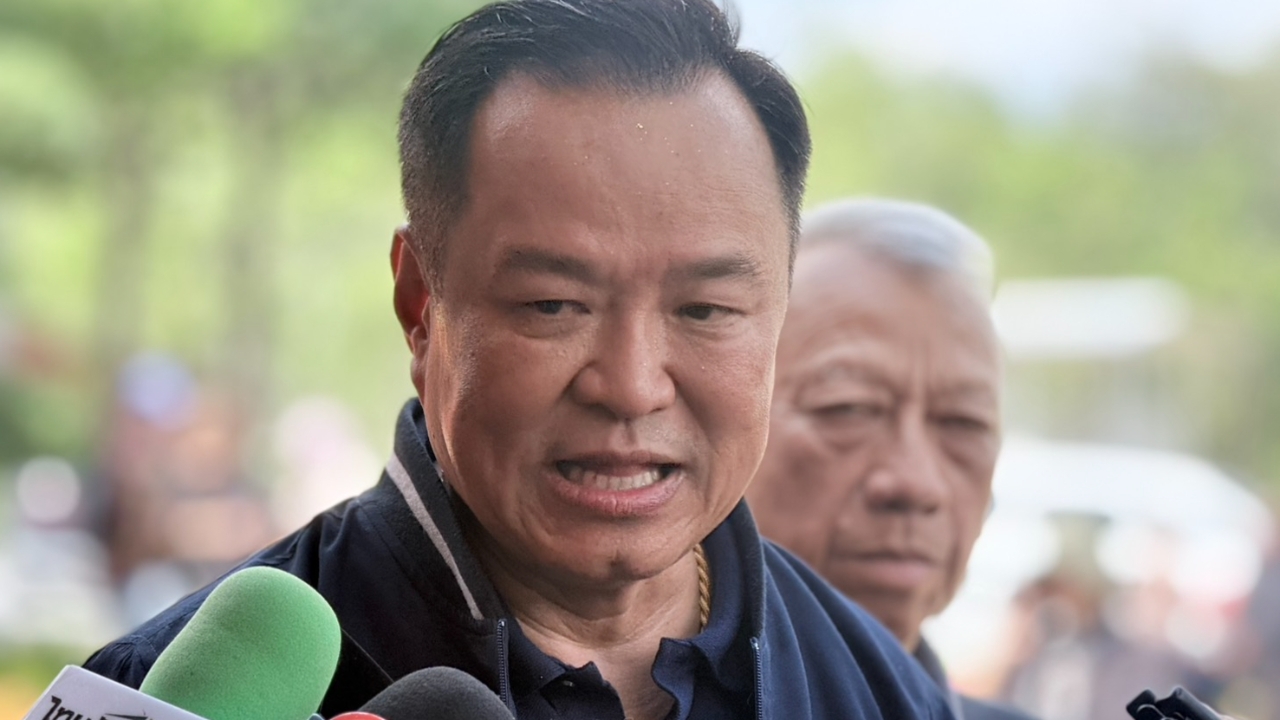
Anutin canceled his election campaign in Phang Nga and ordered Phiphat to take command of the crane collapse incident on the express train. He expressed sorrow over the 22 fatalities and angrily demanded the acting State Railway Governor to reconsider his position. He insisted that there must be someone held responsible for this matter, especially after repeated violations were found.
On 14 Jan 2026 GMT+7, reporters reported that as soon as the news of a crane falling onto a train in Sikhiu District, Nakhon Ratchasima Province was received, Prime Minister and Minister of Interior Anutin Charnvirakul immediately canceled his campaigning duties as leader of the Bhumjaithai Party in Phang Nga Province that afternoon and traveled to Phuket Province to catch a flight back to Bangkok. Deputy Prime Minister and Minister of Transport Phiphat Ratchakitprakarn returned with him. Upon arrival in Bangkok, Phiphat proceeded directly to the accident site in Sikhiu District, Nakhon Ratchasima.
The Prime Minister ordered Phiphat to take charge of the on-site incident command. The most urgent priority at this time is the relief of the injured and the deceased. He also advised the State Railway of Thailand (SRT) to file legal action against the contracting company.
At 13:00, Anutin gave an interview regarding the crane collapse on the high-speed train construction site that caused many injuries and fatalities, stating he had received reports and ordered Phiphat Ratchakitprakarn, Deputy Prime Minister and Minister of Transport, and Anan Phonnimdaeng, acting Governor of the State Railway of Thailand (SRT), to visit the area. The Ministry of Public Health had already transported the injured to hospitals. He expressed condolences to the families of the deceased.
Regarding the cause of the accident, no report had been received yet. He asked to wait for the investigation to determine why the timing coincided so precisely. He said he would question thoroughly as it is his former profession. He emphasized not to politicize the matter but to focus on relief for the injured and preventing further losses.
He noted that this project has had several incidents, including a tunnel collapse last year and now a crane collapse. He emphasized the need to examine why the construction is flawed. Such accidents occur due to negligence or bypassing procedures and doing things that do not conform to design.

When asked whether construction would continue, the Prime Minister said that normally the contractor must halt construction and submit a report and compensation plan for the incident. Penalties apply for damages. The contractor would lose money for the work stoppage. The government suffers delays but does not incur additional budget costs.
When asked if the contractor had provided further explanations, the Prime Minister said, the cause must be urgently determined. The SRT and relevant agencies must investigate. If faults are found, all must be held accountable. He reiterated that someone must be punished and held responsible for poor project oversight.
Regarding whether additional penalties for the contractor are needed, the Prime Minister revealed that at this stage, legal measures are necessary. The Ministry of Transport or the Comptroller General's Department would be responsible for blacklisting. He asked if the Office of the Auditor General (OAG) had canceled the contract but found legal obstacles. With only two months left in his term, he plans to revisit this issue after the election and expose it clearly. He acknowledged that the contractor is the same as before and remains in charge of construction. The Comptroller General's Department must explain why blacklisting has not occurred.
He noted that former Deputy Prime Minister and Minister of Transport Suriya Jungrungreangkit had a policy to create a contractor behavior record book, which he supports. Yet it remains unused because agencies fear legal retaliation. He suggested reforming the law on contractor blacklisting but warned that political opponents might accuse him of targeting past professions, so he delayed action. However, if repeated incidents continue, no delay is justifiable and the principle of "blacklisting by behavior" should apply.

The Prime Minister confirmed that the incident is an engineering issue that would not occur naturally. The crane’s fall must be investigated for worn equipment or rail bearings. These can be proven, and if so, the case is settled. Therefore, hiring contractors in this way requires careful consideration by the government and private sectors. He emphasized that the SRT must also be held accountable. He assigned Phiphat to lead the on-site command, unlike the previous tunnel collapse when he was Deputy Prime Minister and Minister of Interior and Suriya belonged to a different party. He added that Phiphat, as his subordinate, kept him informed by phone throughout.
When asked if projects would be delayed or terminated if similar issues are found elsewhere, the Prime Minister said this depends on project supervisors, both contractors and employers. He said this should not be blamed solely on contractors since projects are approved and contracts inspected. He reassured that the situation will compel investigations. He does not know if the SRT governor will remain, leaving Phiphat to handle the matter. This is a serious incident with 22 deaths. Previously, responsibility was limited to employers, but this time it impacts the public, so he demands the acting governor to reconsider his position while he remains Prime Minister.
Regarding political parties preparing to exploit the incident, the Prime Minister responded, “I cannot forbid them, but this is not a political issue; it is technical. Instead of discussing damages, it has become political. Do not take advantage. Nakhon Ratchasima has many MPs from one party; they cannot blame others. Don’t politicize this.”