

Dr. Ae denounced the daily crane collapses as shameful, raising concerns about similar cranes at Sikhiu, Nakhon Ratchasima potentially being sold deceptively. He emphasized that citizens have the right to file lawsuits and insisted there must be an accountable party.
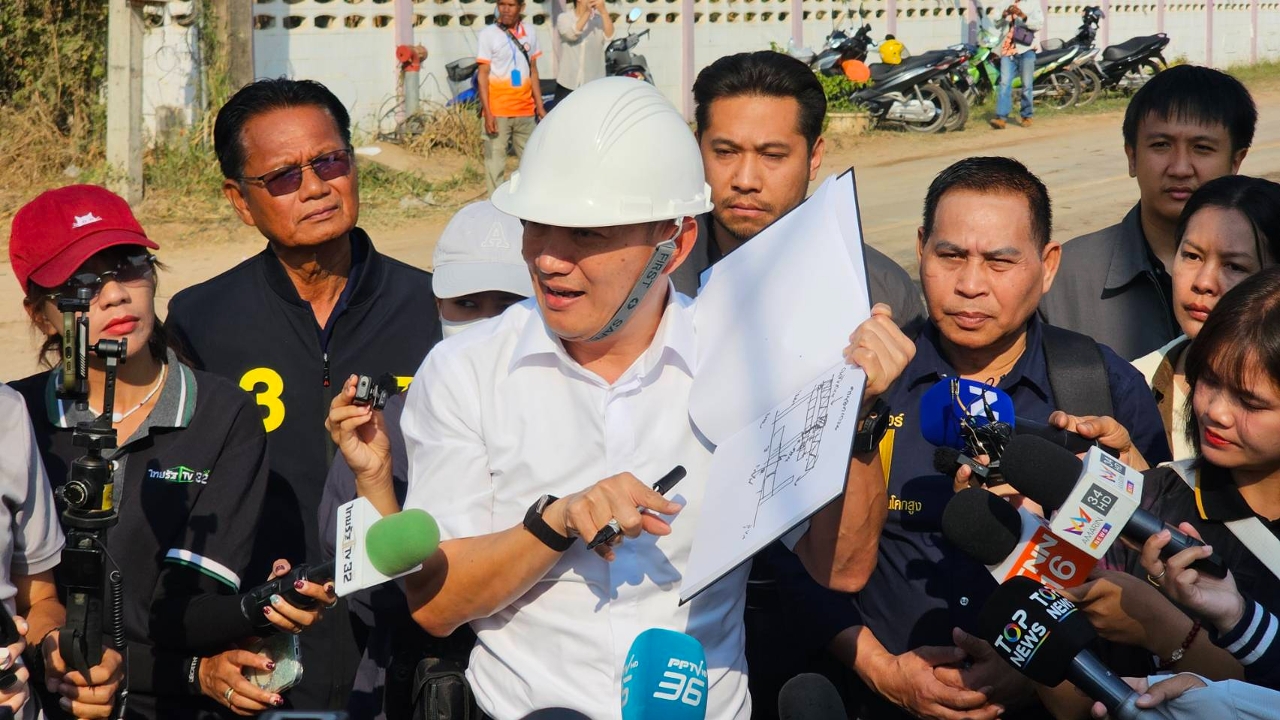
At 09:00 on 15 Jan 2026 in Nakhon Ratchasima province, Mr. Suchatvee Suwansawat, leader of the Thai Move Forward Party and former president of the Council of Engineers and the Engineering Institute of Thailand under Royal Patronage, commented on a crane collapse on Rama 2 Road near the Paris Hotel. Initial reports indicate cars were crushed, with expected casualties and injuries. Upon visiting the site of a crane base that fell onto a train in Sikhiu district, Nakhon Ratchasima, Mr. Suchatvee immediately asked the media in shock: “Did this happen today? Is this really Thailand?” He explained that the crane was similar to the one that collapsed in Sikhiu, Nakhon Ratchasima, and questioned whether these cranes were being deceptively sold. He noted that abroad solid steel is used, making crane movement difficult and the material expensive. Instead, a weaker lattice steel is used here. Therefore, safety standards of equipment must be taken seriously. As an engineer and citizen, he has long demanded accountability before entering politics, criticizing Thailand for lacking a dedicated authority to genuinely oversee public safety. The responsible party should speak out, as they have the most detailed information. For example, in the Sikhiu crane collapse case, evidence has already disappeared.
He suspected the crane was substandard.
Mr. Suchatvee said it was possible the crane was expired or deteriorated, or perhaps it was substandard from the start. It is critical to verify quality. If many low-quality cranes are used in Thailand, this represents a major hazard. Yet, questions remain unanswered, from the Lat Krabang Bridge and Rama 2 Road to the OAG building collapse. It remains unclear if anyone can be held accountable. This is no longer an engineering issue; such work should be 100% safe, which is not difficult given the extensive infrastructure built domestically and abroad. The key question is when citizens will get answers and who will provide them. In developed countries, a central public safety committee under safety laws, staffed by experts, provides such answers.
Those appointed to the committee must sign declarations of no conflicts with contractors, to ensure thorough investigations and evidence collection for prosecution. Citizens must be able to sue; otherwise, perpetrators escape justice. In the Sikhiu crane collapse case, evidence is missing, causing pain. Repeated fatal incidents are a national embarrassment and should never happen again.
Used binoculars to inspect the crane.
Previously, Dr. Ae, as former president of the Engineering Institute of Thailand under Royal Patronage, together with Thai Move Forward Party candidates in Nakhon Ratchasima, visited the site of the high-speed train construction crane that fell onto Express Train No. 21 from Bangkok to Ubon Ratchathani at Ban Thanon Kod, Sikhiu district, Nakhon Ratchasima, causing 32 deaths. Using binoculars, they inspected the construction crane and created a simulated diagram of the crane system operation to model the incident. It is assumed that as the operator pushed the crane forward, it lost balance and tipped forward, possibly due to overextension beyond a safe level. Extending the crane too far causes vibration and allows the hoist to slip, resulting in a guillotine-like fall onto the middle of the train from an estimated height of 20 meters. The crane weighed about 20 tons; impact force could be at least 100 times that, similar to a guillotine slicing through the train, generating an impact force between 1,000 and 2,000 tons.
Emphasized this was not an accident or force majeure.
Mr. Suchatvee continued, affirming this was neither an accident nor an act of God, as no strong winds occurred. The incident resulted from two factors: human error and old or substandard equipment. Non-standard cranes can easily lose balance. Compared to foreign cranes made from solid steel, hollow steel cranes can tilt. Several such cranes have failed before. His binocular observations showed many joints and hollow sections causing vibration and imbalance, likely due to operator negligence. However, the main problem may be prolonged use without maintenance over many kilometers. He urged responsible parties to investigate this thoroughly.
Concerned many such cranes exist in various areas.
“The train vibrations during construction likely had minimal or no effect on the crane collapse. I believe the crane lost balance before the train passed, and the incident coincided with the train’s passage. This is a national disgrace. The responsible parties should be the project owner, subcontractors, and crane owners. The key question is who will hold them accountable. As an engineer, I have witnessed many deaths due to disasters, and perpetrators often evade justice due to insufficient evidence. Courts rely on evidence, and without it, incidents are dismissed as unforeseeable accidents. Claims are then made to insurance companies, denying victims justice. In developed countries, independent public safety organizations investigate causes and prohibit any evidence tampering before official inspection. Thailand lacks such organizations. I also question why contractors involved in the OAG building collapse were allowed to take on large projects again, risking safety. Contract terms cannot be excuses as fatalities have occurred. This must not happen again. I am especially worried about cranes like these, as similar incidents occurred in Lat Krabang in 2023,” Mr. Suchatvee said.
Questioned lack of responsible authority.
Mr. Suchatvee added that international safety standards prohibit dangerous overhead structural work while activities below occur—not only trains but also vehicles or pedestrians. He posed five questions for the government to answer:
1. How could construction proceed while trains were running?
2. How could a contractor linked to the OAG building collapse, proven to have caused damage, be allowed to work on this project?
3. Was the incident caused by rushed construction work?
4. There is no responsible authority. He disagrees with the government tasking the State Railway of Thailand to investigate, as no entity worldwide allows project owners to investigate their own incidents.
5. There must be a central authority to oversee investigations, ideally supported by public safety legislation.