

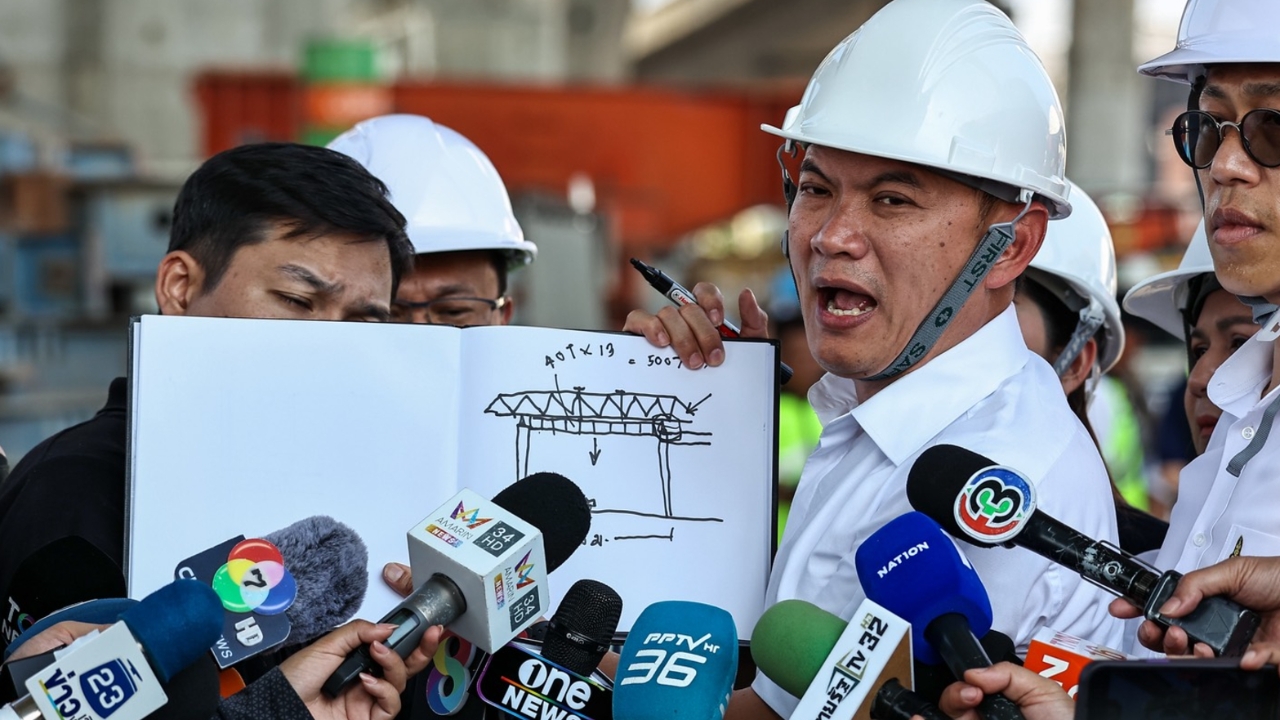
Suchatvechir suspects equipment problems caused the crane collapse on Rama 2 Road and emphasizes that no one fears being blacklisted or penalized with point deductions. He referenced Japan’s strict approach, which includes suing and bankrupting negligent companies and imposing criminal penalties.
At 15:30 on 15 Jan 2026 GMT+7, Mr. Suchatvechir Suwansawat, leader of the Thai Move Forward Party and prime ministerial candidate, as well as former president of the Engineering Institute of Thailand under Royal Patronage, visited the Rama 2 Road site where the elevated expressway motorway M 82 segment 7 crane collapsed, near the Tha Chin River bridge, Moo 1, Tha Chin subdistrict, Mueang district, Samut Sakhon province. He sketched a simulation and investigated the cause, noting the crane was holding beams each weighing 40 tons. He estimated about 12-13 pieces fell, totaling nearly 500 tons, and believed the crane had been in use for some time.
Suchatvechir questioned whether the equipment had been properly inspected and maintained, since a well-maintained crane should bear the load safely. He noted that this crane brand previously caused a collapse in Sikhiu district, Nakhon Ratchasima province, a horrifying event near completion of work. He said such tragedies are unacceptable and Thai lives should not be lost in vain. However, these are preliminary assumptions since no responsible party has provided data. He suspects faulty or substandard equipment, possibly deceitfully supplied.


He asked how this happened, whether subcontractors were involved, and if main contractors withheld payments and profits before passing minimal funds to subcontractors. Ultimately, the public suffers fatalities. No one has preserved early evidence, similar to the Nakhon Ratchasima case where evidence was poorly secured. Courts decide based on available evidence and fairness, yet those responsible evade accountability. Thai people die in vain and suffer huge financial losses, especially on Rama 2 Road. He said this must end; taxpayers face such tragedies. When he was Engineering Institute president, relatives of victims complained about lack of compensation because Thailand lacks a true authority managing these issues.
Asked about Deputy Prime Minister and Transport Minister Pipat Ratchakitprakarn’s order to halt elevated road construction nationwide, Suchatvechir said good people also suffer. He would immediately stop any crane of this type. He has repeatedly asked about causes and solutions, suspecting corruption causing price undercutting. Ultimately, contractors pass work to subcontractors who must use poor-quality equipment due to low budgets.


Regarding blacklisting contractors, Suchatvechir said, no one fears blacklists now because minor companies get blacklisted, but contractors belong to large networks of hundreds of companies, so the measure is ineffective. In other countries like Japan, they immediately bankrupt companies to set an example and criminal cases proceed without compromise. But Thailand lacks evidence to firmly prosecute. The Office of the Auditor General building collapse is an example, with unclear outcomes. The same applies to crane collapses at Lat Krabang and multiple past incidents on Rama 2 Road. No offenders or bankruptcies arise. Blacklists are a joke and ignored. Other countries require a neutral body to oversee inspections.
On using penalty point books for contractors, Suchatvechir questioned who fears them, suggesting they should be abolished since they appease misbehaving contractors. Many good contractors exist. Like other countries, companies should be shut down. But first, a responsible authority must manage this issue; otherwise, no law or evidence will be effective.


