

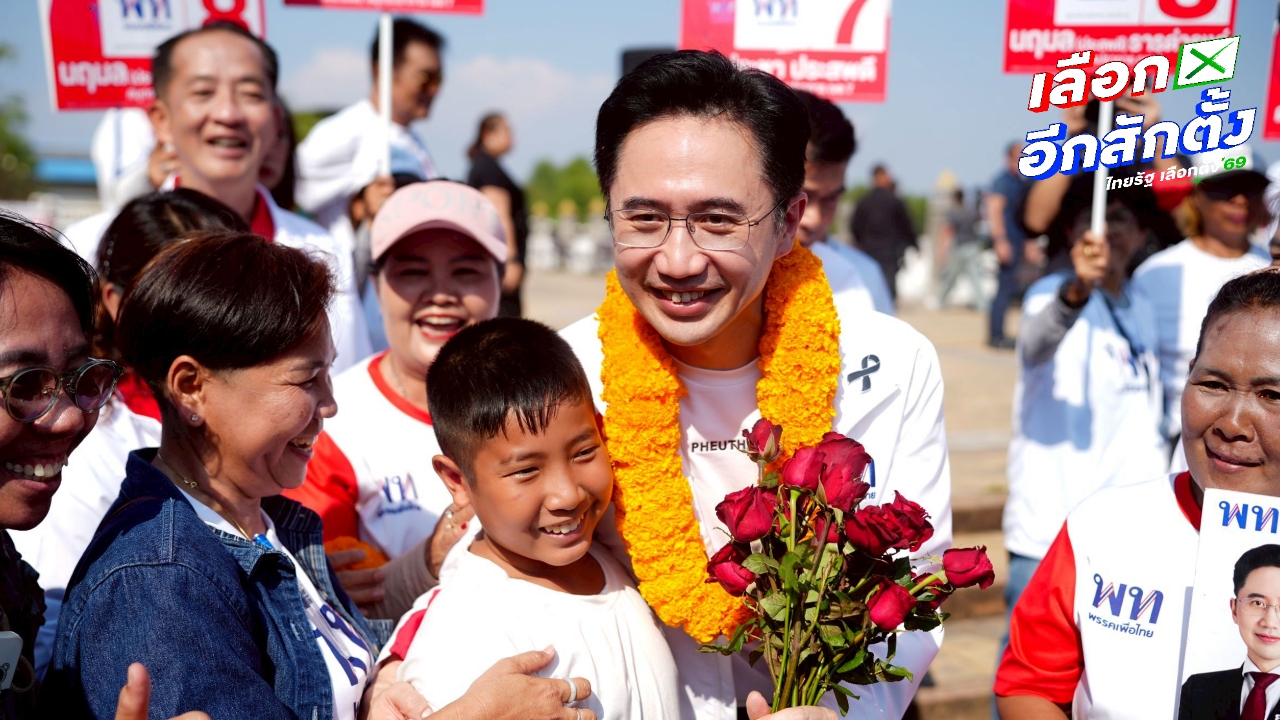
Yotsanan and Dr. Liab led the Pheu Thai team in discussions with the management of Suan Benjakitti Hospital to revamp public health services in Bangkok before heading to campaign in Samut Prakan. They declared their intention to sweep all 8 districts and expressed confidence that votes from the People's Party in Tak Province will support Pheu Thai.
On 16 January 2026, Yotsanan Wongsawat, the prime ministerial candidate, and Dr. Surapong Suebwonglee, former policy advisor to the prime minister and proponent of the 30 Baht Universal Healthcare policy, along with their team, met with the management and medical staff of Suan Benjakitti Hospital in honor of the 84th birthday anniversary. They discussed driving the '50 districts, 50 hospitals' policy to overhaul Bangkok's public health services by establishing 120-bed secondary hospitals in every district to comprehensively serve general patients locally. This initiative aims to reduce the burden on central and large hospitals that handle severe cases nationwide. This policy is to be pursued alongside Pheu Thai's '30 Baht AI Healthcare' policy.

Yotsanan said that Pheu Thai recognizes the importance of reducing inequality in all dimensions. Regarding healthcare, the party aims to elevate public health from the '30 Baht Universal Healthcare' to '30 Baht AI Healthcare' through an integrated overhaul. Field visits to Khlong Toei revealed that people in Bangkok still face insufficient access to healthcare services.
Therefore, Pheu Thai plans to advance by employing technology to assist in providing services to the public and to upskill and reskill healthcare personnel.
Pheu Thai’s initial approach includes three policy directions: lifting restrictions under Section 35 of the 1999 Local Personnel Administration Act to allow hiring medical personnel as needed; fostering cooperation with state enterprise hospitals and other government hospitals to open systems for immediate patient access; and investing in building 120-bed district hospitals in underserved areas to bring services closer to residents and prepare for future public health crises.

Then, Yotsanan visited Samut Prakan Province to support Pheu Thai’s parliamentary candidates. Before meeting the public, Yotsanan, together with Narumon Thardamrong, candidate for District 6, and Pracha Prasopdee, candidate for District 7, paid respects at the Phra Samut Chedi.
They then went to the Iam Charoen Market in Mueang District to assist Phinyo Kitlerpairot, candidate for District 3, in campaigning. Upon Yotsanan's arrival, supporters holding red roses gathered to welcome him and cheered for Pheu Thai, number 9.

After campaigning, Yotsanan said in an interview that Pheu Thai aims to win all 8 districts in Samut Prakan because the party has continuously engaged with the area and understands its real issues. Samut Prakan faces challenges such as seawater intrusion, tourism, and commodity pricing. Pheu Thai is ready to immediately continue addressing these issues. The party has received positive responses; many appreciate its policies and note that its candidates have never abandoned the area. Today, people are more open to giving Pheu Thai a greater opportunity.
When asked about voters calling him prime minister every time he campaigns, Yotsanan replied that there are still two weeks left to prove himself further. He emphasized discussing with candidates that the most important thing for a political party is its policies.

Regarding Tak Province, after the People's Party candidate was prosecuted and resigned, Pheu Thai now has greater opportunity. The key today is to move forward and communicate clearly about policies that resonate with Tak Province.
When asked if the People's Party votes would shift to Pheu Thai, Yotsanan expressed high hopes that if their policies meet public needs, voters would be willing to support Pheu Thai.
Asked about concerns that some Pheu Thai candidates might be listed among 10 individuals connected to gray-zone business, Yotsanan said he is not worried. He stressed that the most important thing is to proceed according to the law. The party's role now is to focus on policies and listen to the people. Beyond that, the justice system must operate concurrently.

Later, Yotsanan took the stage for a major speech at Bang Pu Mai Market in Samut Prakan to support all 8 Pheu Thai candidates. He said, "It warms my heart to see the people today. I am not alone; those who stand with Pheu Thai are here as well. Pheu Thai is united, ready to push forward. Today, we ask for all 8 districts in Samut Prakan to be fully red for Pheu Thai. We stand ready to walk alongside all citizens here, with unwavering commitment. Pheu Thai’s heart is with the people."
On 8 February, more than an election day, it is a day of hope for all Samut Prakan residents. I am ready. If the people give us a chance, I will strive to turn that hope into reality. But I cannot do it alone—I seek to win all 8 districts. Our first hope is for those who have fallen. The most important issue today is debt relief. Without addressing debt, we cannot help those who have fallen during COVID-19 and economic crises, as public debt is high. Therefore, Pheu Thai will reform the entire debt system to empower everyone to repay and stand up again. I affirm that Pheu Thai never abandons anyone."
Yotsanan reaffirmed the 'Thailand Without Poverty' policy, stating they will generate maximum revenue for Thailand and allocate part of it to support the poor, some earning less than 100 baht per day, including bedridden patients. He dismissed criticism labeling this as populism and reiterated Pheu Thai’s core policies: reduce expenses, increase income, and expand opportunities. He confirmed continuation of initiatives like the 3.70 baht per unit electricity rate and urged everyone to help send Pheu Thai to victory.
Yotsanan declared firmly that the fight against corruption, drugs, and scammers will never stop, and Pheu Thai rejects gray capital.

