

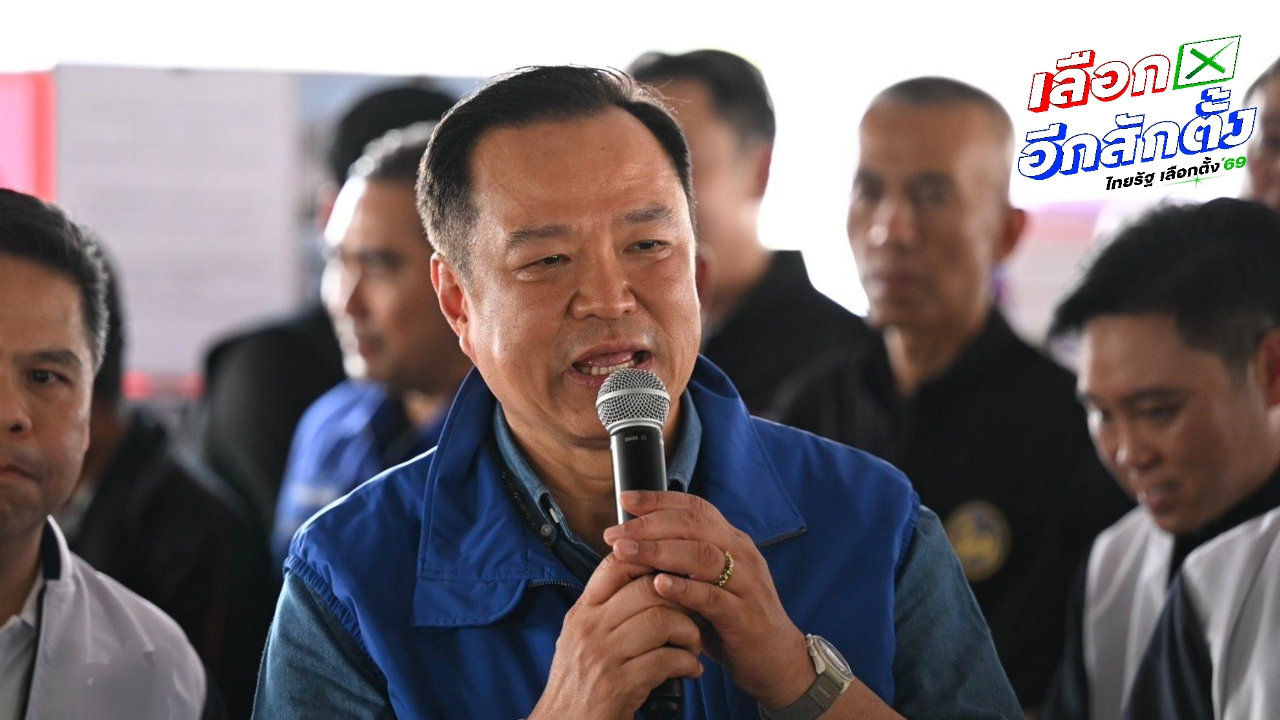
The Prime Minister visited Suphan Buri to inspect the Song Phi Nong watergate, requested a chance to continue his work, and urged citizens to vote in the 8 February election, advising not to vote for those who do not work, before opening the Don Chedi Memorial event and leading the ritual honoring King Naresuan the Great.
At 16:00 on 18 January 2026 GMT+7. Mr. Anutin Charnvirakul, Prime Minister and Minister of Interior. He traveled to Suphan Buri for an official inspection and chaired the opening ceremony of the 67th Don Chedi Memorial event for 2026, welcomed by Mr. Natthapong Sanguanjit, Governor of Suphan Buri; Mr. Udom Prongfa, President of the Suphan Buri Provincial Administrative Organization; senior provincial officials; Mr. Warawut Silpa-archa, party-list candidate for the Bhumjaithai Party; and all Bhumjaithai candidates for the Suphan Buri constituencies including Mr. Praphat Phothasuthon, Mr. Sorachat Sujit, Mr. Natthawut Prasertsuwan, Mr. Noppadol Matsri, and Mr. Samoekan Tiangtham.
Prime Minister Anutin arrived by helicopter at the temporary helipad at Wat Bang Sam School, Bang Takhian Subdistrict, Song Phi Nong District, Suphan Buri. He then inspected the Song Phi Nong watergate at Bang Len Subdistrict, Song Phi Nong District, where many local residents welcomed him. When people requested assistance with flood relief, street lighting, watergate expansion, and other matters, the Prime Minister told them to relay all issues through Mr. Warawut directly to him.


The Prime Minister greeted the people of Song Phi Nong District, Suphan Buri, thanking them for welcoming him to inspect flood problems in the province. He said this has been a persistent issue since his time as Minister of Interior and now as Prime Minister. He understands the problem well, noting that the real issue involves decision-making and budget management. If a house is flooded for more than three days, the government must pay 9,000 baht per household in relief. The total relief budget each year might even exceed what it would cost to expand watergates and drainage.
He added that even for road repairs, water hyacinth removal, and increasing street lighting, over three years at the Ministry of Interior, flood relief payments have been 9,000 baht monthly, totaling about 30 billion baht annually and nearly 100 billion baht over three years. Yet, no water drainage channels have been built or watergates expanded. People only receive relief payments that do not cover their damages. He acknowledged the pressure from local representatives in Suphan Buri and said he knows there is no way to avoid fixing these problems for the people.
He then said, "Let me put it this way: after 8 February, if I return, I will come back and say, ‘Is that all you want?’ The current government is nearing its end. If the people believe we can work, and trust us, then I can continue my work. Whether I return depends on the people nationwide. I believe if I do return, these solutions will happen because we are determined to solve problems sustainably for the people."


The Prime Minister continued, stating that the annual budget lost amounts to tens of billions of baht. He questioned whether the 9,000 baht given to flood victims is enough, especially when floods last four months. The large budget is not only for Suphan Buri but also for provinces like Phra Nakhon Si Ayutthaya, Ang Thong, Singburi, Chiang Mai, Chiang Rai, and southern Thailand. Just last week, it was summarized that about 30 billion baht is spent annually, which is insufficient. Many water channels could be constructed with existing plans. This money belongs to the people, not for political gain or personal benefit. If they can solve long-term problems, they will earn the people’s trust and work for the common good, helping citizens live comfortably without the government having to pay relief annually. He recalled a previous statement by a provincial governor about people needing to wipe away tears, expressing hope that if given the chance, he could serve the people again.
“I will not wipe the tears of the people; I want to see their smiles so they won’t suffer from natural disasters every year. No one can endure it. Every year, floods come for three months; people have to move to upper floors and cannot work. Farms and fields are flooded. I thank those who allow their homes, fields, and gardens to be water reservoirs. We owe them a debt of gratitude for bearing this burden to protect the community. Today, I had the opportunity to meet everyone, received a warm welcome, and saw the problems firsthand. I have only one thought in my mind.”
Prime Minister Anutin revealed that the budget is not the problem compared to the losses and damages suffered by everyone. He urged the responsibility to be theirs and said there is no need to be told what to do. As Prime Minister, he invited all citizens to exercise their rights as the country's owners in the 8 February election. He urged them to choose those who can work and not vote for those who cannot. He encouraged high voter turnout to preserve democracy. He clarified he was not campaigning as he is in office but urged people to protect their rights as the nation's owners. Voters should choose whoever they believe works hard and reject those who do not. He believes if given the chance to serve again, they will fulfill their duties with the trust of citizens nationwide.


The Prime Minister later spoke about his field visit, saying it was the Day of the Elephant Battle. The Governor of Suphan Buri invited him to attend the event. Seeing that he was in the province and had time, he wanted to inspect flood problems because Suphan Buri suffers floods every year. The governor arranged a visit to Song Phi Nong District, the closest district to Bangkok and Phra Nakhon Si Ayutthaya. He saw the actual conditions and recognized that long-term solutions are possible. For various reasons, including politics, funding for projects to help the people has been lacking. He explained that if the Ministry of Agriculture and Cooperatives does not allocate budgets for dredging and expanding drainage channels and watergates, the Prime Minister's central budget must be used.
He added that when floods last over three days, 9,000 baht must be paid per household, costing about 30 billion baht annually to assist flood victims nationwide. Much more could be done to solve the problem long-term. People do not want just 9,000 baht relief per household in exchange for four months of flooding each year. Even 90,000 baht would not suffice. If given the chance to work, now in his third year as Minister of Interior, he sees how to solve the problem sustainably. However, the Ministry of Interior alone cannot fully resolve it. As Prime Minister, even in just two to three months, he understands the problem well and manages the overall budget. He is confident in solving the entire system’s problems.
The Prime Minister then presided over the opening of the Don Chedi Memorial event, conducted the ritual honoring King Naresuan the Great by placing a garland on his statue, presented the garland, sword, and spear props to performers, watched the Elephant Battle reenactment, visited OTOP and Thong Fah shops, and returned to Bangkok the same evening.

