

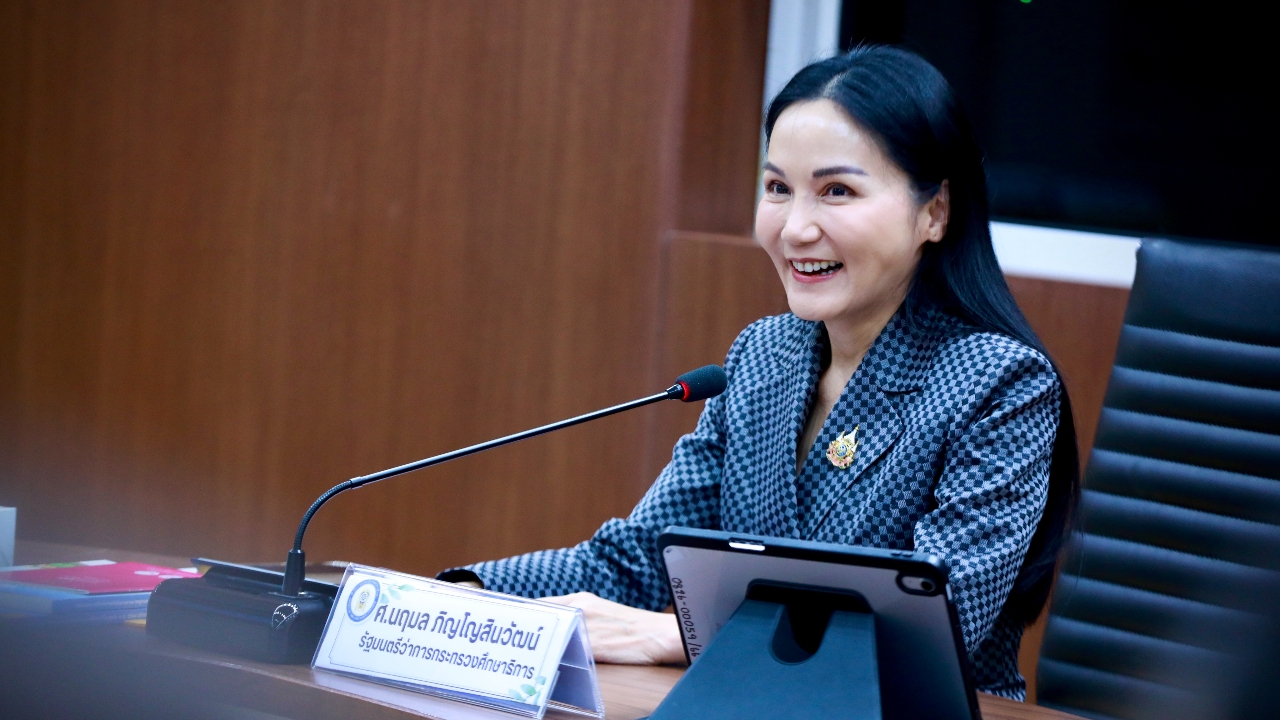
Minister of Education Narumon chaired the Early Childhood Board meeting to accelerate integration of child data to reduce duplication, elevate the Thai Triple-P program to develop childcare skills, advance care for special needs children, and revise early childhood legislation.
On 21 January 2026, Professor Dr. Narumon Pinyosinwat, Minister of Education, appointed by Deputy Prime Minister Thammanat Prompao, chaired the third meeting of the Early Childhood Development Policy Committee for 2025. The meeting was attended by committee members and experts at the Kamhaeng Plangkoon Meeting Room, 3rd floor, 56th Anniversary Building, Office of the Education Council Secretariat.

Professor Dr. Narumon stated that the meeting extensively discussed key issues, including progress on creating an integrated early childhood data information system. This system combines data from all sectors working on early childhood development to allow comprehensive monitoring, reduce data collection redundancy, and importantly support state security. This will enable policies for equitable and comprehensive care from birth through completion of basic education. The Office of the Education Council has linked early childhood data from civil registries, including birth registrations and records for stateless persons, in two phases: a quick-win phase mapping existing Ministry of Education data with the Department of Provincial Administration and related agencies, led by the Ministry of Education; and a long-term phase linking data starting from civil registries updated regularly with newborn information. This proposal is currently awaiting Cabinet approval.


Additionally, the meeting approved advancing the development of early childhood parenting skills by assigning the Department of Mental Health, Ministry of Public Health, to develop the Thai Preschool Parenting Program (Thai Triple-P). This program supports mental health care in remote areas under the royal project of Her Royal Highness Princess Maha Chakri Sirindhorn, with nationwide expansion. In collaboration with the Teachers' Council Secretariat, they are developing an e-Learning curriculum for early childhood and kindergarten teachers to enhance their knowledge, skills, and competencies in child care. This will also help teachers across the country access fundamental knowledge about early childhood care.

Regarding reviewing services for early childhood children suspected of developmental or learning difficulties, the committee proposed measures to accelerate policy adjustments for services targeting special needs children. These include ensuring all children undergo developmental and learning monitoring and screening, with assessments for children showing abnormalities conducted by trained professionals within one month. Continuous promotion and stimulation, organizing services for children suspected of abnormalities, and approving the implementation of the '3 Urgents, 3 Reductions, 3 Increases' policy were also discussed. This includes research on physical activities for children and youth, highlighting the need to develop attitudes among early childhood center managers, caregivers, teachers, and parents toward appropriate physical activities. Guidelines will be established to build knowledge and understanding for relevant agencies, adopting these as standards for early childhood development centers. The committee also assigned the Subcommittee on Legal and Rights Protection to address proposals, issues, and practical limitations from the evaluation report of the 2019 Early Childhood Development Act, aiming to improve legal provisions and operational mechanisms for greater effectiveness.