

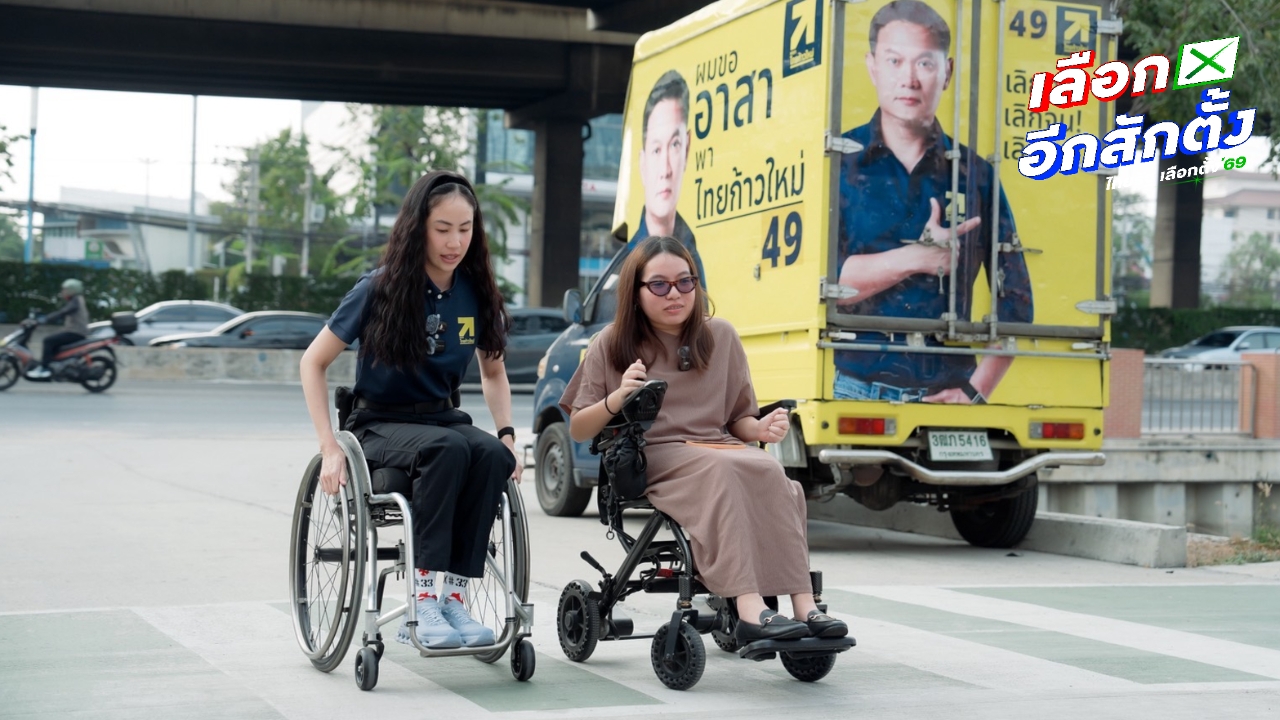
"Jitpasar and Thai Khao Mai" propose a national agenda to enact laws restructuring cities and transport systems to accommodate universal design for people with disabilities, employing AI and technology, coupled with strict legal enforcement, and supporting inclusion in the 10-year national strategy.
At 08:30 on 22 January 2026 at the Thai Khao Mai Party headquarters, Ms. Jitpasar Tunkradakorn, party leader and head of the Equality and Human Security team, announced a key policy to improve the quality of life for people with disabilities. The policy focuses on using technology and artificial intelligence (AI) as primary tools to restructure the country's public transport and public spaces, ensuring genuine accessibility for persons with disabilities. She stressed that accessing public services should not be a "privilege to request" but a "basic standard" the state must equally provide to all. She emphasized that Thailand needs to elevate disability issues to a "national agenda" and include them in the 10-year national strategy for systematic and continuous change, rather than temporary fixes.

"If we continue to let people with disabilities face obstacles in traveling, using public transport, or accessing government and urban spaces, we are silently allowing inequality in their daily lives to persist. This must change."
Ms. Jitpasar further emphasized that beyond the necessary continuation of disability allowances, which many political parties often highlight, Thai society has rarely seriously discussed "structural" and "policy" solutions to enable people with disabilities to live equally in the long term. The Thai Khao Mai Party proposes this policy as a starting point by restructuring "major cities" first to serve as development models, including public transport systems, sidewalks with Braille, ramps, communication signage, public service points, and disability services. It also aims to design public spaces with universal design principles friendly to all before expanding nationwide. Technology and AI will be central to designing the new urban landscape—covering accessibility data systems, optimal route planning, adapting transport services for disabilities, intelligent platforms to assist users, and real-time evaluation for efficient and transparent development. The party also proposes that the government use technology and AI to detect and assess building standards, especially existing structures that do not meet universal design standards for disabilities, such as improper ramps, unsupported elevators, unsuitable restrooms, or unsafe routes, to enable systematic monitoring, inspection, and corrective actions.


Ms. Jitpasar added that developing an equitable society must come with serious law enforcement, clear and strict penalties, and real consequences for agencies or operators neglecting accessibility standards for disability services. This is to ensure that design for people with disabilities is not merely a "symbolic proposal" but a "standard that everyone can truly comply with." She hopes this policy will gain interest from all relevant sectors to collaboratively drive Thailand toward an equitable society and achieve tangible urban restructuring with universal design, improving the quality of life for people with disabilities through the integration of technology and inclusive design for all groups.
