

The Election Commission (EC) revealed a budget of 7.824 billion baht for organizing the general election and referendum. It explained that a decrease in eligible voters led to reducing the number of printed election and referendum ballots by over 400,000, saving costs. No vote-buying has been detected at this stage, but the EC will monitor closely in the final stretch. The Secretary-General is not concerned about lawsuits regarding polling station arrangements and voter identification issues.
On 22 Jan 2026 GMT+7, the Election Commission Office issued a statement explaining the printing of three types of ballots: constituency-based MP election ballots, party-list MP election ballots, and referendum ballots, each totaling 56,100,000. This calculation is based on approximately 53,400,000 eligible voters plus a 5% reserve for distribution and three rounds of voting. According to data processed by the Department of Provincial Administration's Registration Office on 14 Jan 2026 GMT+7, there are 52,922,923 eligible voters for the 8 Feb 2026 general election and referendum. Including the 5% reserve, the printed ballots for each type have been reduced to 55,650,000, a decrease of 450,000 per type, to optimize budget efficiency and maximize benefits.
Explanation of the 7.824 billion baht budget for organizing the general election and referendum.
Additionally, the Election Commission disclosed its annual budget for fiscal year 2026, including an emergency reserve fund to cover expenses for controlling and organizing the general election and referendum scheduled for 8 Feb 2026. This information is provided to the public under Section 61 of the Organic Act on the Election Commission, B.E. 2560 (2017).
The EC approved a fiscal year 2026 emergency reserve budget of 7,824,040,100 baht, comprising 6,174,315,500 baht for election and referendum administration and 1,649,724,600 baht allocated to 14 supporting organizations.

No vote-buying detected so far; attention to be focused on the final stretch.
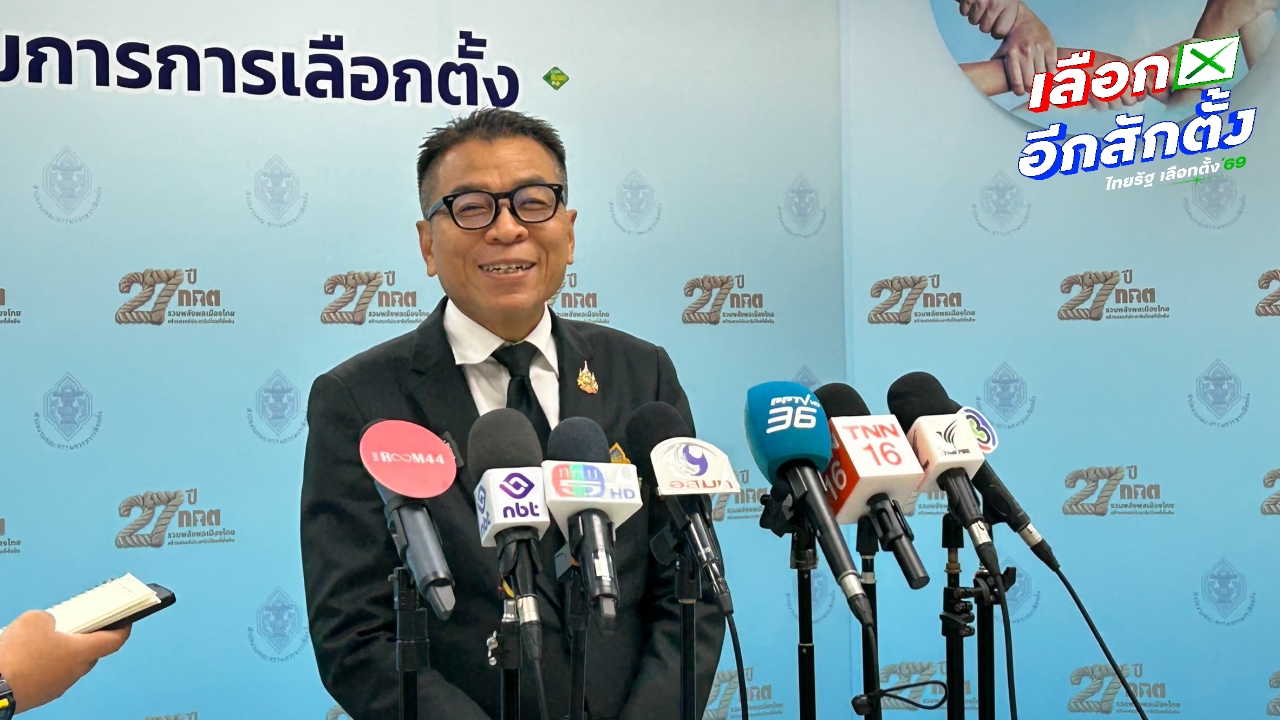
At 3:30 p.m. at the Election Commission Office, Secretary-General Saweang Boonmee commented on the investigation into vote-buying. He said that although there is much talk, actual data and past elections show that vote-buying usually intensifies only in the last week before election day. The money figures being discussed seem more like speculation, and the amounts might cause surprise, but so far no vote-buying has been confirmed. There may be rumors or preparations underway, but the EC is monitoring closely. Vote-buying involves both parties—those giving and receiving money—and gathering evidence can identify locations, but the EC's role is to prevent it. The key now is to explain that money alone cannot buy votes or pressure voters, emphasizing that vote-buying attempts have so far failed. The EC is currently focusing on prevention and deterrence measures.
“At this stage, it is not about vote-buying but about complaints concerning campaign signs and the use of aggressive, defamatory language,” Saweang said.
Not concerned about lawsuits regarding polling station organization and voter identification.
When asked whether the EC can overcome the past perception that citizens saw irregularities the EC did not acknowledge, Saweang said he does not deny such concerns. However, as mentioned, the EC has preventive measures. Although there is still talk of vote-buying, this is typical; those who lose elections tend to express such views, while winners have a different perspective. He added that behaviors have not changed.
Regarding two administrative court lawsuits related to polling station organization and voter identification, Saweang said it is acceptable as citizens have the right to sue. The EC is sued every time, and it will defend itself accordingly.
Overseas voters receiving incomplete ballots; registration types must be checked.
Asked about cases where overseas voters did not receive complete ballots, Saweang said it is still early to conclude since voters have time, and different countries send ballots at different times. It is necessary to check whether the registrants applied for both types of ballots. For example, if someone registered only for the election, they will receive just one ballot, not two. Verification is required to confirm registration status. Similar confusion occurred with the five-digit district codes used in the previous election, which corresponded to postal codes. This time, four-digit codes are used, and some have questioned why not five digits. People can critique, but it depends on how factual the criticism is.