

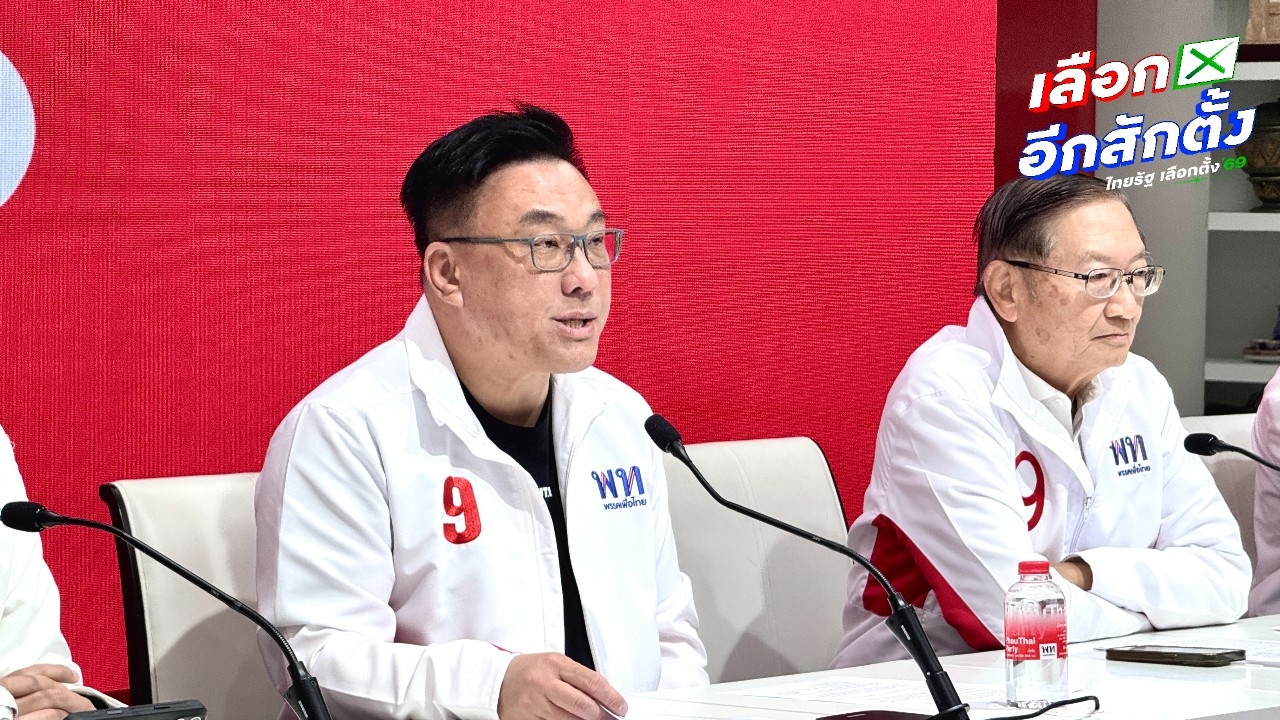
Julapan explained the Pheu Thai Party's policy "Create Millionaire Entrepreneurs," aiming to attract funds into the state and encourage people to join the tax system. He dismissed Pita's campaigning, stating all parties engage well with the public. Dr. Mhing suggested that professional experts should manage social security investments.,
At 10:00 a.m. on 26 Jan 2026 GMT+7, Mr. Julapan Amornwiwat, leader of the Pheu Thai Party and prime ministerial candidate, together with, Dr. Prommin Lertsuridej, a key leader of the Pheu Thai Party, held a press conference at the Pheu Thai Party to clarify, the policy "Creating 9 Millionaire Entrepreneurs Daily, Each Receiving 1 Million Baht.", Mr. Julapan stated this policy is the final puzzle piece to realize the vision of transforming Thailand into a high-income country through technological innovation, by incentivizing people to join the system to build a database that creates a high-value economy and precisely manages welfare.
Mr. Julapan continued, this policy is not free money distribution but uses hope as motivation for people to enter the state's database system. The main objective is to encourage tax participation because Thailand's informal economy exceeds 9 trillion baht. The state’s inability to tax this segment causes lost opportunities for national development. This policy is modeled on successful examples from Brazil and Taiwan, which increased tax revenues by up to 20%. The state expects to collect at least 200 billion baht in value-added tax revenue, while the policy's total cost is just over 3 billion baht, considered a worthwhile investment.
"This policy is not a handout but a way to generate revenue for the state, bringing the informal economy back into the system to create sustainable income and welfare for the country. It is the final piece enabling Thailand’s transformation into a high-income nation through science and technology," he said.
When asked whether the million-baht distribution policy resembles the receipt lottery policy of the People’s Party and if it was a copy, Dr. Prommin said that, upon careful comparison, they are different. They are investing to build the best integrated data system. While other parties focus on spending money, their party emphasizes methods to generate revenue with clear scientific basis.
Asked why payments are targeted to specific groups instead of universal and randomized, Dr. Prommin explained that universal systems cover everyone eligible to purchase goods, offering five daily chances with each receipt possibly winning multiple times. This method motivates people to join the system and addresses untaxed money. Currently, recorded GDP is about 18-19 trillion baht, with 9 trillion baht representing half outside the system. Bringing half of that into the system would be hugely beneficial. They apply Thai cultural values of hope as part of this approach.

Mr. Julapan also addressed the People's Party’s declaration at the large rally at Samyan Mitrtown, stating they want to win by a margin of 30-40 seats over the second party. He said the Pheu Thai Party also desires such a margin, as leading the government formation requires a substantial lead. Ultimately, it is up to the voters to decide.
Regarding concerns about Pita Limjaroenrat, former Move Forward Party leader, campaigning in the final stretch, Mr. Julapan said it is normal for all parties to visit constituencies at this time. He welcomed it and encouraged more parties to meet the public. Pheu Thai has always emphasized this. Many parties starting rallies is positive, helping people consider policies carefully. Whoever meets the public is a good thing.
Furthermore, Dr. Prommin discussed social security system issues, stating Pheu Thai is committed to caring for all citizens and their rights. Regarding democracy, insured persons should have the right to elect multiple representatives, not be limited to one. Simply put, one person should be able to vote for seven representatives, similar to the Medical Council.
On benefits, during his time as former secretary to the prime minister, he tried to integrate the National Health Security Office (NHSO) with the social security fund to improve care. However, this coincided with leadership changes. They focused heavily on anti-corruption; when suspicious transactions involving the SKYY9 building purchase surfaced, investigations were launched, and involved officials were transferred. Unfortunately, they did not remain in office to see the issue resolved. The Social Security Act of 1990 covered many funds and welfare areas including unemployment, retirement, and medical care. Therefore, proper analysis and categorization are essential. For investment management, he strongly agrees professional management is necessary, similar to the Government Pension Fund (GPF).
