

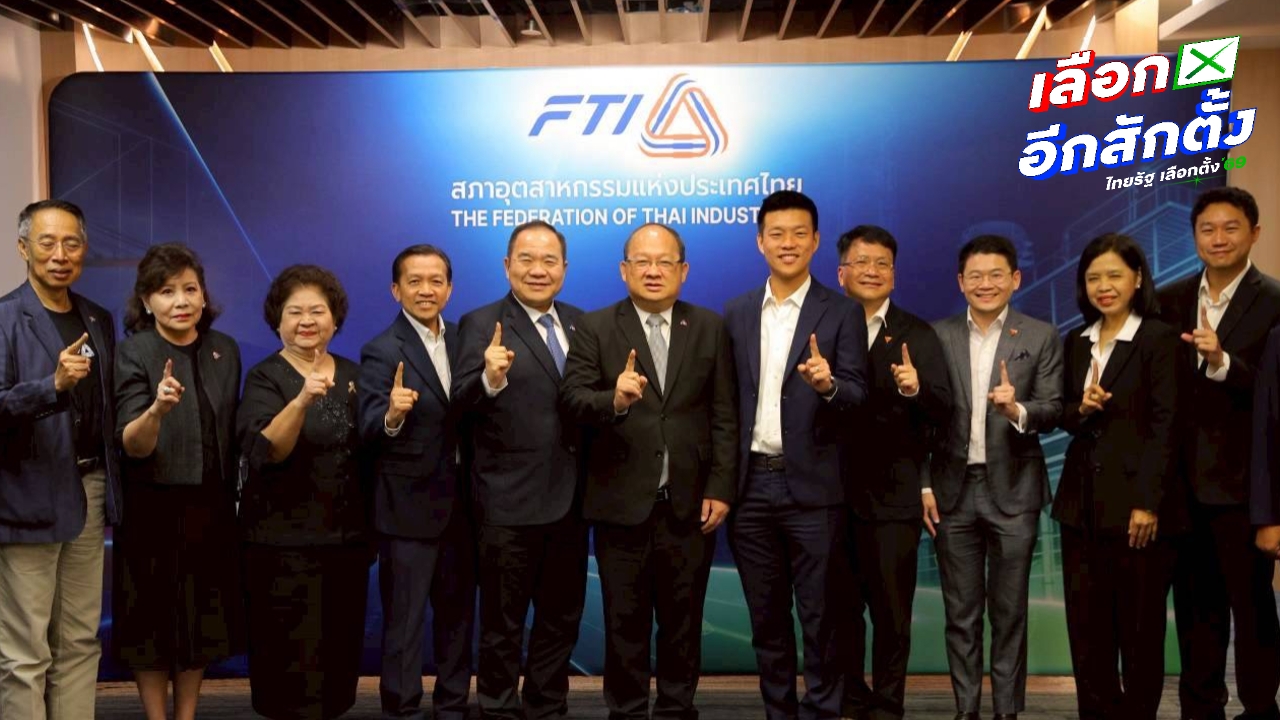
"Teng Natthapong" led the Prachachon Party team in talks with the Federation of Thai Industries to discuss policy directions, affirming they will not pursue short-term vote-seeking policies. He proposed a plan to plug economic system leakages within the first 100 days if they become the government, highlighting corruption as a primary factor.
On 27 Jan 2026 GMT+7 at the Federation of Thai Industries, Mr. Natthapong Ruangpanyawut, leader of the Prachachon Party and prime ministerial candidate, along with Mr. Sitthipol Viboonthanakul, Mr. Sia Champathong, and Mr. Poonsak Janjampee, list candidates of the Prachachon Party, met with Mr. Kriangkrai Thianukul, chairman of the Federation of Thai Industries.

Mr. Kriangkrai said they exchanged views with Mr. Natthapong and his party leadership on economic policies to drive industry, including structural challenges they face. They confront many challenges such as workforce development, environmental issues, and new industries with numerous procedures and obstacles awaiting resolution.
He added they wanted to hear the Prachachon Party’s approach if they form the government after the election—how they plan to solve problems and enhance competitiveness so entrepreneurs can continue progressing. This is a crucial issue as livelihood challenges are paramount, along with intense external competition beyond their control, but internally controllable issues require action.


Mr. Natthapong stated the most important thing is to build confidence. He wants to assure that if they take office, there will be straightforward discussions and comprehensive problem recognition without interruption.
He cited labor protection laws, clean air legislation, noting that the private sector may have some concerns. Speaking as party leader and prime ministerial candidate, he confirmed the Prachachon Party does not pursue short-term vote-based policies but focuses on long-term solutions for the country. The key is balanced, comprehensive policy implementation.

He believes the Federation of Thai Industries and others are ready to support policies that find solutions and foster genuine economic growth. Open talks will build trust for future cooperation.
They also discussed anti-corruption efforts, with participants reflecting on issues during the meeting. Many private sector problems stem from corruption. If there is clear political will and no conflicts of interest upon assuming power, the Prachachon Party is among the best choices to implement policies that remove obstacles for the private sector.

Regarding plans for the first 100 days if they form government to stimulate the economy and industry, Mr. Natthapong said they proposed measures for the first 100 days, the first year, and within four years. Short-term tasks include plugging economic system leakages such as cracking down on cheap counterfeit goods flooding in from abroad, alongside short-term economic stimulus policies.
Representatives from the Federation expressed a desire for existing good policies to continue without politicization or cancellation of beneficial programs like 'Khon La Khrueng' (half-half co-payment scheme). They also supported adding a receipt lottery, which they believe is important to stimulate long-term economic activity for small businesses and individuals.

They also reviewed competitiveness enhancement policies, including support for entrepreneurs who enter the tax system through the receipt lottery policy. This includes raising the VAT ceiling and providing VAT rebates to compliant entrepreneurs. The government’s role is to reward those who act properly, and those who violate laws must face strict enforcement.
Mr. Kriangkrai concluded that the meeting was very beneficial, fostering mutual understanding and perspectives that complement each other. They share a common vision and direction for economic advancement.