

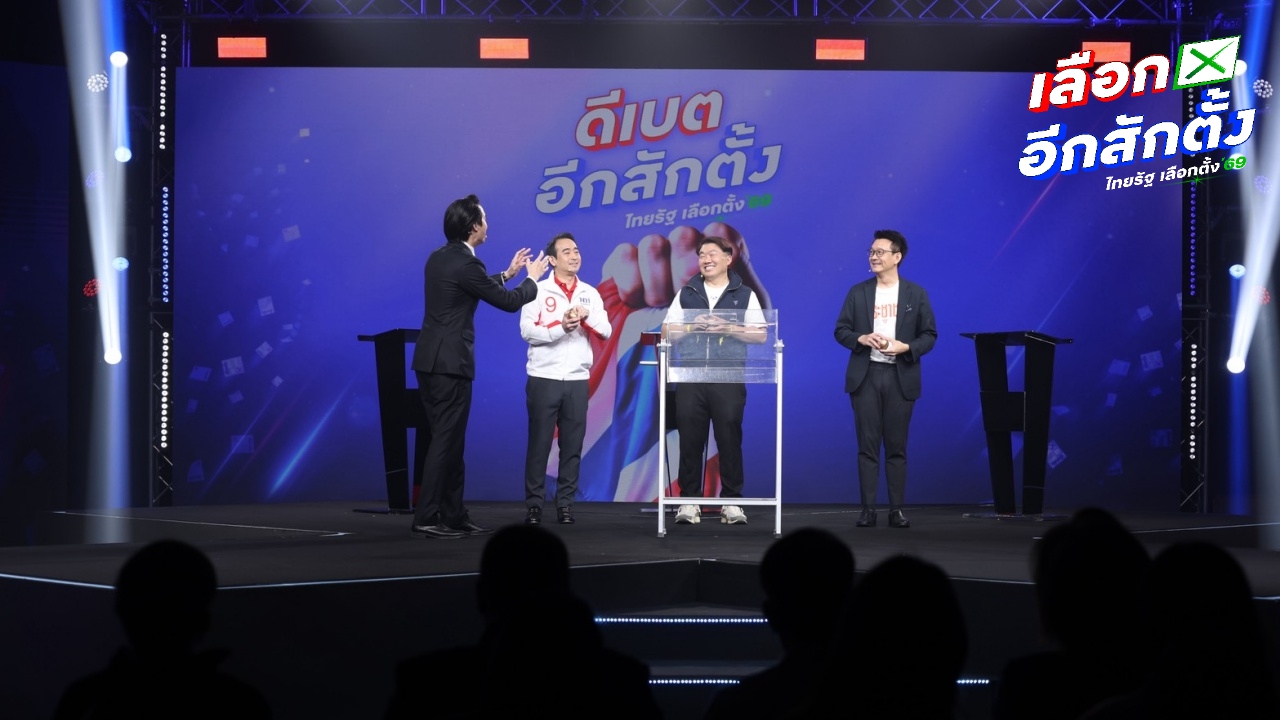
"Pheu Thai Party and Prachachon Party" respond. They answer the question posed by "Bhumjaithai Party" regarding how they would take responsibility if they fail to implement campaign promises made to the public, and what measures they would take to prevent such situations from recurring.
On 30 Jan 2026, during the final stretch of the 2026 election campaign, "One More Debate with Thairath Election 69" hosted by Kai Pongsakem reopened the debate stage, a last-minute showdown before the 2026 election with representatives from each political party: Mr. Paopoom Rojanasakul, Deputy Leader of Pheu Thai Party; Mr. Siripong Angsakulkiet, Deputy Leader of Bhumjaithai Party; and Dr. Weerayut Kanchuchat, prime ministerial candidate of Prachachon Party.

As the segment began, "One Question, Two Debaters" In question 3, Mr. Siripong raised the issue of policies by asking: Regarding the public listening to politicians' campaign promises, when it comes time to implement, some policies are not fulfilled. How will each political party take responsibility for these issues, especially policies that were strongly promised during campaigns but disappear when in office? What should be done?
Mr. Paopoom replied, "You asked directly, so I will answer directly. You probably mean the digital wallet. We have been implementing the digital wallet for two years, half of the government's term. We have been able to distribute funds to the people for half of the policy period. If we complete the full four-year term, we believe everyone will benefit from the digital wallet program, which has been successful in terms of response and numbers. It can increase GDP and reduce inequality more than doing nothing for two to three years. We consider this a success."

"Regarding Pheu Thai's policy proposals this time, economic stimulus policies must be seen in the context of economic appropriateness at any given time, as economic policy design is dynamic. Debt problem resolution is important. You will see that Pheu Thai proposes comprehensive debt-related policies, including financial support for those earning below the poverty line of 3,000 baht, helping them have sufficient income for daily meals.
We have a 30 percent agricultural price insurance program to help farmers have stable incomes, leading to agricultural innovation. We also propose an agricultural lottery, linking incentives with the public's interest in gambling, encouraging savings. We have a Millionaire Project with nine prizes to collect data, expand the tax base, stimulate the economy, and bring new taxpayers. Our SME program supports SMEs in all systems, including Thai e-commerce, encouraging the government to be a bigger customer of SMEs. You will see that Pheu Thai presents comprehensive policies responding to the economic conditions at that time."

On the other hand, Dr. Weerayut answered, "This is a very good and constructive question. I think all politicians and parties must answer this together. For Prachachon Party, we worry about this and have worked on policy training, having those responsible for each policy area find answers about the What, Why, and How—meaning you must specify exactly what you will fix.
Some issues involve regulations and ministerial rules, so ministers can address them directly. For example, on corruption regarding procurement, the key is the 2018 financial regulations. If that can be amended, you see we emphasize that every policy states if it requires an act of parliament, which takes longer to reach consensus, but if it is a ministerial regulation, the minister can act immediately.
Therefore, we prioritize this matter greatly. Another issue is the budget framework that can actually be used. Although there is an annual national budget, the usable budget after expenses is limited. Next year, the usable budget will be about 690 billion baht, the area available for policy spending. So, for welfare like the elderly allowance, we start from the available funds, deciding how much to allocate to economic stimulus, welfare, education, etc. We concluded that the starting amount is 1,000 baht, ending at 1,500 baht, following fiscal discipline. We emphasize budget holders' accountability and have prepared well to enter office and act immediately."