

Thairath Election 69 Debate: "Pheu Thai-Prachachon" unveil social security reform plans immediately after government formation, focusing on transparency and adjusting investment models for maximum value.
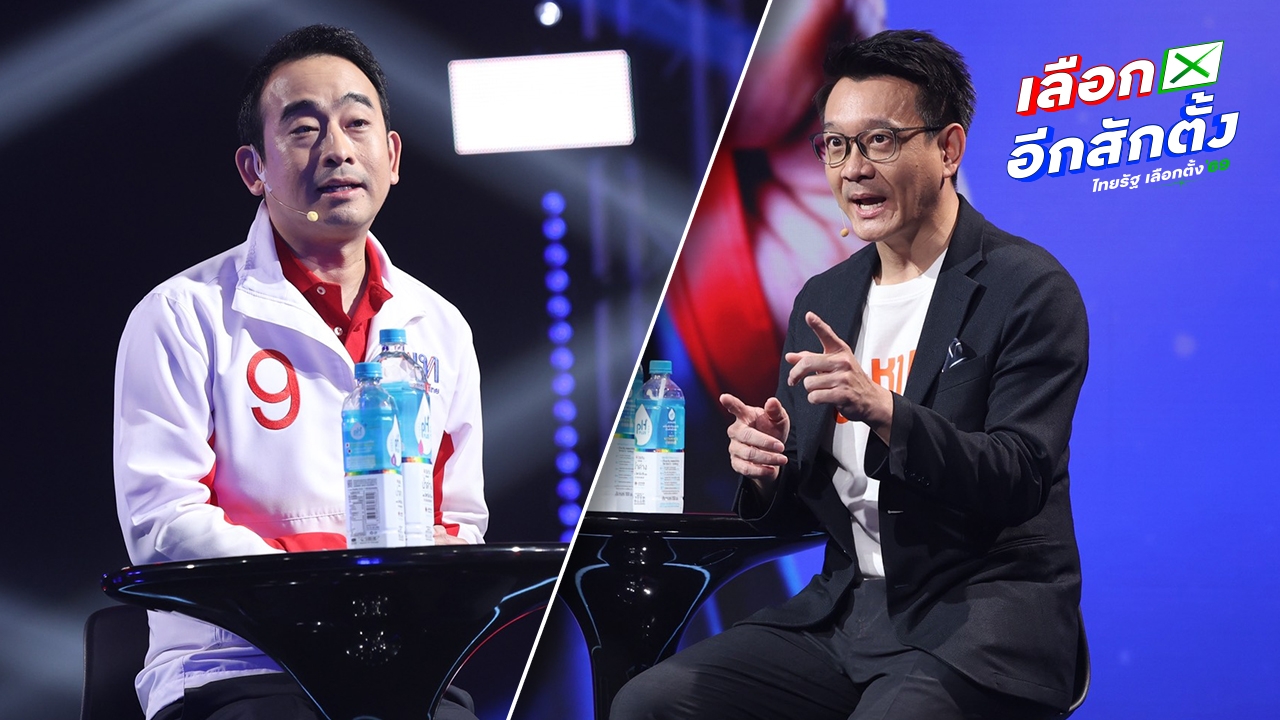
On 30 Jan 2026, during the final stretch of the 2026 election, "One More Debate with Thairath Election 69" hosted by Kai Pongsakem reopened the debate stage for the final race before the 2026 election, featuring representatives from each political party: Mr. Paopoom Rojanasakul, Deputy Leader of Pheu Thai Party; Mr. Siripong Angsakulkiet, Deputy Leader of Bhumjaithai Party; and Dr. Weerayut Kanchuchat, Prime Minister candidate for the Prachachon Party.
During the online segment, only Mr. Paopoom Rojanasakul and Dr. Weerayut Kanchuchat remained. When asked about each party's policies on reforming the "Social Security Office,"
Mr. Paopoom said that Pheu Thai proposes a social security policy called the '3 Returns.' First, returning rights to insured persons by allowing a 1:7 choice ratio based on the principle of ownership of the funds. Currently, the permanent secretary of the Ministry of Labor automatically sits on the board, but Pheu Thai believes the board chairman should be elected among the 21 members because the chairman has significant decision-making power and should not hold the position automatically.

Next, restoring the potential of the social security fund, which is currently underperforming with low returns and misuse of the 10% administrative budget on items like suits and pens. This 10% should be transparently disclosed to the public regarding its use. Investment strategies should also be evaluated for efficiency. Management should be professional, like the Government Pension Fund (GPF), with knowledgeable experts handling investments to avoid redundancies. There should be KPIs and public disclosure of management details.
Finally, restoring welfare benefits to insured persons. Currently, medical treatment rights differ between insured persons and those using the 30-baht scheme. There should be mechanisms to ensure that insured persons’ rights are comparable or superior to the 30-baht scheme. These three rights require reform.
Dr. Weerayut stated that the Prachachon Party has consistently fought for social security reforms since 2023. They aim to be a proactive opposition and have observed irregularities in administration and procurement, particularly in the Ministry of Labor, which was previously considered a low-profile ministry before the social security fund was established. The current use of funds has attracted scrutiny, making the labor minister’s role crucial. He urged the public to review past labor ministers and question the lack of progress.

He added that claims of high profits followed by requests to raise investment ceilings are contradictory and warrant further investigation. Their reform principles combine political will and technical expertise. They have digital teams monitoring procurement systems and emphasize transparency and continuous public questioning. Financially, the focus is not on maximizing profit but achieving returns comparable to the Government Pension Fund or equivalent foreign agencies. Thus, investment principles, digital knowledge, financial expertise, and political will must align.
When asked if the social security fund model remains suitable in an aging society, Mr. Paopoom said it is still necessary because human care, labor, and welfare are fundamental. However, questions remain about investment capacity. In government agencies, investing in stocks can be problematic if prices fall, as selling might be questioned as government loss. This is a limitation the Government Pension Fund does not face. He emphasized the importance of transparency since the fund belongs to insured persons. The issue is not existence but transparent management.

Dr. Weerayut responded that investment models and expected returns can be adjusted to fit changing social conditions, such as setting risk limits and return expectations. Past returns equaling government bonds are insufficient because better returns are achievable. He believes adjustments can be made long-term, but transparency and public representation in decision-making are essential.
When asked if they would act on social security reform from day one if in government, Mr. Paopoom confirmed this, citing the issue’s importance and the high level of public distress.
Dr. Weerayut added that similarly, the Prachachon Party, representing 24 million people waiting, will definitely take action.