

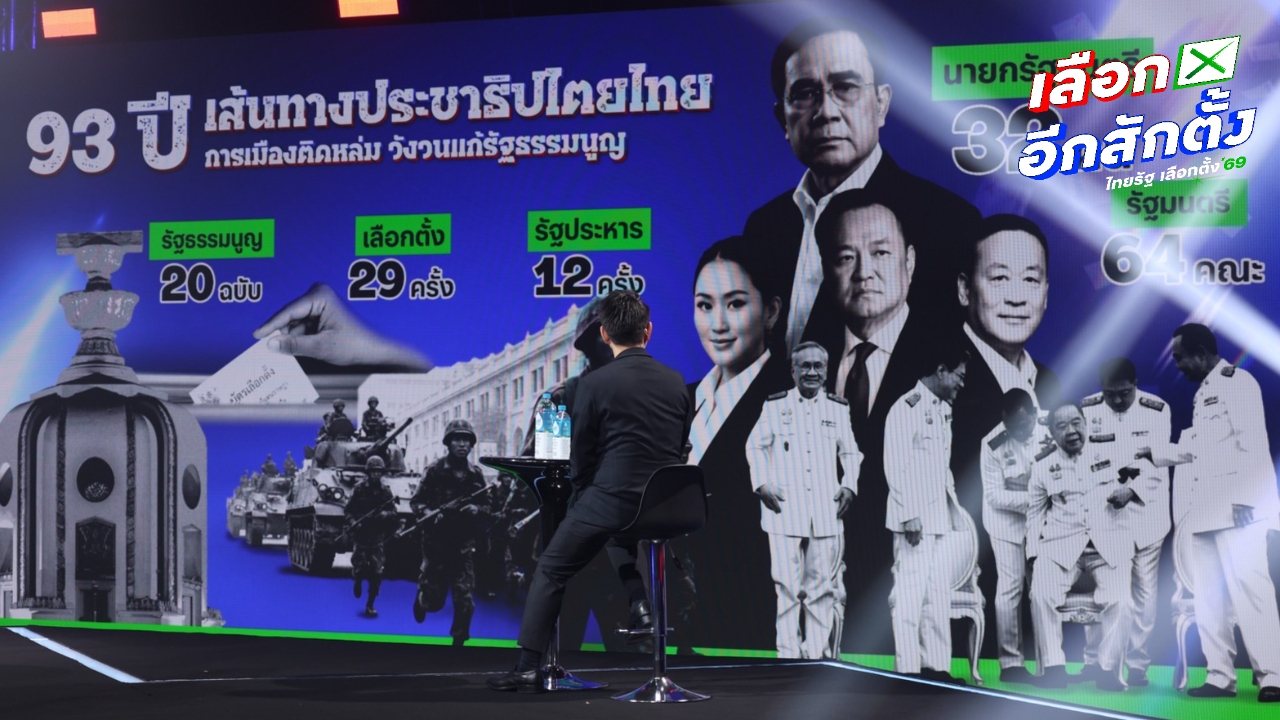
In the Thairath debate, Pao Phum declared that the Pheu Thai Party has always fought against coups, which should never happen. Siripong stressed the importance of not creating conditions that lead to coups. Weerayut emphasized that for Thailand to reach high-income status, it must adhere to democratic principles.
30 Jan 2026 GMT+7 Another debate session with Thairath Election 69. Today’s participants include representatives from three political parties. Mr. Weerayut Kanchuchat, Palang Pracharath Party’s prime minister candidate; Mr. Pao Phum Rojanasakul, Deputy Leader of Pheu Thai Party; and Mr. Siripong Angkasakornkiat, Deputy Leader of Bhumjaithai Party. Hosted by Kai Pongsakem Satyaprasert, the program can be watched on Thairath TV Channel 32 and all Thairath online platforms.
At 18:35, entering the third segment, Kai Pongsakem said that over more than 93 years since 1932, Thailand’s democratic path has been turbulent, with 12 coups, 29 elections, and 20 constitutions. Elections, coups, and new constitutions have cyclically repeated. He referenced South Korea's political events, where the president declared martial law and opposition leaders resisted, asking participants how they would respond if another coup occurred.

Mr. Pao Phum : said The Pheu Thai Party has consistently rejected coups, including those that occurred during their government tenure. This opposition comes from the public, party members, MPs, and party personnel because coups undermine democracy. We suffered losses, with some comrades imprisoned and many sacrifices made, but this did not stop our struggle. Therefore, coups should never happen and must be resisted continuously.
He invited reflection, noting that today the public no longer accepts coups. All parties recognize them as undermining democracy and unacceptable. However, the methods causing coups are evolving, such as legal warfare and other processes acting as new mechanisms or developments. Pheu Thai must fight and explain to the public that these processes exist and hinder democratic progress.
Mr. Pao Phum continued that currently there are three main pillars: judiciary, executive, and legislature. Yet, there is an additional pillar—the independent agencies. If their origins and powers aligned properly, that would be acceptable. However, the problem is that these agencies’ members are selected by the Senate, whose own origin is questionable, raising public debate and distrust about possible connections or conflicts of interest.
This problematic origin leads to independent agencies whose power does not correspond to the people’s mandate. These agencies can challenge or remove those elected by the public, which is the core issue. This mismatch between origin and power must lead to constitutional amendments for better alignment.


Mr. Siripong stated that it is undeniable that some groups try to question why the military does not intervene and attack politicians, which should not happen. He gave an example: elected MPs cannot serve on various boards, but members of the National Legislative Assembly (NLA), formed during a coup, can. He asked civil servants about this and was told it is because they are NLA members, not MPs, regardless of origin. This shows the bureaucratic system’s roots tied to unelected power. He believes this must be fixed because, although politicians have flaws, they are elected representatives.
To prevent future coups, he agreed with Mr. Pao Phum that the public now rejects coups. While holding state power, it is essential not to create conditions that allow coups and to reject every coup attempt. Prevention is best.
“I believe elections are like a pendulum swinging left and right. After six years of elections, the pendulum is balanced. Previously it might have swung too far one way, but now it is stabilizing. We hope to never see another coup in our lifetime.”

Meanwhile, Mr. Weerayut cited South Korea as an example, stating that Palang Pracharath, formerly Future Forward and Move Forward parties, firmly stand ready to defend democracy. Their position is clear, but systemic issues like the constitution must be addressed. Hence, this referendum is crucial because the 2017 constitution, born from a coup regime, must be amended to reflect the people’s will. This referendum opens the door for constitutional reform, followed by further processes. He urged citizens to vote in favor.

Importantly, public understanding must grow during this coup-free period. Thai society needs to grasp the real cost of coups. We rarely discuss this. Since the coup regime began, 'gray capital' has flowed in. The cost of coups extends beyond their occurrence, especially now with gray capital, visa provisions, and citizenship processes facilitating money laundering.
Regarding the economy, South Korea experienced major protests in 1980, which was a turning point that prevented a return to military rule because of economic factors. This final phase before becoming a high-income country shows South Korea as a good example. Dictatorships can only go so far but cannot progress. The last phase toward high income requires upholding democracy. Therefore, 1. society must better understand the cost of coups for the public and 2. deeply connect this to economic dimensions, as democracy is key to leading the country to high-income status.
