

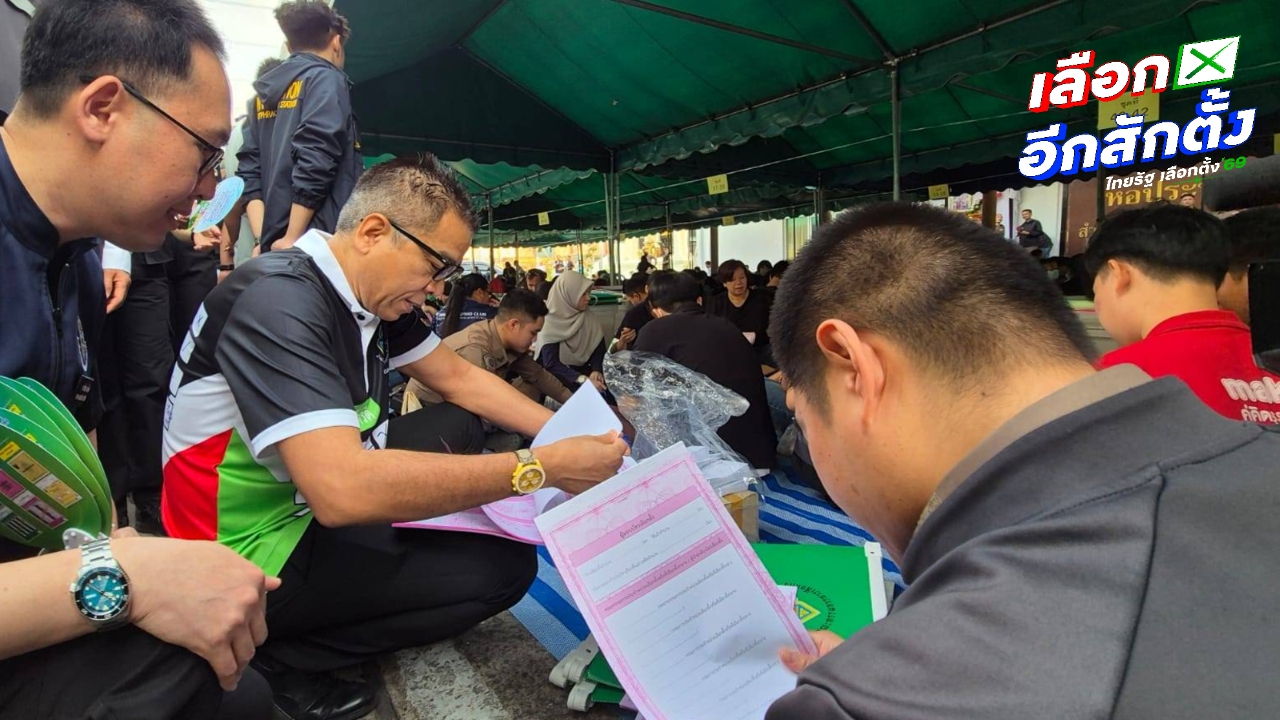
The Secretary-General of the Election Commission visited the central polling station in Bang Kapi district to oversee the receipt of ballots and election materials. Bang Kapi is the district with the highest number of out-of-district advance voter registrations, totaling 58,728. He reported that the overall situation is proceeding smoothly and well organized.
At 10:00 a.m. on 31 Jan 2026 GMT+7, at the Bang Kapi District Office in Bangkok, Mr. Sa-ong Bunmee, Secretary-General of the Election Commission, observed the delivery of ballots and election materials at the central polling station for both in-district and out-of-district voters. On this day, all polling station committee members arrived to receive ballots, ballot boxes, voting booths, and signed the ballot receipt forms, along with other election materials, preparing for the advance voting scheduled for 1 Feb 2026, from 08:00 to 15:00. Bang Kapi district has 58,728 registered out-of-district advance voters, supported by 86 polling unit teams prepared to serve voters. During the inspection, Mr. Sa-ong wore a shirt depicting valid and spoiled ballots and engaged in conversation with polling officials.


Mr. Sa-ong later gave an interview regarding the readiness for advance voting on 1 Feb 2026. He stated that all 424 polling stations are currently receiving election materials for the advance voting scheduled for the next day. Overall, preparations seem to be proceeding smoothly. He specifically visited Bang Kapi district because it has the highest number of registered advance voters, approximately 58,000. The district has prepared to facilitate voters well, including traffic management and parking. He believes that voting itself should not present issues, as the procedures have already been practiced thoroughly.


Mr. Sa-ong added that he is confident in the performance of polling station officials across all provinces. Bangkok is considered special due to the large number of registered voters. Furthermore, the advance voting on 1 Feb differs from the general election on 8 Feb because the central polling stations bring voters from all 77 provinces together in one location. He believes that thorough rehearsal of the officials and prior public information campaigns will ensure the election proceeds smoothly.
“On 1 Feb, eligible voters will receive two ballots: a green one for the constituency vote and a pink one for the party list. They will also receive a ballot envelope, which will carry the voting intentions of all registered advance voters to their respective 400 constituencies. The front of the envelope does not require voters to write anything; polling officials will fill in the province, constituency, and a four-digit constituency code. Upon receiving the two ballots and the envelope, voters mark their choices, fold both ballots, place them in the envelope, and hand it to officials. Officials verify that the voter has inserted both ballots by checking the envelope’s holes on both sides. Once confirmed, the envelope is sealed and signed on the back by officials, then returned to the voter to personally deposit into the ballot box.”

Mr. Sa-ong confirmed that for advance voting in Bangkok, where there are many registered voters, the Election Commission has selected the most convenient locations with easy access and designed voting procedures to be efficient and quick. Some locations might experience traffic congestion due to large crowds, but the Commission will strive to manage this as best as possible.
Mr. Sa-ong then led the media to observe preparations at the central polling station for in-district and out-of-district voting at the Tawan Na Bang Kapi project in Bang Kapi district, Bangkok. The district office has facilitated voters by providing municipal officers and signage directing voters to the central polling station. Upon entering, voters will see signs indicating regional polling units by color: green for the North; pink for Bangkok, Central, West, and East regions; brown for the Northeast; and purple for the South. Colored flags guide voters to their regional polling units. Additionally, three information points have been established to assist voters in casting their ballots correctly. Medical teams, public health officials, and emergency ambulances are also on site to assist voters who may become ill during the process.