

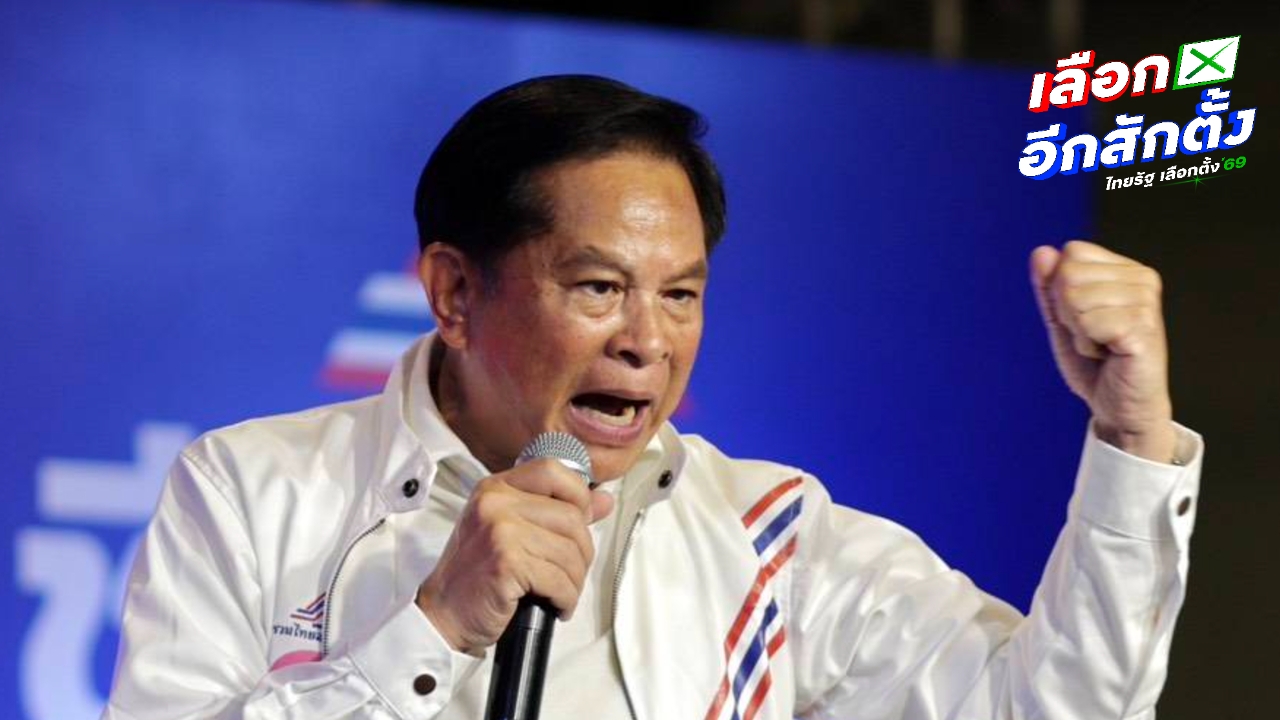
Peerapun declared, "Our lives are not a game for politicians," openly confronting monopolistic capital across all sectors. He reaffirmed RTSC's stance, promoting purity and courage to control one's own destiny. On 8 February, vote for "United Thai Nation" number 6—no lies to the entire country.
On 3 February 2026, the United Thai Nation Party (RTSC) held a major campaign rally at Avenue Zone A, MBK Center shopping mall, under the campaign "Choose number 6, choose your own destiny." Led by Mr. Peerapun Salirutwiphak, party leader and prime minister candidate, alongside key leaders and party executives such as Mr. Chatchawan Kongudom, party secretary-general; Mr. Witthaya Kaewparadai; Mr. Attawit Suwanpakdee; and Mr. Nopphat Kaewthong, two deputy leaders and candidates ranked 2 and 3, as well as party members and candidates for all 33 Bangkok constituencies, attended in full force. A continuous stream of citizens filled the venue to listen.
Mr. Nopphat spoke about agricultural policies, noting that Thai farmers remain poor due to high production costs, especially fertilizer which depends on imports and fluctuates with global markets. He proposed utilizing domestic resources like "potassium" to reduce fertilizer prices to no more than 500 baht. He highlighted that Thailand has natural gas to produce urea locally, lowering farmers' costs. For rice, he suggested shifting from selling paddy rice to processing rice grains, with the state supporting drying, milling, packaging, and nationwide distribution platforms, aiming to raise paddy prices retroactively to 15,000 baht per ton. This initial investment would sustain the system and reduce redundant subsidies. Additionally, he proposed zoning production areas, using Big Data to link commerce and agriculture data, supporting Young Smart Farmers to access global markets and modern technology, reducing middlemen's roles, and elevating farmers to sustainable agribusiness entrepreneurs.

Meanwhile, Mr. Attawit addressed RTSC’s achievements, particularly in energy. Despite criticism that a lawyer is unsuitable for energy management, tangible results prove that Mr. Peerapun has "changed the rules" of Thailand's electricity system by lowering electricity rates from 4.70 to 3.94 baht per unit—a reduction of 0.76 baht or about 16%—unprecedented in Thai political history. This has saved citizens over 270 billion baht. Regarding Thailand’s credit bureau system, which hinders free competition and results in banks earning over 200 billion baht profit annually, he contrasted it with other countries’ credit scoring systems that promote interest competition and fairer loan access. On agriculture, he acknowledged high fertilizer costs result from monopolies. He admitted that fighting monopolies reduced the party's MPs significantly, but RTSC remains principled for the public’s benefit, declaring their candidates nationwide may lack deep funds but have "100% heart" to challenge the entrenched power structures without retreat.
On constitutional reform, Mr. Attawit stated he disagrees with spending as much as 10 billion baht to rewrite the entire constitution. He questioned the sincerity of proponents of this approach, noting that constitutional amendments can follow proper processes, but total repeal is a serious problem, especially for investor confidence. If the country’s highest law is unstable, investment decisions inevitably suffer. He cited Japan, where, despite drafting a constitution after World War II, amendments have been continuous rather than complete repeals. He emphasized that this principle reflects legal and political stability, affirming the constitution as the supreme law must be amended through its own evolution by strong, prudent politicians—not hastily. Protecting the constitution is everyone’s duty, including political parties. Amendments are possible but must not overthrow the entire system.

Mr. Peerapun declared RTSC’s political stance under the theme "Our lives, our choice," stressing that elections should not fall victim to old political rhetoric using fear and strategic manipulation to guide voters. Over the years, some politicians have used "election strategy" to pressure citizens to follow predetermined political games, but ultimately politicians gain power, positions, and budgets while citizens’ lives remain unchanged, with no true answers about what they gain from voting. He also criticized politics based on colors, noting that colors touted for virtue eventually blend into the same hue, questioning whether the claimed virtues are mere facades. RTSC firmly asserts its "white" stance, immune to power or interest manipulation, upholding nation, religion, and monarchy without riding popular trends or using them politically.
Mr. Peerapun added that RTSC is the first party to straightforwardly discuss public livelihood policies, including reducing electricity bills, living costs, and welfare, before other parties adopt these ideas but avoid key issues like lowering oil and gas prices, which are major daily expenses. He cited past efforts to cap liquefied petroleum gas prices despite high costs without passing the burden to citizens, questioning who benefited from price increases after his tenure. He emphasized that "the people's strategy" means seeing tangible results from their tax money, not anyone’s political strategy. Regarding the Thai-Cambodian border issue, recently raised by many parties during the election but neglected in the past, he affirmed RTSC does not need to exploit this issue because it has worked alongside the military continuously for over 20 years with strong ties.
Mr. Peerapun continued on the party’s energy policy, saying all policies stem from over 30 years of political experience and close engagement with citizens’ livelihoods. He stressed understanding the struggles of laborers and daily wage earners supporting their families. He pledged that if granted authority to govern with full decision-making power, electricity rates could be further reduced by 0.50 baht to 3.30 baht per unit concretely. He set a goal that within four years, RTSC’s energy policies would save citizens over 1.7 trillion baht in total expenses.
Furthermore, Mr. Peerapun announced RTSC’s commitment to reform Thailand’s entire education system to restore the future of children under the policy "Learn what you want to learn," aiming to reduce inequality and long-standing pressures in Thai society. The party proposes abolishing entrance exams, allowing children and youth to directly choose their interests, reducing stress and inequality while creating genuine equal opportunity. The party’s new idea is that students can study for any length of time and graduate when ready, enabling them to work to support their families without losing educational rights. He emphasized that true learning is not about speeding graduation but gaining real knowledge and skills to develop oneself, family, and nation long-term. Therefore, RTSC’s stance is to avoid political games, not sell ideology, and stand firmly for people under the concept "Our lives, our choice; people are not pawns in political games."


