

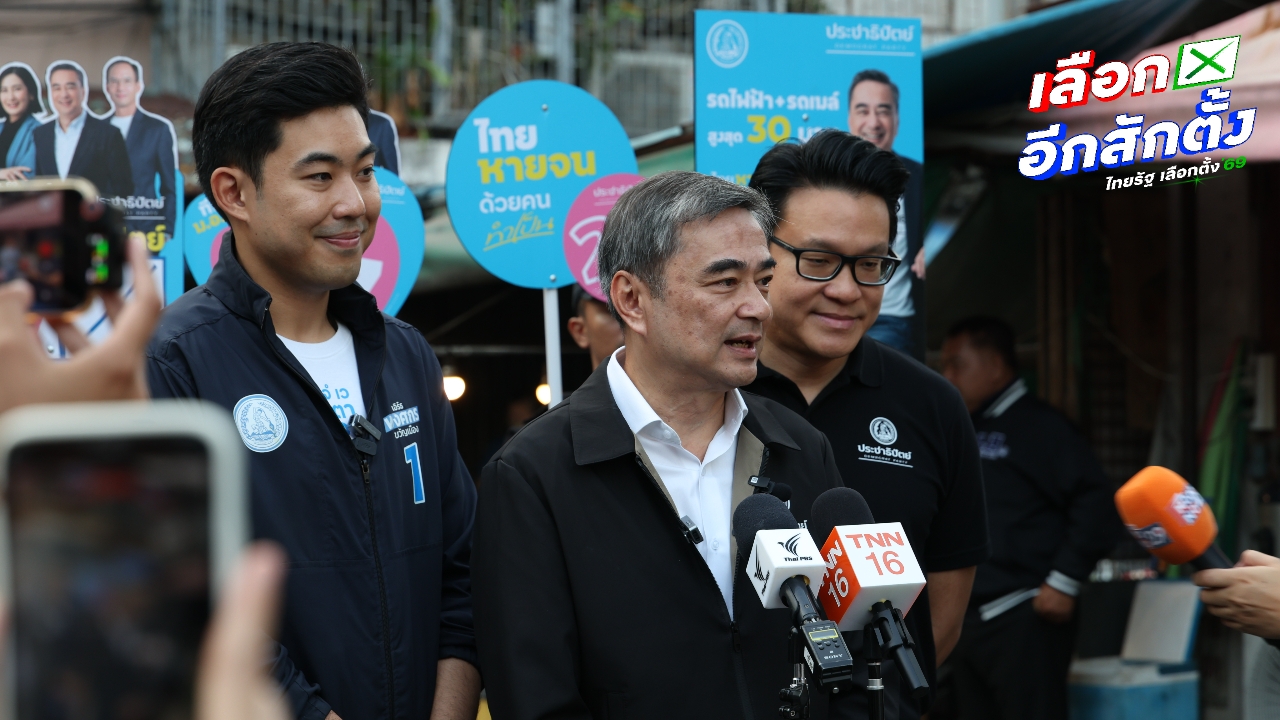
"Abhisit" campaigns in Khlong Toei and Watthana to support "Pongsakorn," emphasizes a commitment to honest politics, affirms strict candidate selection with no qualification issues, responds to TDRI's criticism of the Democrat Party's policy budget as exaggerated, and insists calculations are careful and do not impact fiscal stability.
At 07:00 on 4 February 2026, Mr. Abhisit Vejjajiva, leader of the Democrat Party, accompanied by Mr. Sakolthee Phatthiyakul, the party's deputy leader overseeing Bangkok, visited the 4th electoral district covering Khlong Toei and Watthana to support Mr. Pongsakorn Khwanmuang, the Democrat Party's candidate number 1 for Bangkok MP. The visit was warmly welcomed by local residents and market vendors, with many people requesting photos and giving flowers as encouragement.


Mr. Abhisit said with a smile that returning to Watthana and Khlong Toei felt like coming home because these were his old constituencies where he had built strong ties and earned trust over time. This time, he brought a young generation figure, Mr. Pongsakorn, to continue the commitment to serving the people.

Explains issue of Democrat Party's policy budget alleged to be inflated, insists calculations are careful and do not affect public finances.
Mr. Abhisit gave an interview clarifying the case where the Thailand Development Research Institute (TDRI) analyzed that the Democrat Party's campaign policy budget was quite high. He said the reported figures were communicated in accordance with the Election Commission's (EC) regulations, and must be considered in the context of timeframes and the existing budget structure.

Mr. Abhisit explained that the budget the party submitted to the EC represented the committed budget over four years, not expenditure for a single year. Importantly, many policies include "existing budgets" already spent by the government, which are included in the calculation. He also commented on the electricity cost policy analysis, stressing that this policy does not use state funds but involves price restructuring and efficient management. The party has thoroughly studied this to ensure it will not affect financial stability or fiscal discipline.
"I want to further clarify that the budget we submit to the EC—for example, in the case of elderly allowances—we must submit the entire project budget. Currently, payments are around 600, 700, or 800 baht, but we submit 1,000 baht, which actually includes the amount already being paid. So, it does not increase as much as might be misunderstood. Every project follows this pattern. Regarding TDRI's observation, we are slightly puzzled because, in the case of electricity costs, we do not use any budget at all. I affirm that we have reviewed all budget increases each year in relation to economic growth rates, increased tax revenues, remaining fiscal gaps, and borrowing capacity for deficits. We are confident there is no problem."

Mr. Abhisit also commented on TDRI's overall critique, saying it applies the same standards to all parties. Comparing with other major parties, such as the People's Party, the budget figures are not vastly different, and some policies of the People's Party may even have higher budgets. He expressed concern about unequal transparency among parties, noting that many parties propose expensive policies but do not disclose budgets in documents submitted to the EC.


Regarding the Election Commission's plan to submit a list of candidates with qualification issues to the court for disqualification, Mr. Abhisit affirmed that this is a normal legal process and will not affect the overall election. The Democrat Party has strict candidate qualification measures with two clear steps: 1) self-certification, where every candidate must sign to confirm their qualifications and the accuracy of their information; 2) proactive verification, where the party sends candidate data to relevant agencies for background checks, even if sometimes the information received is incomplete. The party has explained these procedures to the EC since the application submission to demonstrate its transparency and diligence in candidate screening.
Regarding a candidate in Udon Thani province found to be unqualified due to a 2007 court ruling, Mr. Abhisit explained this case is complex because the candidate ran in elections in 2019 and 2023, during which neither the party's records nor the EC's verification system showed this offense. The disqualification was only detected by the EC recently during the current election.
Concerning concerns about the party leader's responsibility or potential impact on the party, Mr. Abhisit confidently stated that the party has made every effort to conduct thorough checks and has provided detailed explanations of its procedures to the EC in advance. This is not a case of addressing problems only after they arise. The Democrat Party communicated its verification process from the start, conducted openly and honestly. Individual issues regarding voting rights or incomplete personal data must be explained by the candidates themselves through proper channels.
"We have made efforts to verify already and explained our procedures. Everyone must comply with the law."