

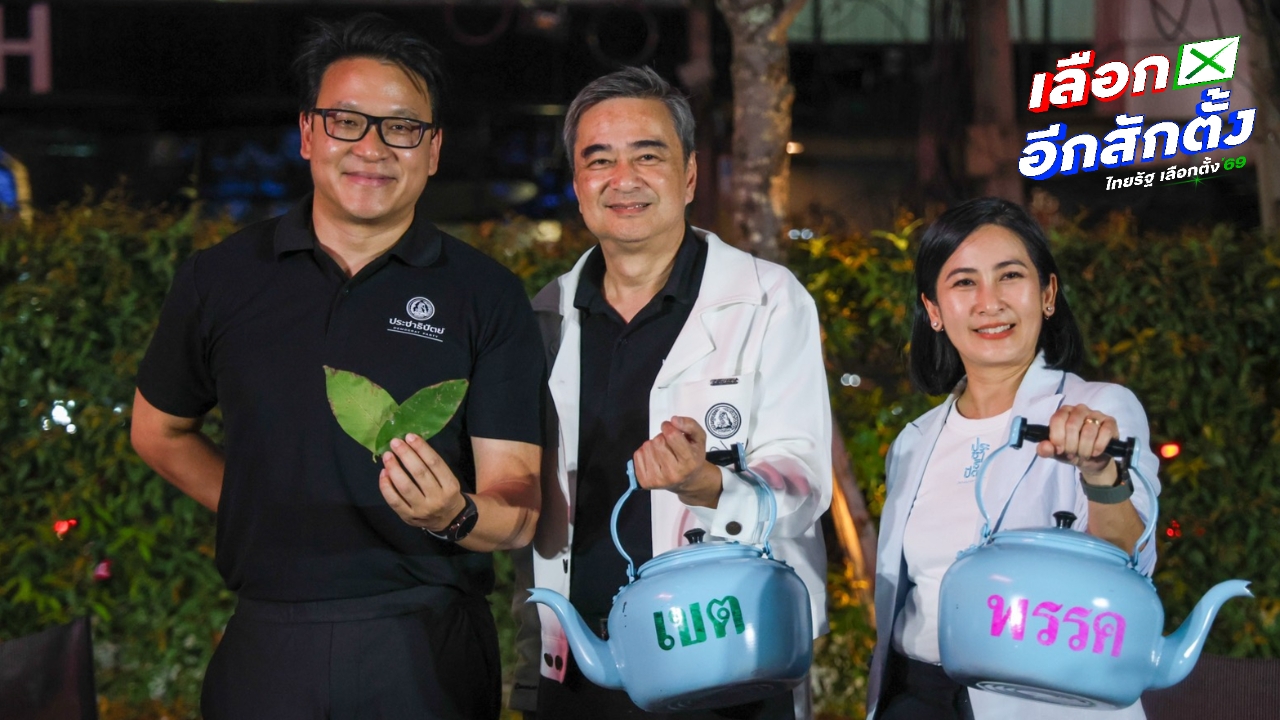
Abhisit led Karn Dee and the Democrat Party's Bangkok MP candidates in a garden discussion titled 'Thailand's Direction Is Up to You,' pointing out that in the election's final stretch, there are efforts to divide sides to make the other look bad, with parliamentary dissolution only cycling back to the same situation.
On 4 Feb 2026 GMT+7, Abhisit Vejjajiva, leader of the Democrat Party, together with Dr. Karn Dee Liao Phairoj, the party's prime ministerial candidate and Bangkok MP candidate, held a discussion with the public in front of the Park Silom building under the theme 'Thailand's Direction Is Up to You.' The event took place in a garden setting with participants seated on camp chairs.
Abhisit took the stage and said that reaching the election's final stretch, he has observed the situation as an attempt to clearly divide factions by portraying the other side as the villain. Over the past four years, even with parliamentary dissolutions, the cycle returns to the same point. The country is in danger due to gray capital and scammers causing significant damage. Looking back over 20 years, Thailand was once viewed as a leading example of democracy and freedom, but now all of that has vanished, leaving only negative questions. He emphasized that 8 Feb represents an opportunity to pull the country out of this state, and the Democrat Party's policies provide the safe solution to do so.

Abhisit also remarked that last year's Thai tourism clearly illustrated the case of Chinese tourists. When speaking with Chinese people, he heard that they could not come to Thailand because it was unsafe, referring back to the incident of a Chinese actress being abducted near the border. Although she was eventually rescued, there was pressure on Thailand regarding how such events could occur within the country.
For him, Bangkok holds political importance because it has 33 parliamentary constituencies. Therefore, most Bangkok residents tend to vote based on party affiliation, meaning the chances of aligning politically are always present. This may differ from many other regions, except for the South, where they hope for unified support, while other regions remain divided. It is not just about numbers but also about signaling the country's direction. The question is, if Bangkok residents can do this, what do they want to say or offer to Thai politics and the nation? He proposed the idea: 'Can the people of Bangkok lead in creating a way forward for Thailand?'

When asked why Bangkok should support the Democrat Party, Abhisit said it is because of existing relationships and that in past elections, those who supported the party represented the fight for honesty, integrity, and good governance. Their experience in managing the economy and addressing various crises remains a solid foundation. Although some complications may arise, it is undeniable that this legacy still exists and inspires confidence.
Regarding social security, Abhisit responded that when he was prime minister, he assigned the Ministry of Labor to work on making the Social Security Office an independent agency. When the ministry's proposal did not meet that goal, it was sent back for revision but was ultimately not completed in time. Without transparent and efficient management, damage can easily occur. He also tried to expand labor protections and encourage those without employers to join social security through budget incentives, increasing the fund's size and insured persons. However, these programs gradually diminished or disappeared. The previous social security system revealed many issues previously unconsidered, which is positive because it raised awareness that change is necessary. Therefore, there must be a clear vision for this change, focusing on transparency and anti-corruption measures. The reform must go further and deeper in many aspects.

Dr. Karn Dee explained his background as a futurist, describing how he studies possible future scenarios. Previously, he collaborated with international researchers on Bangkok's future, envisioning it as a regional technology hub and a place where diverse ideas and cultures coexist and create shared value. Bangkok could be a place where people grow, retire, and become a smart city. The data gathered supports these possible scenarios. This vision motivated him to join politics with Abhisit, believing that focusing solely on self-interest, factions, or family will not advance the country. His commitment is rooted in the confidence that their efforts will lead Bangkok and the nation toward a better future.


Photo: Saran Pongsawat