

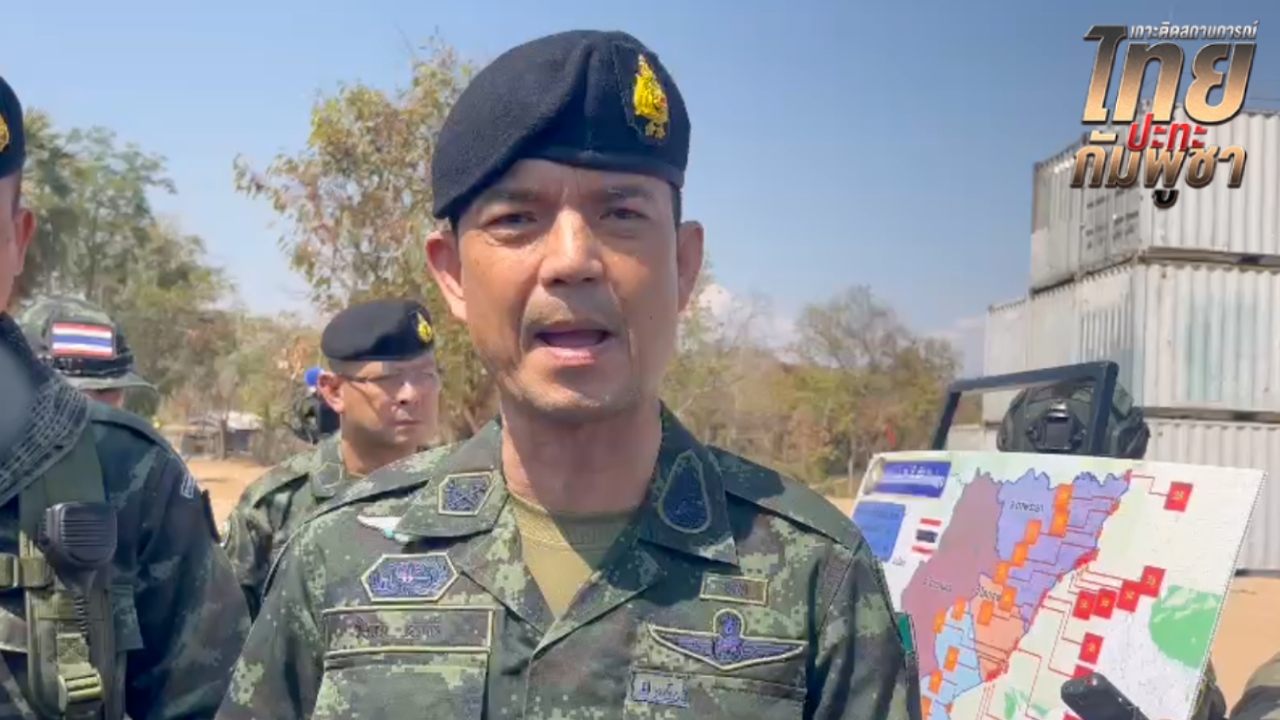
The Army spokesperson indicated that the border situation results from Cambodia rotating its troops and exhibiting lax discipline, but their non-aggressive stance allows for some understanding. He is confident that if incidents occur on the 2026 election day, each unit has its own response plans.
On 5 February 2026, Major General Winthai Suwaree, Army spokesperson, summarized the mission of bringing media to the Thailand-Cambodia border in Sa Kaeo province, under the responsibility of the Burapha Task Force, First Army Area. He explained this was done because the environment had become safer. Previously, although media had reported from the area, they could not access some locations. The visit had two main purposes:
1. To allow direct contact with the commanders operating in the area, which is not easy due to the semi-populated nature of the region. It also demonstrated that Thai forces operate within rules and prioritize civilian safety, achieving the goal of no civilian casualties or injuries.
2. Because of the physical terrain and equipment in this area, the media might assume operations are straightforward and easy. However, in reality, the factors and procedures involved require operators to be resourceful and tactically skilled to meet objectives, establish security, and ensure the safety of personnel.
Comparing the situation in the First Army Area with the Second Army Area, where continuous incidents occur, the key factor is troop deployment in mountainous forest terrain. Incidents reported periodically, such as explosions and grenade launcher sounds, result from occasional errors but are not intended to threaten Thai military operations. These reflect lax discipline among Cambodian troops, caused by troop rotations bringing in less familiar personnel. Alternatively, some provocations may occur but are not serious enough to disrupt Thai operations.
Regarding concerns that Cambodian soldiers might lose discipline and cause incidents on the 8 February election day, the Army spokesperson said this must be assessed locally. Each unit has communication channels and, if they judge there is no cooperation or intent to maintain ceasefire agreements, they will have measures ready to respond accordingly. International observers are also monitoring the stances of both Thailand and Cambodia. So far, Thailand has received praise and will maintain standards. He assured there is no need for concern; if any actions require a response, the military will respond if those actions lack reasonable justification.
Regarding past incidents where Cambodian forces dropped flares or fired 40mm grenades near Thai bases and excused these as discipline lapses, this is plausible. However, if Cambodia truly has a hostile attitude, the truth will eventually emerge. Currently, the situation still appears reasonable. Coordination behavior shows whether it is aggressive or respectful; if aggressive, a different approach is needed, but if reasonable and without harsh or aggressive attitudes, the situation remains manageable.