

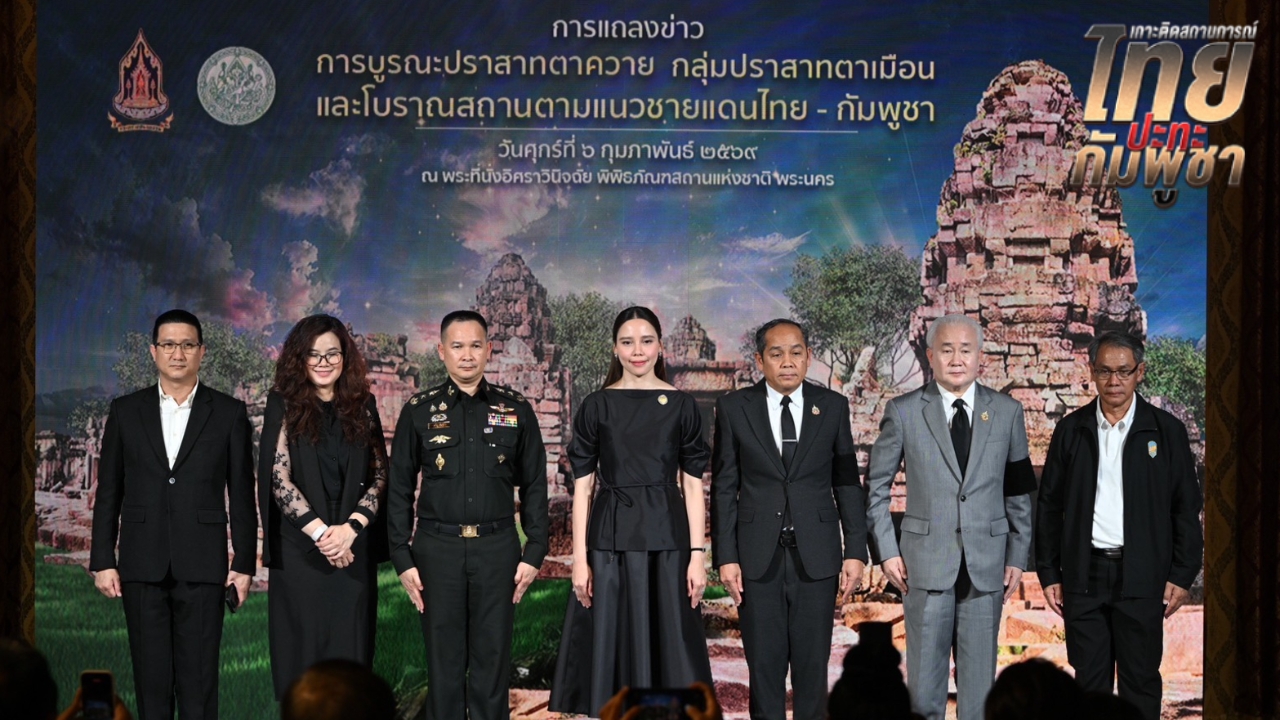
Culture Minister Sabida declared Prasat Ta Kwai as a Thai archaeological site, registered since 1935, and announced urgent restoration efforts after Cambodia established a military base there, causing destruction to this cultural heritage of humanity.
On 6 Feb 2026 GMT+7, Ms. Sabida Thaiset, Minister of Culture, chaired a press conference on the restoration of Prasat Ta Kwai, the Ta Muean temple group, and other archaeological sites along the Thai-Cambodian border. Attendees included Mr. Prasop Riangngern, Permanent Secretary of the Ministry of Culture; Mr. Phanomboot Chantrachot, Director-General of the Fine Arts Department; representatives from the Royal Thai Army; Ms. Lipikar Kamlangchai, Inspector General of the Ministry of Culture; Foreign Ministry representatives; and national security integration agencies. The event was held at the Isarawinnichai Throne Hall, National Museum, Phra Nakhon.

Ms. Sabida explained that following Cambodia's protest letter requesting Thailand's Ministry of Culture to halt restoration of Prasat Ta Kwai and the Ta Muean temples, claiming them as Cambodian heritage, the ministry clarifies that these are Thai archaeological sites. Specifically, Ta Muean Thom and Ta Muean Tod temples were registered as archaeological sites in the Royal Gazette in 1935. The Thai government allocated budgets for restoration from 1990 to 1996, successfully completing the main temple restoration without objection from Cambodia. The Ministry of Culture, through the Fine Arts Department, must urgently act to prevent further damage caused by Cambodia's military use of the site, violating internationally accepted principles and damaging this cultural heritage important to humanity.


Thailand continues to assert the necessity and legitimacy of restoring Prasat Ta Kwai, the Ta Muean temple group, and other archaeological sites along the border that are officially recognized as Thai heritage and located on Thai territory.
Prasat Ta Kwai is an archaeological site located in Phanom Dong Rak District, Surin Province. The Fine Arts Department conducted surveys in cooperation with Thai Border Patrol Police during 2001–2002, producing archaeological survey reports as evidence. At that time, Fine Arts officials confirmed no Cambodian military personnel were present, as the area is Thai territory. The site was still intact then, so no restoration budget was allocated, but it was listed among unregistered archaeological sites.

Ms. Sabida stated that recent clashes between Thai and Cambodian soldiers provided clear evidence that Cambodia used Prasat Ta Kwai as a military stronghold, causing severe damage to the site. This action violates international norms prohibiting military use of heritage sites. After the ceasefire and Thailand re-established control over the land around Prasat Ta Kwai and the Ta Muean temples, significant damage to Prasat Ta Kwai and signs of damage to the Ta Muean group were evident. The Ministry of Culture assigned the Fine Arts Department to immediately survey for restoration, with cooperation from the 2nd Army Region, as Cambodia had placed numerous landmines inside and around the site, posing a major obstacle to survey and restoration efforts. Survey results confirmed urgent restoration is needed due to severe structural damage to Prasat Ta Kwai.