

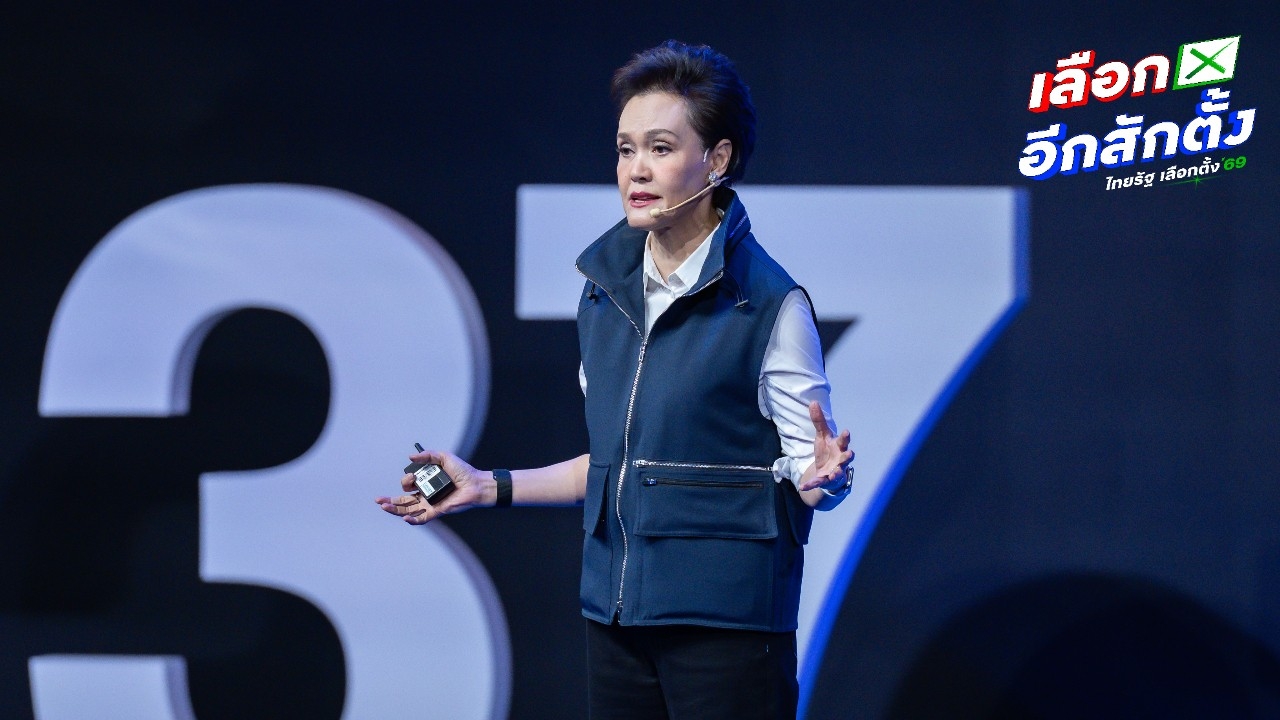
Supachai elaborates extensively on solutions for livelihoods and trade, taking a jab at those who have handled economic issues repeatedly, questioning whether they see the problems. She refutes any devaluation of exports, boasts of working 73 days to raise rice prices, appeals to Taem for a chance, and insists she is not working for any political party.
On 6 Feb 2026 GMT+7, Ms. Supachai Suthamphan gave a speech, stating early on that Taem is here again not as a politician but for all fellow citizens and all Thai people in the country. She said she is no different from Mr. Ekniti, who was advised by friends and teachers not to do this, but she asked everyone because she cares about all of us.
She said the country is facing many uncontrollable storms, which worries her. Mr. Sihasak has spoken on geopolitics about global conflicts forcing choices between sides, but in reality, we are not big enough to choose. Therefore, we must strive to get along with everyone with dignity, as geopolitics surrounds us. Security and foreign economic matters are intertwined, and we see the world pressuring us, including in trade.
She questioned why three people who should not be here (Sihasak, Ekniti, Supachai) must stand here—because marketing, economic trade, and security are linked. We are in a frightening storm, so our ship is sailing with difficulty and challenges. This is Thailand today; the three of us volunteer to help steady this ship to pass through and reach new seas full of brightness and hope.

Ms. Supachai added that now is not the time for internal quarrels, as conflict doesn't help. We must unite government, private sector, and the public. She gave an example that we used to be Asia's fifth tiger, but today Thailand's GDP growth is very low, making us the sick man of Asia, not the fifth tiger anymore.
She said the IMF forecasts Thailand's growth at only 1.6% this year, questioning if we should accept this low growth. She emphasized acknowledging our reality. Mr. Ekniti spoke about populism, noting limited funds but aiming for beneficial, widely distributed outcomes. Thus, money must be used precisely. To grow beyond this, cooperation is needed. Mr. Ekniti showed in 73 days how to revive old cars from the ditch, leading to 1.8% growth in Q4. Now, with a 1.6% forecast, people must decide whether to trust him alone, but one Ekniti is insufficient—we also need Taem. We must discuss income generation, which is our way out.
Ms. Supachai then outlined four major sources of national income: 1. Purchasing power and total income, which must be stimulated to reach all groups; 2. Investment, targeting nearly 500 billion baht in foreign investment alongside skill development and supporting new industries like AI, new automotive, and high-value tourism, focusing on industry, investment, and employment to grow beyond projections.
3. Government spending: Thailand has about 3 trillion baht income but 4 trillion baht expenditure, with 3.1 trillion for fixed expenses and 400–500 billion baht for obligations, leaving about 500 billion baht for actual spending, which is low. Therefore, spending must be precise and effective, implementing projects that generate side benefits rather than mere giveaways, considering revenue sources. The public debt ceiling is nearly reached at 66–67%. Promises of spending 600–700 billion baht yearly lack funding sources, with many ineffective policies. The Bhumjaithai Party focuses on targeted policies and denies lack of policy. Managing the country must be based on facts, genuine effort, and precise targeting.
4. The fourth engine is improving export and import efficiency. However, Thailand’s exports are concentrated in the US and China, accounting for about one-third of total exports. Relying on countries in conflict poses risks, so new markets must be sought.

She criticized those who have handled economic matters repeatedly, asking whether they have seen the problems.
Addressing criticisms that she belittled exports, she denied ever disparaging them but believes we can do more. If problems are unseen, how can they be fixed? If things were already good, would the country be like this? Thailand has had economic issues. In just three months, we've achieved significant results, unlike those who have managed the economy many times over the years but claim no export problems exist. Do they see the problems or not? She acknowledged other regions' growth but questioned if we want to maintain risky growth. Therefore, we must find new markets and expand our base—how is that wrong?
She said Europe and the Middle East are growing, but is it enough? We must move forward to enter new markets for greater growth, reducing reliance on countries we currently depend on for one-third of exports. Export strategies must maintain old markets strategically, coordinating security, foreign affairs, and trade. No party is better prepared than Bhumjaithai. Old markets must be maintained, and new ones expanded. Given concentration in conflicting countries, the risk is high, so we must grow in other markets more.
She refuted claims of belittling exports and boasted of 73 days of work raising rice prices.
Regarding export problems and reducing concentration, Ms. Supachai said about 30,000 exporters are registered in Thailand, with 7,000–8,000 large operators holding 74% market share; the rest are SMEs. We must help SMEs by strengthening skills through programs that improve access to funding, markets, and protect them from nominees, which has been done. She questioned why previous economic managers failed to address this for years. We must help SMEs grow continuously and more extensively.
On reducing concentration further regarding products, she said in 2025, exports were 11.1 million and imports 11.4 million, with imports exceeding exports. The products exported and imported are in the same groups, like machinery, computer equipment, and auto parts, placing Thailand in the middle of the supply chain. The solution is to diversify export products, not concentrate on the same groups as imports.
Addressing accusations of belittling exports, she questioned if that was true. We must promote Made in Thailand products, which would be positive, alongside fixing counterfeit goods issues and improving processed agricultural exports. The economic team’s role is to help increase farmers' incomes.
Regarding agriculture, she has focused on three areas: precision agriculture, secure agriculture, and sustainable agriculture. In 73 days, she managed to raise rice prices using market mechanisms without spending money by absorbing supply and selling within the state group, while finding markets. They are also addressing issues with aromatic coconut exports related to Chinese warehouses, legalizing them, and opening new markets. Durian export markets are being developed. Precision agriculture must be seized.
For secure agriculture, markets must be found with exchange methods beyond mere purchase to help farmers improve livelihoods. Farming contracts with advance sales can reduce farmers' market worries.
Sustainable agriculture emphasizes environment, organic farming, and low-carbon methods. Ensuring stable farmer incomes will improve many people's livelihoods. Thailand offers food security, vital when uncontrollable factors arise. Selling food security abroad strengthens farmers' stability and supports the economy out of difficulty.

She appealed to Taem for a chance and insisted she is not working for any political party.
Ms. Supachai emphasized not to say current conditions are good just because problems are unseen and unresolved. We must accept reality about what to fix and keep. This is the economic cabinet’s focus, which, if allowed to continue, will pursue security, economy, and trade.
The future is in everyone’s hands: will we sail the stormy sea or venture into new waters? After all she has said, is there hope? The future depends on choosing hope or conflict, choosing problem solvers or those who change systems without understanding the problems.
She concluded by asking Taem for a chance, urging not to deny her the opportunity to do what she intends for the people. She is fully committed, working at 100%, and reiterates she is not a politician nor affiliated with any party but sincerely determined to help everyone in the country, enabling Thais to escape worrying and dangerous situations. She volunteers to bring hope once again.
After the speech, people presented Ms. Supachai with a Buddha statue in meditation posture before taking photos with the crowd and descending from the stage.

