

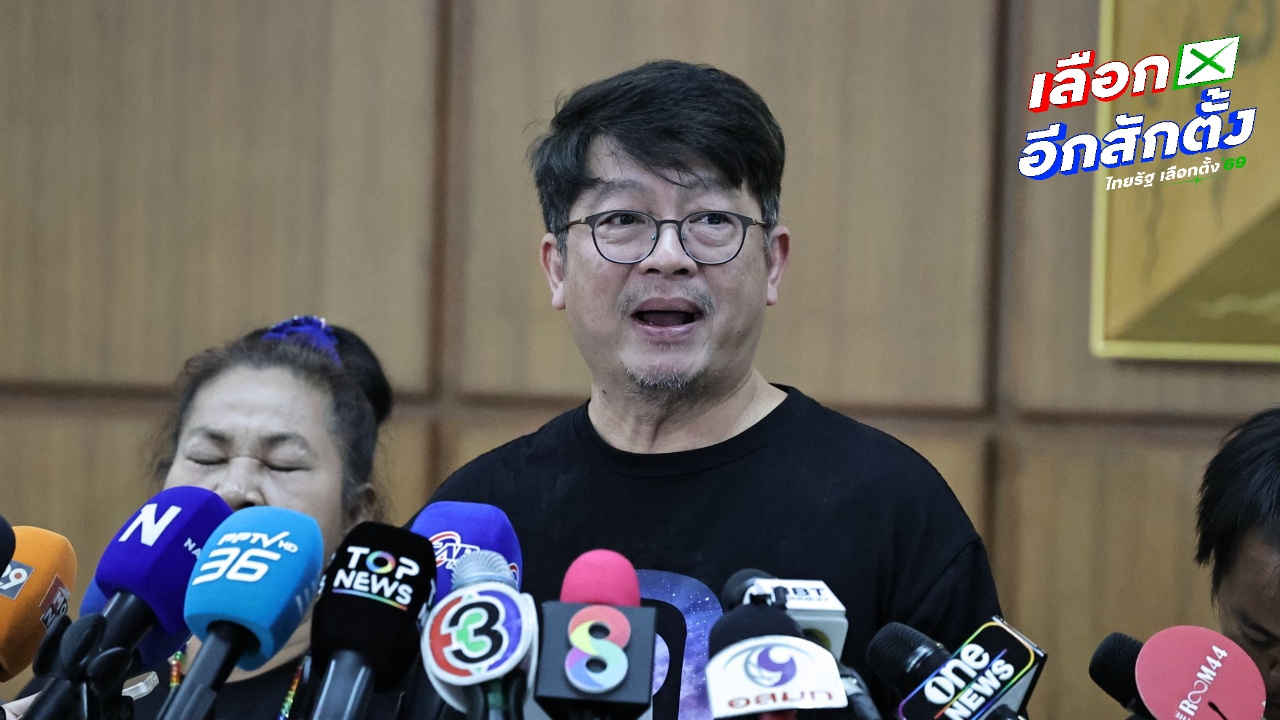
Somphat Boonyamanong confronts the Election Commission (EC), pointing out that it is now the third day after the 2026 election, yet the public still cannot access vote counts from all polling stations. He criticizes the system as poor and notes discrepancies between the number of voters and valid ballots.
On 11 February 2026, Somphat Boonyamanong, also known as "Bor Kor Lai Joot," visited the Election Commission (EC) office to demand answers regarding issues in managing the 2026 election. Upon arrival, he spoke with Pol. Lt. Col. Natthawat Sangsiasak, Deputy Secretary-General of the EC, inquiring about the vote counting process. Pol. Lt. Col. Natthawat explained that all questions could be answered but only by the officials responsible for each area, adding that they were currently gathering facts on all cases.
Somphat then asked whether vote counts from every polling station were consolidated at the EC office. The Deputy Secretary-General responded that the ECT Report's unofficial results had been completed on 8 February 2026. Somphat further questioned discrepancies between data in the system and that at the polling stations. The EC advised relying primarily on data from the polling stations, noting that information was still being continuously uploaded. Regarding why these data had not appeared online after three days of counting, Pol. Lt. Col. Natthawat said only unofficial results had been announced to inform the public, all steps complied with legal requirements, and the EC was not yet able to provide a fully official 100% report.
Later, Somphat said in an interview that he came because it was now the third day since the election, yet the EC still could not announce official results. During this delay, many questions arose about the election’s fairness, transparency, and integrity. The public had never been informed about how the EC’s vote aggregation system worked after precinct committee members completed the count and announced results. He asked how those results were transmitted to the EC, where the war room was located, and whether experts from other agencies monitored the process.
He said these procedures should be open for media, related agencies, or external observers to view, since it was unclear where these processes took place. He noted concerns about the EC releasing fluctuating vote count numbers and discrepancies between voter turnout and valid ballots. This raised questions about where data entry and adjustments occurred, under what reasons, and by whom. During vote counting, the EC website crashed, leading to chaotic data. Therefore, the system's operation must be made transparent.
“Given the explanation that data influx caused system disruption, it shows the EC’s system is poor. There must be clarification whether this is true. Now it is day three; why can’t the public access data from every polling unit?”
Somphat added that the EC explained each polling unit’s documents had to be sent to the district office, and currently all documents remained at the provincial level, which was still processing them. Therefore, data could not be sent from provinces to central office, causing delays. He saw this as unreasonable, believing election data should not be this delayed since it was not complex. He called for all processes to proceed quickly, saying the delays reflected a lack of transparency, inefficiency, and inaccuracy. If it were accurate and transparent, results would be visible from day one. Instead, chaos prevailed with frequent human errors since 2023, occurring repeatedly. He wants explanations on how these issues will be addressed.