

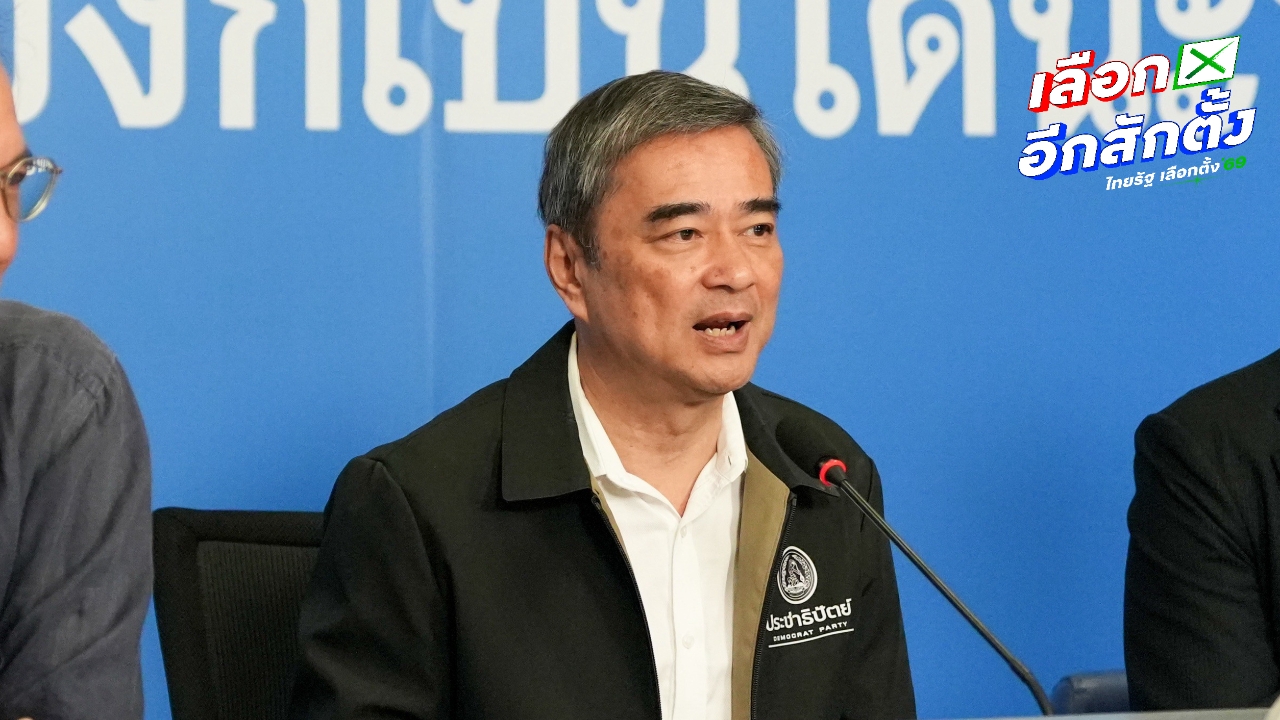
Abhisit supports the Election Commission's release of election data for every polling station, emphasizing the urgent need to resolve discrepancies between the two voting systems before the issue escalates. He maintains his original stance and conditions, rejecting the need to wait for any government coalition invitation, and is ready to proceed with rigorous investigations.
At 10:00 a.m. on 11 Feb 2026 GMT+7, Abhisit Vejjajiva, leader of the Democrat Party, attended a party executive meeting to set the party's post-election stance. Afterward, Abhisit said the meeting analyzed election results and set the party's future direction, focusing on two urgent issues. First, election management problems, such as vote counting in many areas, which risk spreading doubts about the process. He urged the Election Commission to urgently enhance transparency by fully disclosing relevant information to the public, including detailed vote counts by polling station and the number of ballots from both systems, which have shown significant discrepancies in many areas. He called on the EC to exercise its authority to recount votes or order re-elections if necessary, as a fair, honest election process builds legitimacy and trust in democracy, including government formation.
Abhisit added that if doubts persist and are prolonged, causing widespread loss of confidence in the system, it would severely impact political stability. Therefore, the Democrat Party wants the EC to act quickly to ensure transparency. He acknowledged public dissatisfaction with irregularities but urged all parties to be cautious to avoid undesirable situations that would harm Thailand's political image. He called on the EC to clarify the issues clearly and said the party is willing to receive complaints from its candidates for analysis to reveal the truth as transparently as possible.
Abhisit continued that second, the meeting discussed ongoing efforts to address scammer problems since the start. With only 17 days remaining since the government imposed asset seizure measures, he urged expedited action to avoid the 90-day window passing without effective results. He noted that some individuals and businesses, including financial institutions linked to prior matters and projects like iris scanning, have not been adequately addressed by relevant agencies regarding asset seizure or preventing asset transfers. While aware this is caretaker government work assigned to the Anti-Money Laundering Office and the Securities and Exchange Commission, he stressed the urgency of this matter. Delays, especially during a prolonged caretaker government, risk nullifying these measures and undermining enforcement efforts.
Regarding legislative work, Abhisit said the party has appointed personnel to accelerate legal reforms aligned with its campaign policies and to prepare for parliamentary duties. They are also restructuring internal management since the current executive committee has had little time for this due to recent election campaigning. On government coalition talks, he confirmed no contact has been made and reaffirmed the party’s clear stance during the campaign on conditions for joining or not joining a government, stating no invitations are awaited.
When asked if this means definitively closing the door on joining a government, Abhisit replied that, as stated, the party will not join any other party unless policy conditions he previously mentioned are met. Regarding concerns about opposition duties involving the 'orange and blue' parties combined, he said that if managed transparently, there is nothing to fear.
On the vote counting delay in Chonburi’s District 1, which the EC says will take two days, and whether this can keep pace with the spreading issues, Abhisit said this is why they urge the EC to expedite the process and not treat it lightly. Many areas face similar problems, undermining confidence in the entire process. After 2-3 days, the EC should be ready to present data such as polling station vote counts. Comparing to 2023 regulations requiring detailed results disclosure within five days, this time the rule only states 'as soon as possible' without specifying five days, which should not be exceeded. The sooner the better, allowing public scrutiny. If irregularities are found, the EC can use its authority to order recounts or other actions to ensure a fair election, fulfilling its democratic mandate.
Asked about calls for nationwide vote recounts and whether that could cause chaos, Abhisit said it is not yet clear if fraud occurred, but given today’s information environment and citizens’ ability to share evidence such as photos or videos, it is unsurprising that questions arise amid apparent irregularities. Images from certain areas have fueled demands for a complete recount.
The best course now is for the EC to promptly disclose existing data. Abhisit believes no further investigation is needed beyond publicizing information such as why vote counts from the two ballot systems differ significantly in many areas. The EC should have detailed records of how many people received ballots and vote totals per district or station, which should be made public. This transparency is the best way to restore public confidence. Delay risks escalating the problem and harming the entire political system.
Asked whether he expects government formation next week, Abhisit said the Prime Minister, as leader of the largest party, has expressed a desire for election results to be certified clearly first. The EC has 60 days by law, and although the party wants speed, clarity is essential. The EC has faced criticism since the last election for limited prosecutions despite widespread allegations of election law violations. This time, accusations of vote-buying are surpassed by concerns about the EC’s own processes, which deeply affect public confidence. He urged the EC to quickly clarify these issues.
Regarding fears of repeating the 1957 election crisis, Abhisit said history shows that whenever election processes are questioned and rejected, disorder follows. If the EC is confident in its procedures, it must release information promptly. Delays only deepen distrust and spread the problem. Experience at home and abroad shows election legitimacy is a highly sensitive matter. The EC should not act as if this is routine; the issue has escalated from a single area to a nationwide campaign, demanding urgent national-level response.
For social peace, transparency must begin with the electoral process and government administration. When everything is straightforward and transparent, problems do not arise. But whenever legitimacy issues emerge, problems inevitably follow.