

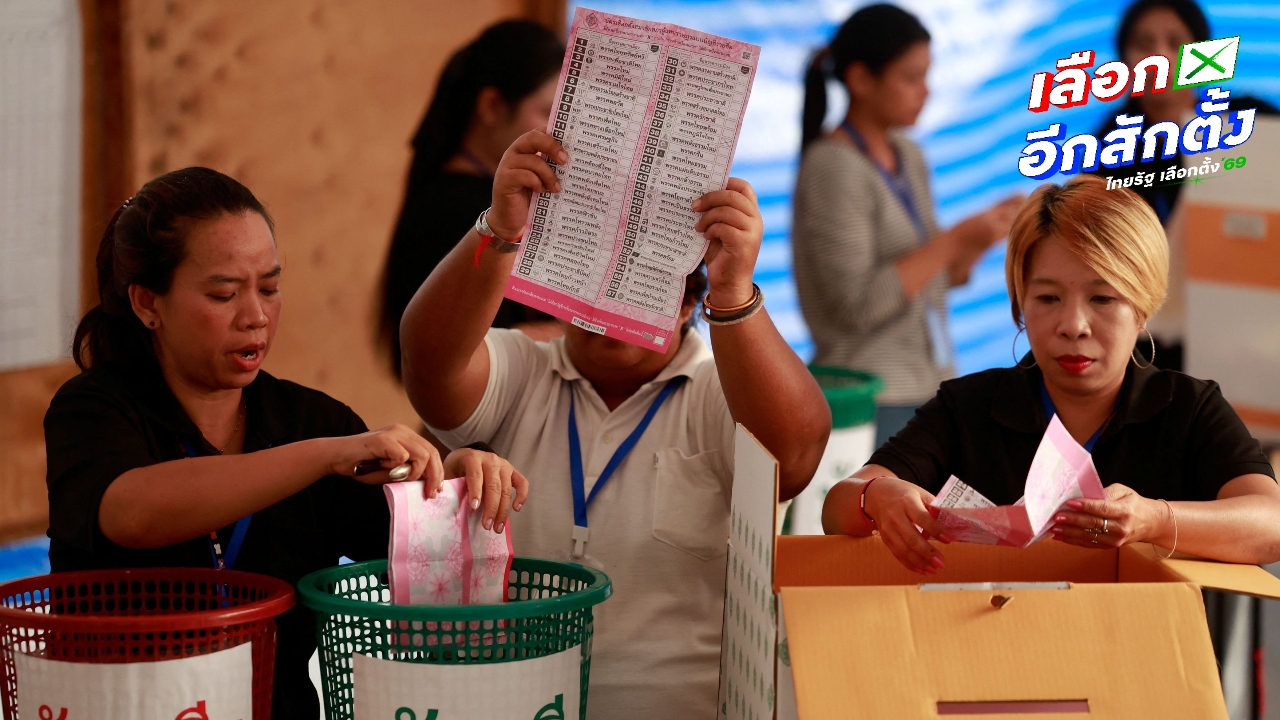
Summary of the controversy over ballots containing QR codes and barcodes leading to demands for a new election. The Election Commission (EC) recently confirmed that this complies with the principle of “direct and secret voting.”Tags: [election controversy, Election Commission, QR code, barcode, voting privacy]
Following a heated issue in Thai politics, concerns were raised that barcodes on ballots could be tracked retroactively, potentially identifying who voted for which candidate. This raised fears that voting confidentiality was compromised, fueling calls for a new election.Tags: [political controversy, ballot barcode, voting secrecy, election integrity]
The issue began when several Facebook users pointed out that the ballots for constituency members of the House of Representatives (green ballots) and party list members (pink ballots) contained both barcodes and QR codes. Scanning these revealed unique codes, causing concern that they might allow tracing back to identify "who voted for which number," raising worries about voter privacy.Tags: [social media, ballot codes, voter privacy]
On the same day, the Election Commission explained that barcodes on ballots are a security measure. They clarified that these codes indicate the batch and polling unit of the ballot, not the political party it belongs to. This explanation sparked intense social media debate overnight.Tags: [Election Commission, ballot security, social media reaction]
Regarding this matter, Mr. Somchai Srisuthiyakorn, former Election Commissioner, commented that the EC may assign codes to prevent forgery but must not use them to trace votes backward.Tags: [former Election Commissioner, vote tracing, election law]
Meanwhile, Lieutenant Commander Sita Tiwari, former member of the Thai Sang Thai Party, cited a Constitutional Court ruling that even incorrectly orienting polling booths led to the annulment of the 2006 election.Tags: [constitutional court, election annulment, polling booth]
Mr. Wiroj Lakkhanaadisorn stated regarding the barcode issue that if the unique number links back to the ballot stub, the EC would be violating the law. He emphasized that the EC should not remain silent on this issue.Tags: [legal concern, ballot tracking, Election Commission accountability]
On 13 Feb 2026, lawyer Aun submitted a letter to the Ombudsman regarding the barcode and QR code on ballots, declaring that this election must be invalidated. This sparked the hot hashtag #InvalidElection with many people proposing a new election.Tags: [legal challenge, Ombudsman, election invalidation, public protest]
At 14:00 on 13 Feb 2026, the Election Commission held a press conference reaffirming that voting was conducted in accordance with the principle of “direct and secret voting.” They noted laws prohibit taking marked ballots out of polling stations and forbid photographing ballots.Tags: [Election Commission, voting secrecy, legal regulations]
Therefore, to determine who a voter voted for requires three factors: 1) the marked ballot, 2) the ballot stub, which are stored separately, and 3) the voter list, held separately at the registry office for verifying absenteeism. The EC emphasized that all polling stations conduct direct and secret voting in compliance with constitutional law.Tags: [voting process, ballot security, constitutional law]
The EC explained this stems from legal authority allowing it to assign codes, marks, or other special identifiers without prior notice to prevent forgery and to efficiently control and manage ballots.Tags: [legal authority, ballot management, election security]
Regarding photos of ballots with attached stubs, the EC acknowledged these could reveal the ballot number and that they would investigate who was responsible. They affirmed that barcodes and QR codes on ballots are not intended to trace back who a voter selected. The EC also stated that images circulating on social media do not disclose personal voter information.Tags: [investigation, privacy assurance, social media misinformation]
Regarding referendum ballots lacking barcodes or QR codes, the EC explained that three types of ballots were printed by three different printing houses with varying technologies. They confirmed that referendum ballots can be tracked but cannot be disclosed publicly.Tags: [referendum ballots, ballot printing, election technology]