

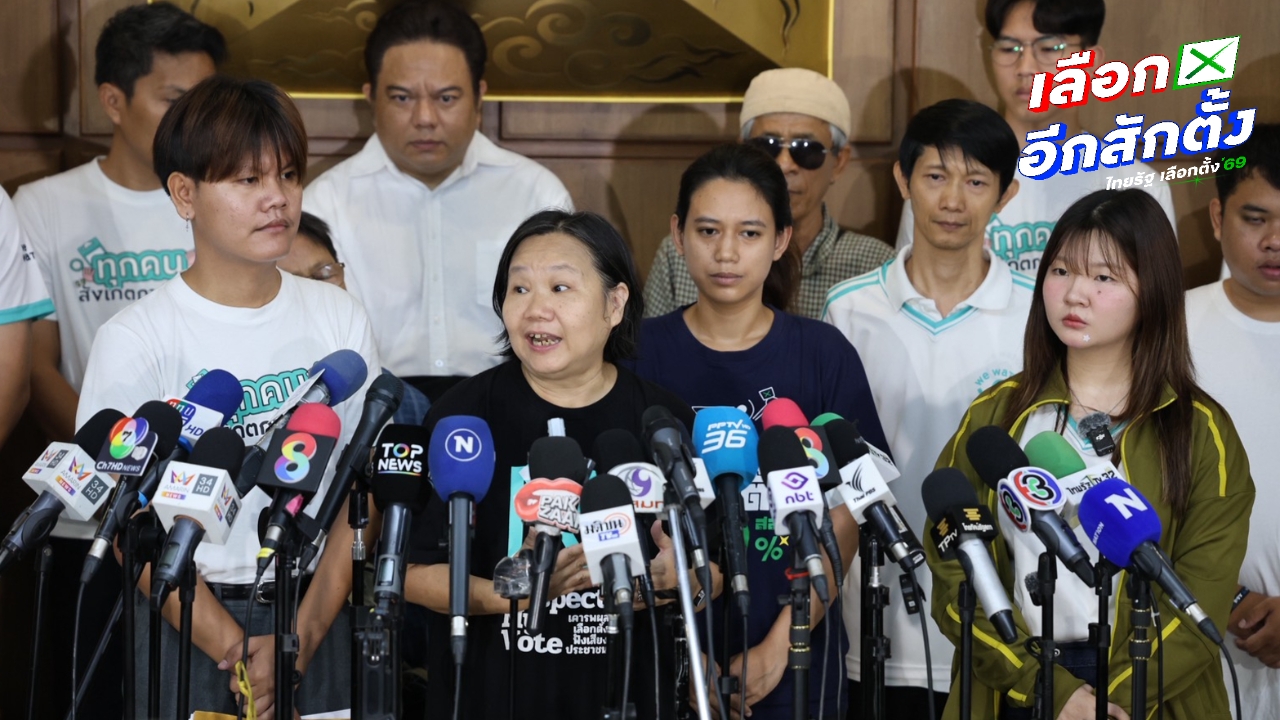
The We Watch group assembled to urge the Election Commission (EC) to promptly release 100% of the official 2026 election results, suggest resignations to take responsibility for the problems, and emphasize the need to reform and reduce the EC's excessive powers.
At 10:00 a.m. on 16 Feb 2026, a civil society group representing We Watch went to the Election Commission office at the Chaeng Watthana Government Complex, Building B, to submit a statement demanding that the EC take responsibility for managing the election.
Mr. Pongsathorn Kanthawong and Ms. Thanaporn Juthasompakorn, representatives of We Watch, read a statement summarizing that due to problems occurring during the early voting on 1 Feb and the general election on 8 Feb 2026—regarding transparency, corruption, fairness, efficiency, professionalism, independence, and accountability—they have demands for the EC to resolve these issues for the public, divided into two phases.

Phase 1: Urgent measures to address public suspicion.
1. The EC should disclose 100% of the official election results via the ECT Report system as soon as possible, including publishing summary documents of vote counts by polling station. If feasible, they should also reveal images of tally boards at each polling station and the early voting ballots of all types.
2. Systematically clarify all concerns with detailed explanations supported by evidence and verifiable, such as issues of decreased or inconsistent vote counts, reporting system failures or website crashes, and problems related to ballots with barcodes and QR codes.
3. Recount votes only at polling stations where problems or doubts exist, conducting counts publicly in front of citizens, observers, and the media.
4. Open opportunities for civil society to participate in auditing the EC's processes to enhance transparency.
5. To build legitimacy with the public, the EC should seriously consider its accountability by resigning from their positions to sincerely demonstrate responsibility for the problems.

Phase 2: Long-term measures to guarantee fairness and credibility of future election management.
1. Reform the EC's composition to ensure independence, credibility, and neutrality through a transparent selection process linked to the people, who hold sovereign power.
2. Restore the EC's role at the provincial level to enable prompt problem-solving without waiting for central directives, which may delay resolutions.
3. Reform to reduce the EC's power because currently, the EC holds excessive authority, especially in investigation, inquiry, and dispute resolution, as well as decisive powers that create conflicts of interest—effectively combining legislative, executive, and judicial powers within one body.

Ms. Phatsarawalee Thanakitwiboonpol, known as Mind, a civil society representative, stated that today's demands submitted to the EC aim to address errors and controversies that have arisen. Previously, the EC did not clarify public doubts, causing dissatisfaction and widespread public distrust in the election management and the EC's work.
Furthermore, the responsibility to protect the people's votes should lie with the EC, as this is crucial in a democratic system. However, the EC has shifted this burden onto citizens themselves to protect their own rights and votes. This situation has undermined public confidence in the EC, which was already low. Therefore, the EC must show accountability and resolve the problems to ensure the election outcomes reflect the people's will. If it is not the EC's duty—funded by taxpayers—then whose responsibility is it?
Ms. Phatsarawalee added that while the EC has issued statements addressing problems, these have been from its own perspective and have not considered the public's viewpoint. As a result, their statements have been unconvincing. She suggested the EC stop daily press briefings and instead hold thorough dialogues with the public. This would allow civil society to present over 5,000 complaints collected by We Watch and request the EC to transparently disclose complaints at polling stations to compare issues and collaboratively resolve them.

Regarding the NIDA Poll revealing that most citizens are satisfied with the EC's performance, Ms. Phatsarawalee viewed it as a survey of a specific group. She noted that nearly all citizens nationwide have clearly seen the election's irregularities and lack of transparency. Many have sacrificed personal time to monitor the work of election officials at polling stations.
Therefore, she called on the public who observed vote counting and election officials at polling stations to cooperate with civil society by submitting raw data—including photos of tally boards and numerical data—to vote62.com. This would allow civil society to cross-check this information with the EC's website data for consistency.
Later, Mr. Pongsathorn stated that We Watch conducted a survey with a sample of 1,000 people, finding that 57% were dissatisfied with the EC's performance. Ms. Jiranuch Premchaiporn, a representative of the Constitution Campaign Network, added a call for the EC to withdraw complaints and end prosecutions against citizens who observed vote counting and ballot transportation. She emphasized that civil society plays a vital role and the EC must prioritize transparent election management and listen to the public by inviting participation in fact-checking and collaborative work with the EC.
