

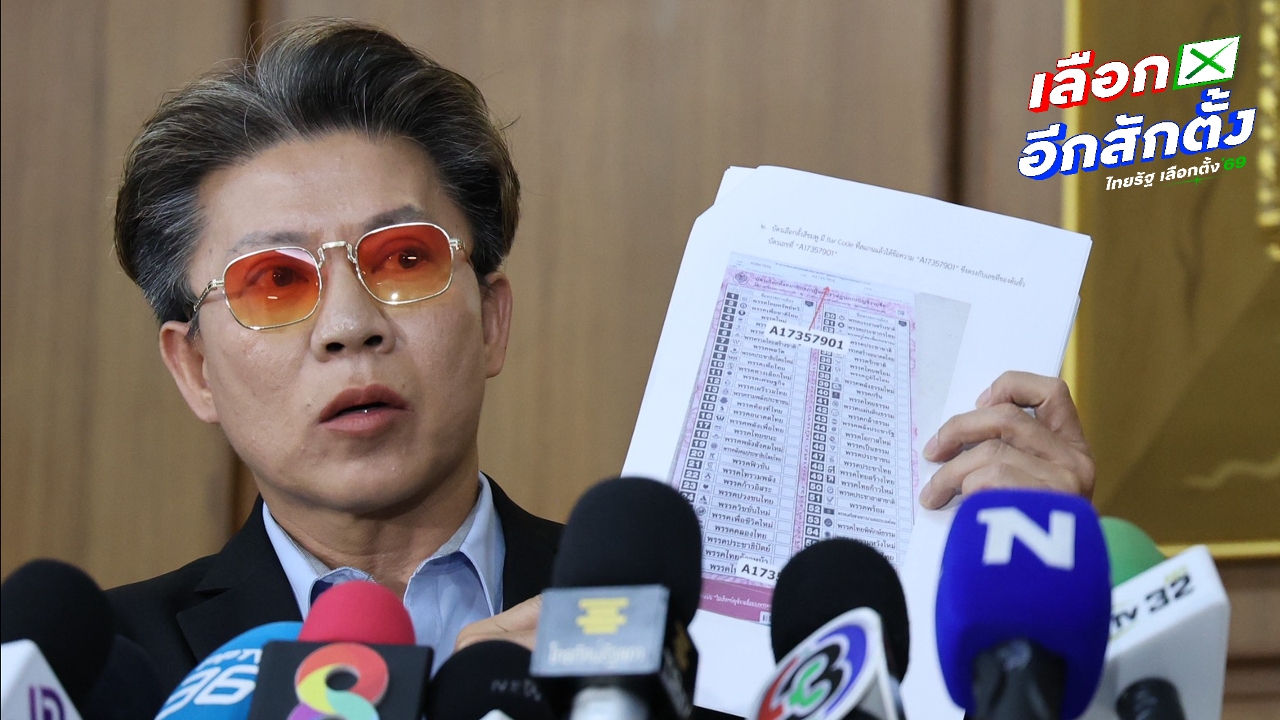
"Mike," former Pathum Thani MP from the Prachachon Party, has filed complaints with the Personal Data Protection Committee to pursue administrative and criminal charges against the Election Commission over the creation of barcodes on ballots, which has led to personal data leakage.
At 11:00 a.m. on 16 Feb 2026 GMT+7 at the Election Commission office, Mr. Prasit Patamapadungsak, candidate for Pathum Thani's 7th district with the Prachachon Party, held a press conference. He announced he had filed a complaint with the Personal Data Protection Committee (PDPC) to take action against the Election Commission for producing ballots with barcodes that can be traced back to individual voters, violating the secrecy and directness of elections and breaching personal data laws. Although past cases involved data leaks, no action has been taken against data collection steps until now. His complaint targets the entire process from data collection to dissemination. The barcode on ballots allows tracing the voter, enabling tracking nationwide, which violates Section 19 regarding data collection without consent, Section 22 requiring data collection only as necessary—where the QR code is unnecessary for vote counting, Section 23 mandating prior notice before collecting personal data, which was not given, and Section 26 prohibiting collection of political opinions without consent, which carries criminal penalties of up to six months imprisonment or a fine of up to 500,000 baht.
Mr. Prasit further stated he wants the PDPC to investigate whether the ballot barcodes can truly be traced back to voters. He noted that the Election Commission's own statements already confirm this possibility. Although QR codes on district ballots may not directly link to a central database, if there is a database matching card numbers to QR codes, tracing is possible. He urges the destruction of ballots or permanent separation of barcodes from ballots—such as physically removing or destroying the barcode area at the bottom—to prevent further data linkage, as the candidate number information remains on top. He also calls on the PDPC to impose both criminal and administrative penalties on the Election Commission. He anticipates the Commission might argue election management is their duty and that they can collect data; however, under PDPA Section 4(4), while state agencies may collect data for judicial purposes, this does not extend to administrative data collection. Printing ballots with barcodes is an administrative procedure, as is vote counting, not a judicial process. Therefore, the Commission's defense is untenable. He also rejects the claim that barcodes enhance security, pointing out there are many alternative ways to prevent forgery without infringing on citizens' fundamental data rights.
Mr. Prasit emphasized that his complaint is not for personal gain but concerns the rights of over 30 million citizens who vote. It is unrelated to vote counts but centers on data collection and privacy violations. Intruding into political opinions is highly dangerous. He referenced five grounds he submitted to the Administrative Court on 15 Feb 2026 GMT+7, noting that if political parties gain access to voters' choices, they will know who supports or opposes them. In cases of vote-buying, targeting becomes more precise. This data creates political advantages and disadvantages, potentially affecting election outcomes repeatedly. Moreover, knowledge of voter preferences could impact civil servants' careers; officials not supporting a ruling party might face stalled advancement if that party gains power. Therefore, he insists that voting booths must remain the safest places for voters' privacy.