

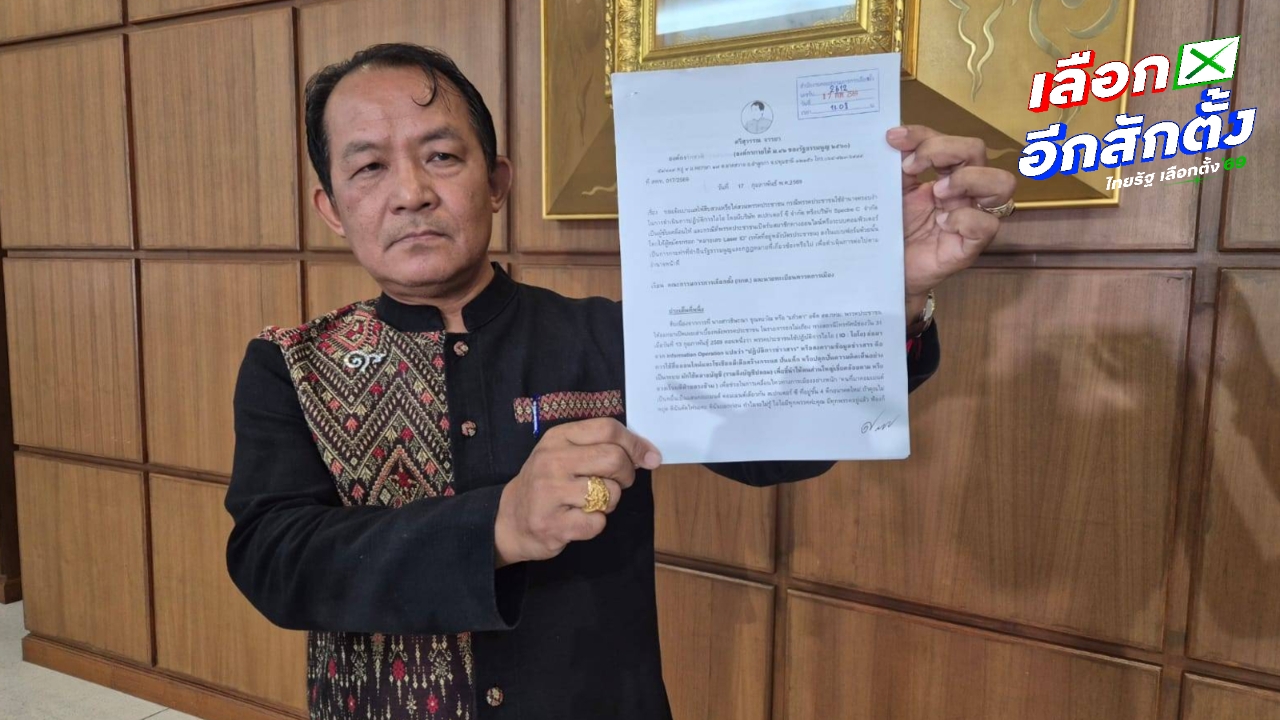
Srisuwan has proceeded to file a complaint with the Election Commission (EC) demanding the dissolution of the Prachachon Party over allegations of conducting information operations (IO) through Spectre C and collecting members' laser ID card data, firmly asserting these actions violate the law and questioning in what capacity Panikarn Chao is representing the party.
On 17 February 2026 at 10:30 a.m., at the Office of the Election Commission, Mr. Srisuwan Janya, leader of the Rakchat Rakphaendin organization, arrived to submit a letter to the Election Commission (EC) and the political party registrar, requesting the dissolution of the Prachachon Party. This follows disclosures by Ms. Thisana Chunahawan, former Bangkok MP from Prachachon Party, who revealed internal party information about orchestrating information operations (IO) to influence political movements through the company Spectre C. The issue has drawn significant public scrutiny, with media investigations tracing the company's office to the same location as the party's headquarters, raising suspicions about whether party members or executives are involved with the company or if the IO operations were conducted on behalf of the party.
Mr. Srisuwan further stated that over time, it has been noticeable that party members, executives, management, and parliamentary candidates appearing on TV or other media have attracted unusually high vote counts, arousing suspicion. One media outlet even reported irregularities in the voting process leading to vote cancellations. This serves as additional evidence. Moreover, the constitution clearly prohibits political parties or their candidates from holding shares in any media or newspapers. Linking this to the contracted company reveals significant connections.
“When this was publicly disclosed, the Prachachon Party spokesperson admitted the company exists. Furthermore, an individual previously found by the Supreme Court to have committed severe ethical violations has come forward claiming to represent the party, despite having no involvement with the party or the company, and has defended the company notably. This may constitute a violation under the Political Parties Act, Section 20. Additionally, if the EC investigates and finds that on the election day, 8 February, the IO operations involved defamation or dissemination of false information, it could violate the Election Act, Section 73, paragraph 5, potentially enabling the EC to exercise its authority under Section 92 to dissolve the party.”
Besides the IO issue, I have also asked the EC to examine the party's membership application forms, which require members to provide confidential laser ID card numbers. The 12-digit number on the back of the ID card is confidential personal data. This may violate constitutional provisions, specifically Articles 32 and 25, which prohibit misuse of personal data for any benefit. Other related laws include the Personal Data Protection Act (PDPA). Therefore, the political party registrar must conduct a thorough investigation, as this issue links back to the first matter. If confidential citizen data is misused, it could pose risks such as creating proxy accounts. Hence, Rakchat Rakphaendin has lodged complaints with the EC and the party registrar, demanding strict scrutiny and investigation to verify if the claims made by Ms. Thisana are accurate.”},{

Regarding the party leader’s explanation that permissions were properly obtained and the data were used only for identity verification, Mr. Srisuwan said he acknowledges the statement but emphasized that Article 32 of the constitution clearly prohibits such acts. As the constitution is the supreme law, it is up to the EC to determine whether violations occurred. If so, Section 92 mandates party dissolution. When asked if obtaining permission still constitutes an offense, he confirmed that it does.
On the IO operation issue and whether it could lead to party dissolution, Mr. Srisuwan explained that the company is officially registered with the Ministry of Commerce with documented directors and shareholders. The key issue is the company’s connection to the Prachachon Party, as it has reportedly received contracts from the party, especially from the political party development fund, which strictly forbids such engagements under the Political Parties Act. Therefore, the EC and party registrar must investigate whether the company, sharing the same address as the party and founded by individuals who later became party secretary-general, has significant links to the party. This is a matter for the EC’s determination.
Regarding Ms. Panikarn Vanich, spokesperson for the Progressive Movement and assistant campaigner for the Prachachon Party, who has clarified that her involvement is separate and concerns non-political products, Mr. Srisuwan stated: “I understand the defense, but I still question what role Panikarn holds in that company and within the Prachachon Party. She might be just a campaign assistant, but now that the election is over, that claim is less valid. Everything Panikarn has presented must be viewed in the context of her position. What capacity is she speaking in? Representatives of the company have never publicly spoken or clarified anything. Also, when media were taken to the room mentioned by Khun Kaew, whether on the 4th or 5th floor, figures such as Parit Watcharasin, former leader of the Move Forward Party, and most recently Panikarn herself have been there. In what capacity did she bring the media? That is the question I want answered.”

Later, at 12:00 p.m., lawyer Ronarong Kaewphet held a press conference announcing that he had submitted a letter to the Ombudsman, requesting the Constitutional Court to rule the election null and void because the EC printed QR codes on election ballots, compromising the secrecy of the election. He explained that after hearing the EC’s briefing on the QR codes, he was concerned whether the recent election was truly secret as mandated by Article 85. He feared that voters’ choices could be traced. Following the EC’s announcement on 13 February, he filed a complaint accusing the EC of misconduct under Criminal Code Section 157. He also petitioned the Ombudsman to refer the matter to the Constitutional Court to interpret whether the EC’s regulations allowing QR codes on ballots are lawful.
“We are simply asserting our right to a secret ballot. There is no need to know trivial personal details like what color underwear one wears. The constitution guarantees freedom to choose any party. Printing QR codes that allow traceability, even if the EC claims it is legal and regulatory, violates the constitution and impacts voters’ rights. Therefore, we submitted this issue to the Ombudsman to review how EC’s regulations conflict with the constitution and affect citizens’ rights to a confidential election.”
Mr. Ronarong added that since the law requires secrecy, but the EC issued rules permitting any markings on ballots without informing voters that their data can be traced, he urges the EC to promptly respond to the Ombudsman without waiting seven days if it insists it acted lawfully.