

ThaiHealth launches a new career for persons with disabilities as “Listeners,” developing the Mind First Aid model to create jobs and care for workers’ mental health after finding that over 40% of working-age people experience high stress from economic problems and changing work patterns.
At 13:30 on 17 Feb 2026 at Club Siam Glowfish, the Thai Health Promotion Foundation (ThaiHealth) together with the Institute for Sustainable Mental Health (TIMS) and Young Good Governance company held a press conference to announce a project. “Mind First Aid” or mental first aid by persons with disabilities, launching a new career "Special Listeners" to create employment opportunities for persons with disabilities while playing a key role in supporting workers’ mental health.
Dr. Phairoj Saonuam, Deputy Manager of ThaiHealth, said that according to the 2023 Mental Health Survey of Thai employees by the Department of Mental Health, over 40% of working-age people experience high stress due to economic problems, changing work formats, and business uncertainties. ThaiHealth therefore supports the Mind First Aid project by persons with disabilities to develop their capacity as listeners providing basic psychological assistance.
The project developed two key models: 1. A training curriculum for mental first aiders using the 4S concept: Self-care (caring for oneself), Support (strengthening morale), Sense (understanding others), and Summarize (reflecting), combined with 3O learning methods: Online, Onsite, and On-the-Job Training. A total of 915 people completed the training, including 210 persons with disabilities. 2. Employment model hiring persons with disabilities as “Special Listeners” via the “Sati” application, with 40 persons with disabilities employed, generating over 5.7 million baht in employment value over 12 months.
Ms. Methawi Tatsanasathirakij, project leader, stated that 10 persons with disabilities piloted counseling calls to employees in two organizations and the general public via the app over four months, handling 1,587 calls totaling over 29,000 minutes. The average satisfaction score was 4.66 out of 5, and the service significantly reduced clients’ self-harm tendencies. The goal is to expand and develop 500 persons with disabilities as listeners nationwide.
Dr. Jennifer Chawanovanich, Associate Dean of the Faculty of Psychology at Chulalongkorn University, presented research on the impact of mental first aid in organizational contexts, finding that service users are motivated by internal and external factors to access services, feel safe speaking freely, and experience a nonjudgmental listening environment. Organizations with concrete mental health support systems help reduce burnout and foster a culture conducive to mental care.
Additionally, there are three key recommendations:
1. Develop the mental first aid process into a continuous system to enhance service providers’ capabilities.
2. Increase accessibility by ensuring convenience, privacy, and trust-building.
3. Integrate mental health care clearly into organizational policies.
Mr. Omtep Satchamuniwong, founder of Sati App, shared the concept and curriculum structure of “Mind First Aid,” aiming to enhance listening and mental health assistance skills systematically within organizations. The curriculum is designed in four key categories, starting with
1) Support Ecosystem: Understanding current mental health situations, the importance of mental well-being, and coping with various stress forms.
2) Sense: Developing basic listener skills such as building relationships, questioning, reflecting feelings, summarizing, and observing context to gain deep understanding.
3) Summarize and Appropriate Referral: Learning effective conversation closure techniques (Landing & Terminate) and forwarding information for appropriate assistance (Forwarding).
4) Self-Care: Emphasizing the listener’s role in self-care, maintaining proper attitudes, and applying listening skills without harming their own well-being.
Asst. Prof. Dr. Theerapat Angsuchawan, Faculty of Social Sciences and Humanities at Mahidol University, noted that organizational mental health care systems build psychological immunity among personnel, reduce self-criticism, and increase self-compassion. Leadership plays a key role in promoting policies and fostering a psychologically safe organizational culture.

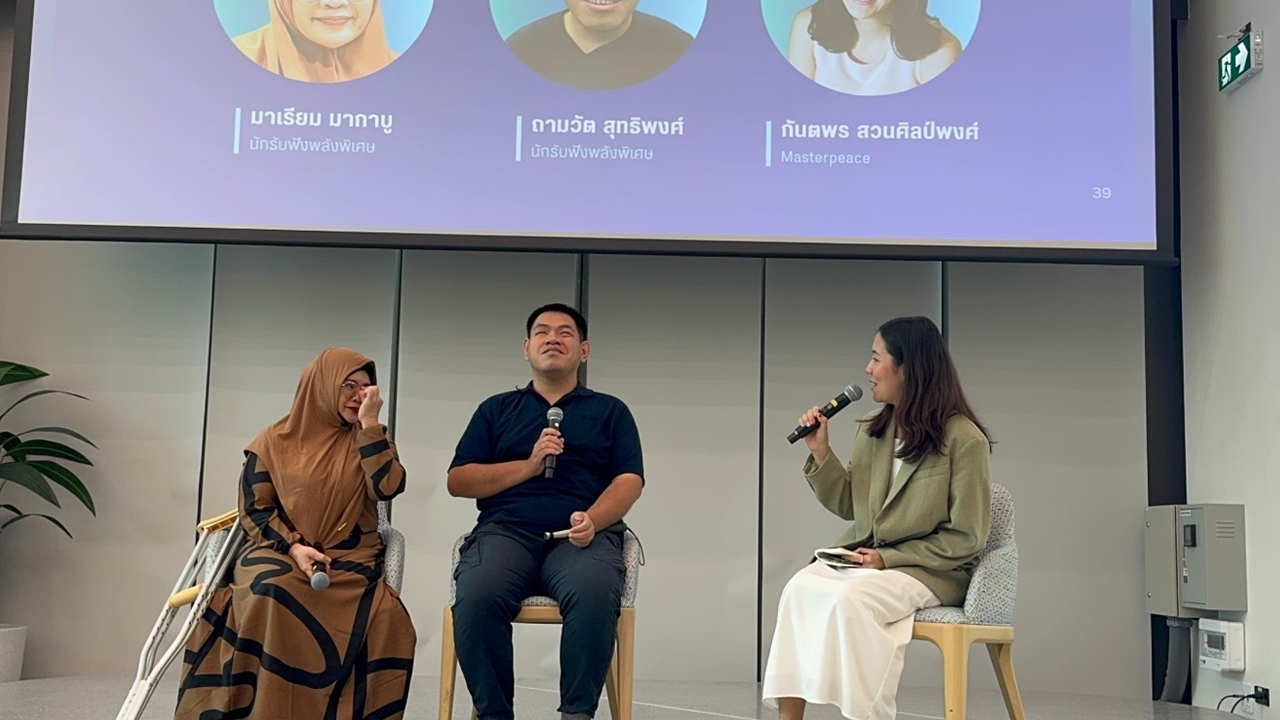
From the perspective of the Special Listeners, Mr. Tammawat Sutthipong, a visually impaired person, and Mariam Magabu, a person with mobility impairment, both trained in the program, revealed that before joining the course, they were unaware of their accumulated stress and worries, believing they could handle all problems until reaching a point where they could no longer manage their feelings.
“I thought I could handle everything, but at one point, I couldn’t anymore. What I learned isn’t just for listening to others; it helped me on days when I was also a victim,” said Mr. Tammawat.
He added that learning to maintain a neutral mindset, emotional awareness, and applying the principles helped him stop negative thoughts and regain composure.
Mariam Magabu, another graduate, said the key to being a good listener is having self-compassion and proper emotional regulation because if the listener’s mind is unstable, they cannot create a safe space for callers seeking help.
“We don’t need to do anything grand, just learn about our own mind and be aware of our emotions. When we have experienced a safe space, we can pass that on to others,” Mariam said.
Both reflected on challenges in listening roles, especially with sensitive cases such as a mother stealing powdered milk from a supermarket or someone quitting a high-paying job to start anew. Listeners must remain neutral, avoid judging right or wrong, and use careful language within defined boundaries and ethics.
They admitted that the instinct to help often pushes them to quickly give advice or solutions, but mental first aid teaches to “listen first, advise appropriately, and refer when necessary” to truly make conversations a safe space. This marks an important shift turning persons with disabilities from “recipients of help” into “providers of help,” opening a new career path as “Listeners” that not only generates income but also supports and restores the mental health of Thai society broadly.
