

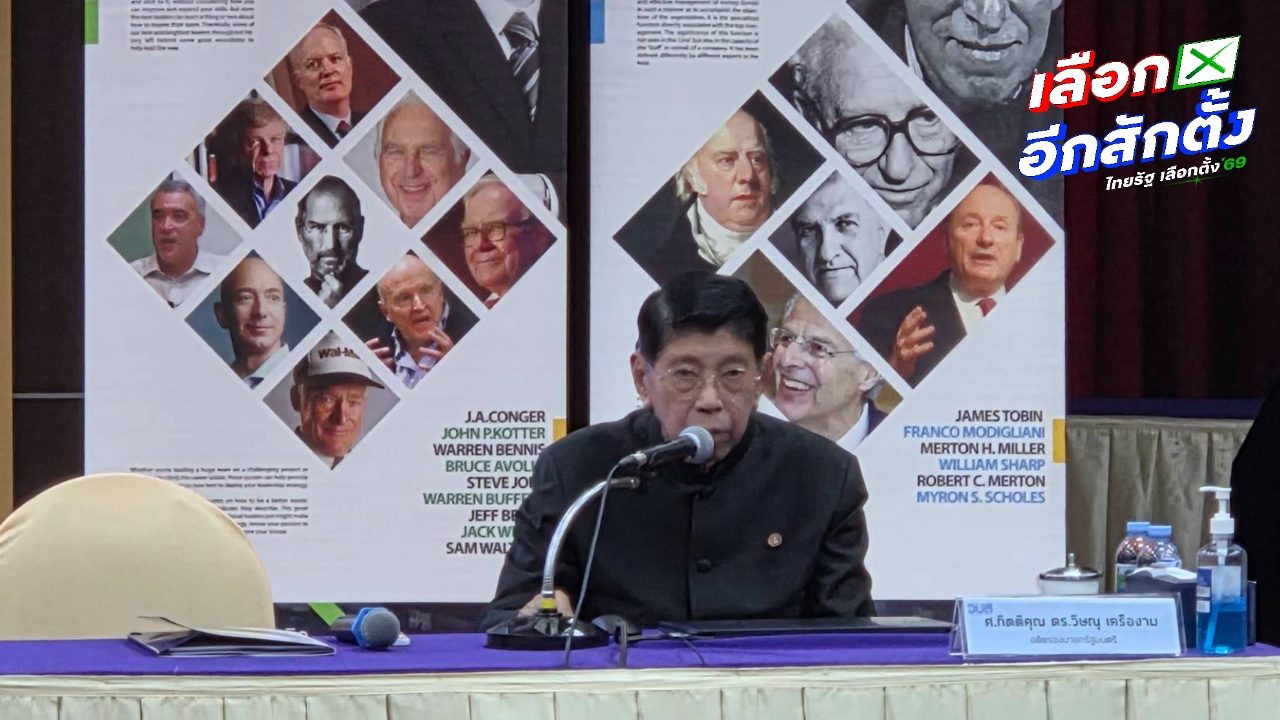
Visanu Kruengam, former Deputy Prime Minister, interprets the issue of printing barcodes on ballots as potentially violating Article 85 of the Constitution, which mandates elections be conducted by direct and secret voting, thus risking the election being declared void.
On 19 Feb 2026 GMT+7, reporters reported that on 18 Feb 2026 GMT+7, Visanu Kruengam, former Deputy Prime Minister, gave a lecture titled "Decoding Leadership - Case Study of Former Thai Prime Ministers" as part of the Management Sciences course for senior executives, Class 14, at the National Institute of Development Administration (NIDA).
After Visanu completed his main lecture topic, he opened the floor for questions and discussion with the course participants. Several questions expressed concern about ongoing political instability after the election, especially regarding the possibility of the election being void due to barcodes printed on ballots that allow traceability back to individual voters, potentially compromising ballot secrecy and violating the Constitution. Visanu responded that there are two possible legal interpretations regarding this issue.
First interpretation: The election results are "non-secret." The Election Commission (EC) has violated the Constitution because the barcode allows tracing how each voter voted, which breaches Article 85 requiring direct and secret voting in elections.
Second interpretation: The election results remain "secret" because secrecy is judged at the moment the voter marks the ballot in the booth, not afterwards. The barcode case differs from the 2006 election, where voting booths were arranged so passersby could see voters' marks. That established a precedent that secrecy is judged at the moment of marking.
Visanu elaborated further: If you ask my personal opinion, which might be wrong, I agree with the first interpretation that it is "not secret" because traceability is possible if someone chooses to do so. The key issue is whether there is a possibility of knowing the vote. If yes, then it is not secret. The term "secret" in Article 85 means the election must be secret at all times—secret to the world entirely. If secrecy only applies after voting and the votes can be revealed two months later, then it cannot be called secret because it has been disclosed.
Visanu stated that if this case goes to the Constitutional Court, they will prove it by taking one ballot with a barcode, comparing the barcode to the stub, and then matching the stub to the voter registry. If the name "Mr. A" appears, then it proves the vote is "not secret."
Before concluding, Visanu emphasized that this is his personal view and he might be wrong. When asked if the election might be void under these circumstances, he replied, "I cannot answer and do not dare to speculate." When asked earlier if the vote is secret, he said it is "not secret." If the voting is not secret, it is up to the EC to decide. If the EC finds it "not secret," the only option is to order a new election nationwide, not just in some constituencies, because the ballots are the same across the country.
In 2006, a nationwide re-election was ordered due to voting booths being arranged so passersby could see voters' marks. At that time, the irregular arrangement was only in some locations, yet the EC ordered a full nationwide re-election, regardless of the cost running into billions of baht.
If the EC does not want to order a nationwide re-election, the only way out is to interpret that secrecy applies only at the moment of marking the ballot, not afterward, as I have explained.
Visanu said he does not dare to predict how the Constitutional Court will rule, but it will not be as simple as making the EC solely responsible. In the 2006 case, there were multiple consequences: a nationwide re-election, EC accountability, and jail sentences. This time, he is unsure if the EC will face jail, but they bear some responsibility because the barcode ballots were approved by the EC.
Visanu also predicted that the turmoil over barcodes on ballots is only a short-term issue. The next government will face long-term conflicts, including internal government disputes over positions and conflicts arising from constitutional amendments following the referendum. The constitution drafting process will involve many people, including members of parliament representing diverse political views and social groups.