

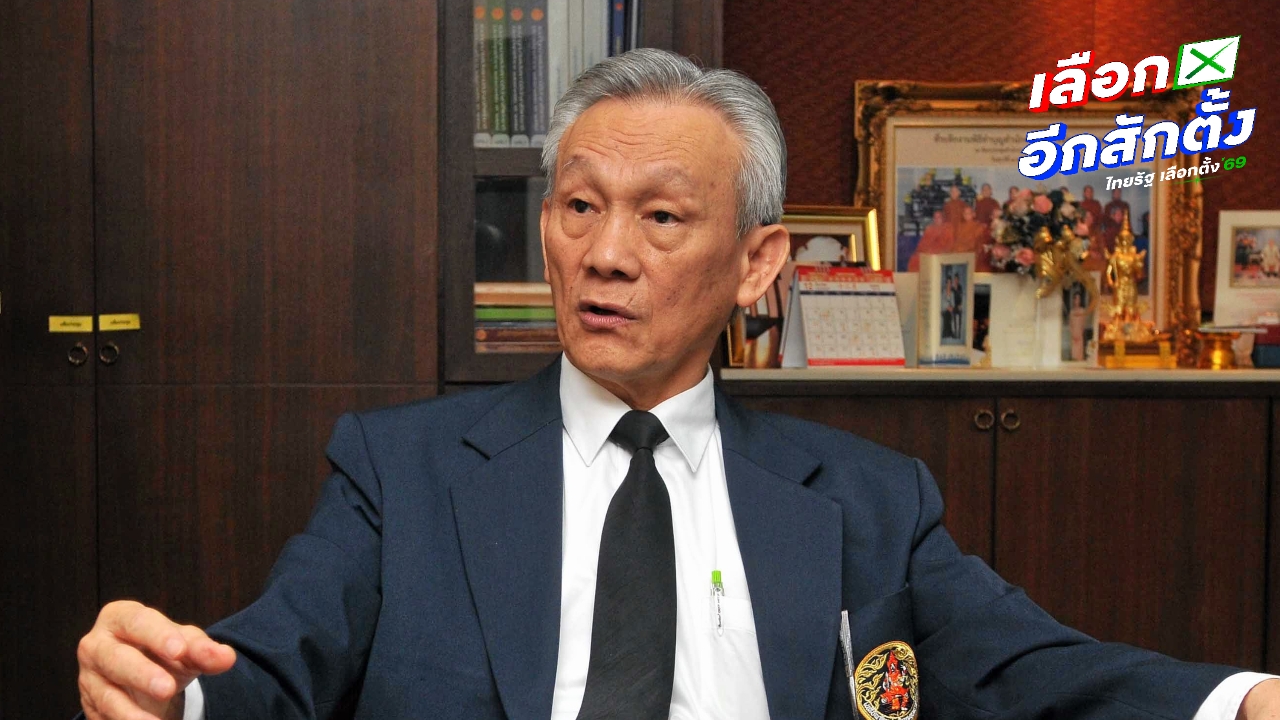
Former Constitutional Court Justice Charan Phakdeethanakul pointed out that if it can be proven that ballots can be traced back to individual voters, this would violate the constitution and could lead to new elections or annulment. He stressed that voting must be secret, while counting must be transparent.
On 18 February 2026, Special Professor Charan Phakdeethanakul, former Constitutional Court Justice, said during a segment of the Kom Chad Luek program regarding the issue of barcodes and QR codes on the 2026 election ballots, and whether they violate the constitution. He said that if it can be proven that retrospective checking is possible and it is clear who cast each vote, then the voting is not secret, which would conflict with the constitution and invalidate the election, leading to new elections and harm to the nation.
However, if it can be proven that the data cannot be used retrospectively to verify who voted for whom or the number of such cases, and no votes have been checked or revealed except in complaints alleging the use of ghost ballots, double voting, or counterfeit ballots with duplicate QR codes, then if it is confirmed that retrospective checking is impossible and that the codes are kept solely to verify such complaints and ensure no fraud occurred, the voting remains secret and does not conflict with the constitution.
"Therefore, at this time, it cannot be concluded whether the voting is secret or not. But if it is not secret, this election is invalid and a new election must be held."
Regarding whether theoretical proof of retrospective checking is sufficient or whether actual practice is required to determine secrecy, Charan said that if electronic and scientific evidence shows that nearly all ballots can be checked retrospectively, the court may decide that secrecy is lost even if no retrospective checking has yet occurred. This theoretical possibility alone is dangerous. If there are cases where voters were pressured or threatened by those paying them how to vote, even one or two such cases would indicate a loss of secrecy. So far, however, no such cases have arisen, so the debate remains theoretical, relying on advanced digital technology principles.
"We must not rely on partisan beliefs or public emotions. The public has been emotionally charged for months before the election and supporters compete fiercely. If there is any hint of unfairness or loss of secrecy, the public will feel cheated and this is dangerous. The risk of serious unrest is greater than annulment of the election—it could lead to clashes between opposing groups without any provocation. If disinformation campaigns intensify, the situation worsens. This is extremely dangerous as it could become an invitation to a coup if tensions reach a breaking point. Therefore, we must all help prevent escalation. The issue can be conclusively proven, with clear winners and losers, truth and falsehood. The only request is to avoid inciting people to protest in the streets or on social media, which is the starting point. If one side incites their supporters, the other side will do the same, or the public may mobilize on their own. The country is at a critical juncture."
Special Professor Charan emphasized, that if evidence proves retrospective checking is possible for every ballot, regardless of political context, there is a high likelihood the court would rule that secrecy is lost. However, this cannot yet be confirmed 100% because no precedent exists. It differs from the 2006 case, where it was clearly shown that secrecy was lost at the time of voting, not retrospectively. The core principle is "secret voting, transparent counting." Therefore, preserving evidence to enable retrospective verification is necessary.
When asked to interpret the meaning of "secret," the former Constitutional Court Justice explained, that the real meaning is that voting must be secret at the moment of casting the ballot, which is most important. After voting, counting must be transparent and not hidden. Lack of transparency during counting causes problems. There have been complaints and lawsuits alleging that some election officials at polling stations did not count votes transparently. Such cases must be investigated and the officials held accountable, but this is separate from systemic issues. Officials who violate rules may face penalties under Section 157, with imprisonment of 5 to 10 years, which is a serious matter for the country. However, this should not be used as a reason to invalidate the entire election.
The host asked what would happen if the court ultimately ruled the election invalid, whether the current Election Commission (EC) would remain in office or face legal consequences. Special Professor Charan replied, that according to Section 5 of the constitution, actions that violate the constitution have no legal effect and are considered void. In plain terms, the election is invalid and must be rerun. The next issue is who will be responsible for the 7,000-8,000 million baht spent, and for the millions of voters who lose work time and have to vote again.
"The responsible party would be the EC. They cannot deny responsibility, which includes potential criminal and civil liability. They cannot manage the next election because public trust will be lost. This is dangerous. The EC must have addressed this clearly from the start to prevent escalation, with all seven commissioners presenting electronic evidence to ease public doubts. Unless a group refuses to believe and takes the matter to court, which is a separate issue. The situation escalated because the explanations were weak. Blaming the opposing side is not justified."