

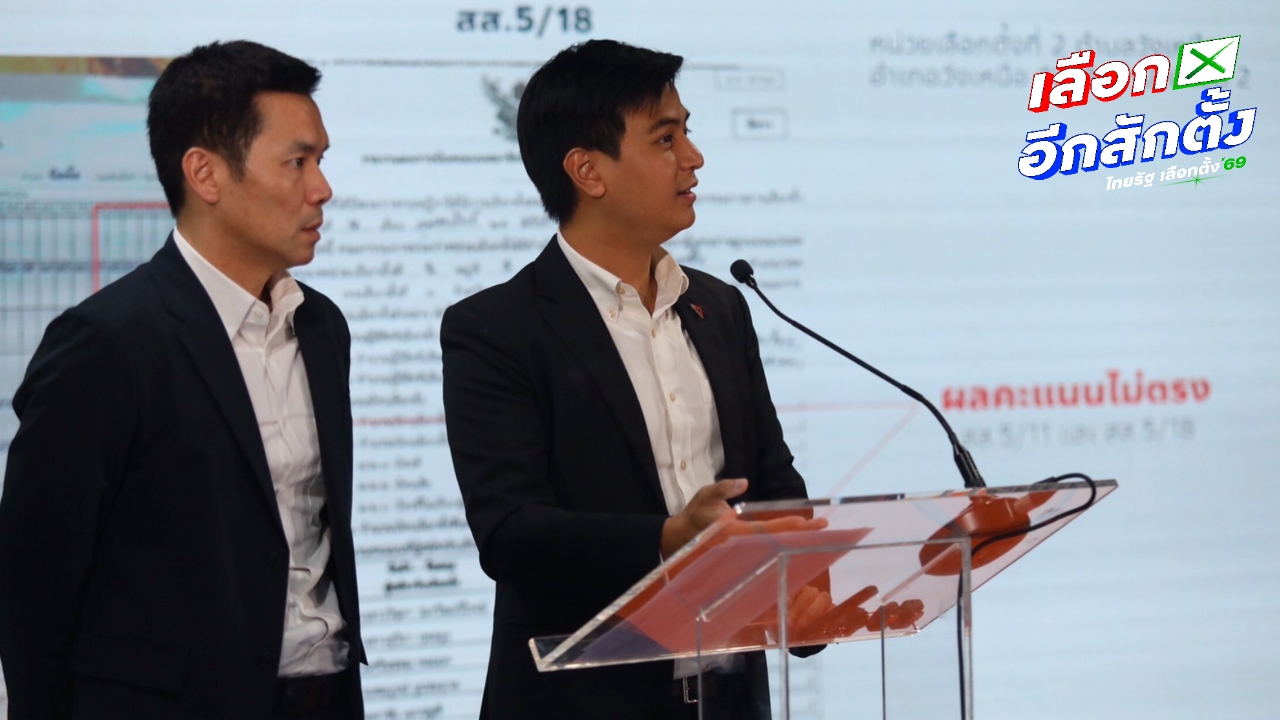
Parit Watcharasinthu, spokesperson for the Prachachon Party, revealed that next week the outcome of Dr. Vayo's draft complaint under Section 157 against the Election Commission (EC) will be known, affirming there is solid evidence regarding the "barcode" on election ballots. The party awaits the 22 February re-election for clear verification.
On 19 February 2026, on the 7th floor of the Future Building at the Prachachon Party headquarters, Parit Watcharasinthu, spokesperson for the Prachachon Party, spoke about the party’s plan to file a complaint against the Election Commission (EC) under criminal code Section 157. He said that Dr. Vayo Asawarungroj, the party’s legal officer, is currently drafting the complaint, expecting to submit it officially next week. The slight delay is due to new information emerging daily, and they continue to collect evidence, but anticipate filing the complaint soon.
When asked about the strongest evidence to use in the complaint and to prove whether the voting process was secret or not, Parit said the detailed content under Section 157 would be disclosed during the filing. The main issue revolves around the barcode, which they see as compromising the secrecy of voting. Multiple parties have investigated this issue through various channels. The Prachachon Party emphasizes that their main intention is to scrutinize the EC’s work, not to reject electoral defeat, but to protect every citizen’s vote and hold officials accountable under the law. The barcode issue is significant; they must prove whether any negligence was in good faith or if someone intentionally committed fraud using this system. Therefore, they have decided to utilize Section 157 to demand legal accountability.
Regarding comments by former Deputy Prime Minister Wissanu Krea-ngam and former Constitutional Court judge Charan Pakdithanakul, who similarly stated that if it’s proven that the ballots were not secret, the election would be void, and whether this supports the Prachachon Party’s position, Parit responded that these matters must be considered step by step. Currently, opinions about whether the voting was secret differ. The Prachachon Party’s position has been clear: secret voting must prevent any possibility of tracing votes back to individuals, whether theoretically or practically, including access to data or ballot samples. This definition aligns with many political figures’ views. They believe it is clear that this election was not secret. Whether public complaints and alternative legal routes will affect the election is another issue, but the party views the barcode’s presence as compromising ballot secrecy.
When asked how the Prachachon Party will obtain evidence given the EC’s ongoing claim that the ballots do not compromise secrecy, Parit said that on 22 February, the EC currently defines secrecy differently than many, including the party and legal experts, who consider any theoretical possibility of tracing votes as a breach of secrecy. Therefore, no further proof is needed. The EC has already stated that the barcode identifies ballot serial numbers, which settles the matter from their perspective. However, the EC’s definition of secrecy focuses on the difficulty of linking data. The key question is how secrecy is defined. According to the EC’s definition, even without direct access to ballots or ballot samples after counting, there are procedural loopholes allowing some parties to check who voted for whom.
“On 22 February, we invite the public to observe. The key point is that if the EC insists that the 8 February election had no problems and that the same procedures and barcoded ballots must be used again, with vote counting conducted transparently, that confirms no issues. But if the process on 22 February differs from before, it shows that the 8 February election had problems.”
Asked about the EC’s conduct during the 2023 and 2026 elections, including announcements, voter information, and lack of press briefings, and whether these signal irregularities or abnormal behavior by the EC, the Prachachon Party spokesperson said that public confidence in the EC’s work is crucial for trust that elections are efficient, transparent, and accurate. If the EC wants to improve its credibility and image as discussed in its meetings, it should start by responding to public questions. One-way communication through press releases is insufficient; the EC should hold periodic press conferences to address lingering doubts among the public.
Secondly, the overall situation reflects problems with the 2017 Constitution, which designed independent agencies so that regardless of their performance or public satisfaction, the public lacks the right to evaluate or initiate removal processes as in the past. The Prachachon Party questions that if Parliament resumes, the party—with over a hundred MPs—will propose constitutional amendments article by article to restore the public’s right to initiate the removal of independent agencies for misconduct, a mechanism that existed in the 1997 and 2007 Constitutions but was removed in 2017.