

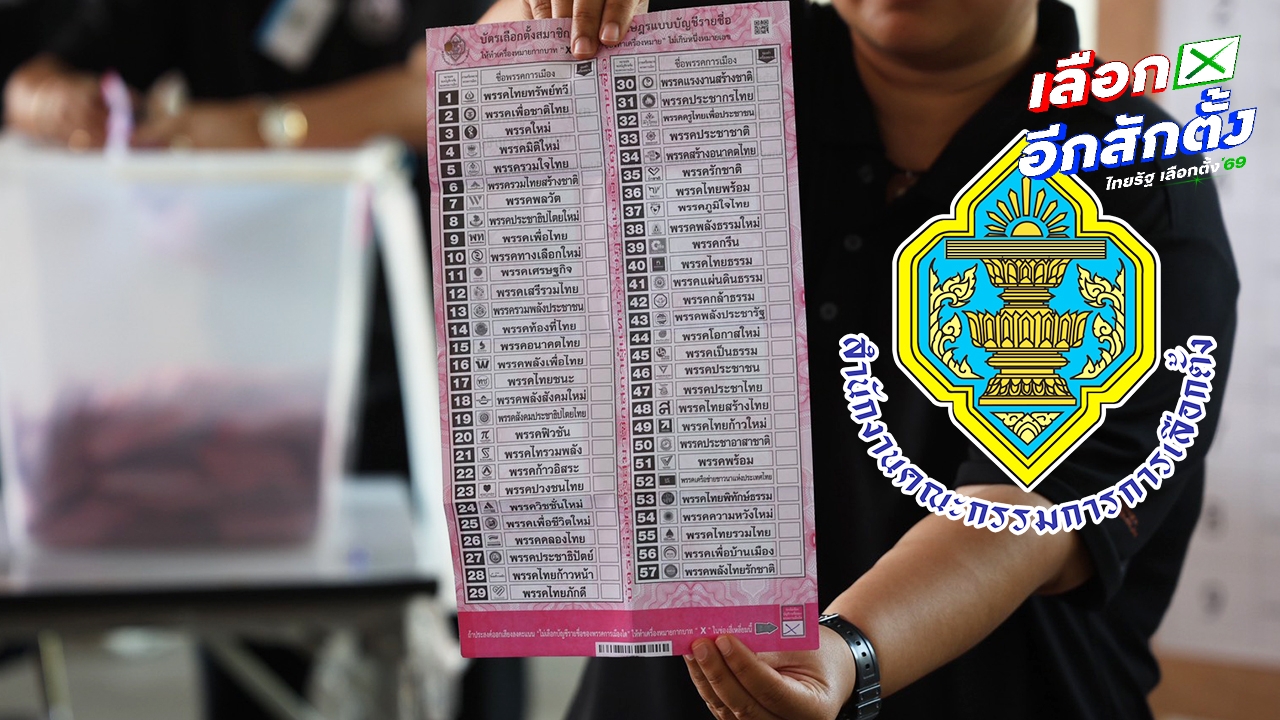
The Election Commission explained that discrepancies between district-based and party-list ballot counts occur because the results are reported separately. If a polling unit reports more than 95% of results in one category, those results will not be presented through ECT Report 69, leading to differences between the two types of vote counts.
On 19 Feb 2026 GMT+7, the Office of the Election Commission clarified the procedures for reporting election results amid concerns about significant differences between district-based and party-list MP election data—known as "stray ballots." Since each voter receives two ballots—one district and one party-list—the results should match. This discrepancy affects public trust, election integrity, and the Commission's reputation. They explained the vote counting and reporting steps from 8 Feb 2026 GMT+7: 1. Once the Polling Station Committee (PSC) completes counting, they prepare separate result reports for district-based MPs (Form S.S. 5/18) and party-list MPs (Form S.S. 5/18 (PL)) for that station, posting them publicly for local observation. If discrepancies or errors arise, the PSC must record them as evidence. Similarly, the Vote Counting Committee (VCC) prepares reports for early votes cast before election day in district (S.S. 5/16) and party-list (S.S. 5/16 (PL)) formats, as well as votes cast outside the district or country (S.S. 5/17 and S.S. 5/17 (PL)).
The PSC and VCC photograph these result report forms—including S.S. 5/18, 5/18 (PL), 5/16, 5/16 (PL), 5/17, and 5/17 (PL)—and record data as required. They send these via their assigned phones to the district vote aggregation center or district Election Commission office, which then forwards them directly to the district Election Commission.
2. When the district subcommittee or district Election Commission verifies the accuracy of these election result reports, they utilize the data as follows:
(1) They compile and announce unofficial vote counts for district-based and party-list MPs at district Election Commission offices to inform the public and stakeholders.
(2) They publish results via a dashboard on the ECT Report 69 system through the unofficial election results website (https://ectreport69.ect.go.th), allowing the public to track results from the first polling stations as soon as counting finishes on election night.
(3) They prepare official announcements of vote counts for district-based MPs (Form S.S. 6/1) and party-list MPs (Form S.S. 6/1 (PL)) to inform the public and relevant parties.
3. After the district Election Commission submits the vote count reports (Forms S.S. 5/18 and 5/18 (PL)) and vote counting reports to the provincial Election Commission office, these reports are published on the provincial Election Commission's website and linked to the national Election Commission website. This allows public access to verified election results. The PSC or VCC are responsible for preparing and posting these reports at polling or counting stations for public viewing. They also report to the district subcommittee or Election Commission to facilitate timely unofficial result publication or official announcements. All steps rely on data from the PSC or VCC reports, which are available to the public 24/7 via the Election Commission websites www.ect.go.th.
Thus, the public can independently verify the accuracy of district-based and party-list MP election results using the information published by the Election Commission as described above.
Regarding media reports that the district-based and party-list MP election results shown on ECT Report 69 (https://ectreport69.ect.go.th) differ significantly—referred to as “stray ballots”—the Commission clarifies that these discrepancies stem from the system’s design. The ECT Report 69 system separates reporting into two distinct categories: district and party-list results. When the PSC reports results, the district vote aggregation center verifies each category’s results separately. For example, if district results are confirmed before party-list results, the district data will be displayed first on the dashboard, followed by party-list results once confirmed. This process occurs uniformly across all district vote aggregation centers nationwide.
The system displays results for each category only up to 95% of polling units in that district. If over 95% of results in one category are reported, those results are excluded from the ECT Report 69 dashboard. Consequently, this causes discrepancies between district-based and party-list vote totals.
The Election Commission emphasized that the purpose of this reporting system is to provide unofficial, rapid election results nationwide, allowing the public, political parties, candidates, and media to track vote counts. It is not intended for official reference by voters, candidates, or parties. The Commission reaffirmed that its operations are conducted honestly, fairly, and legally, as explained above.