

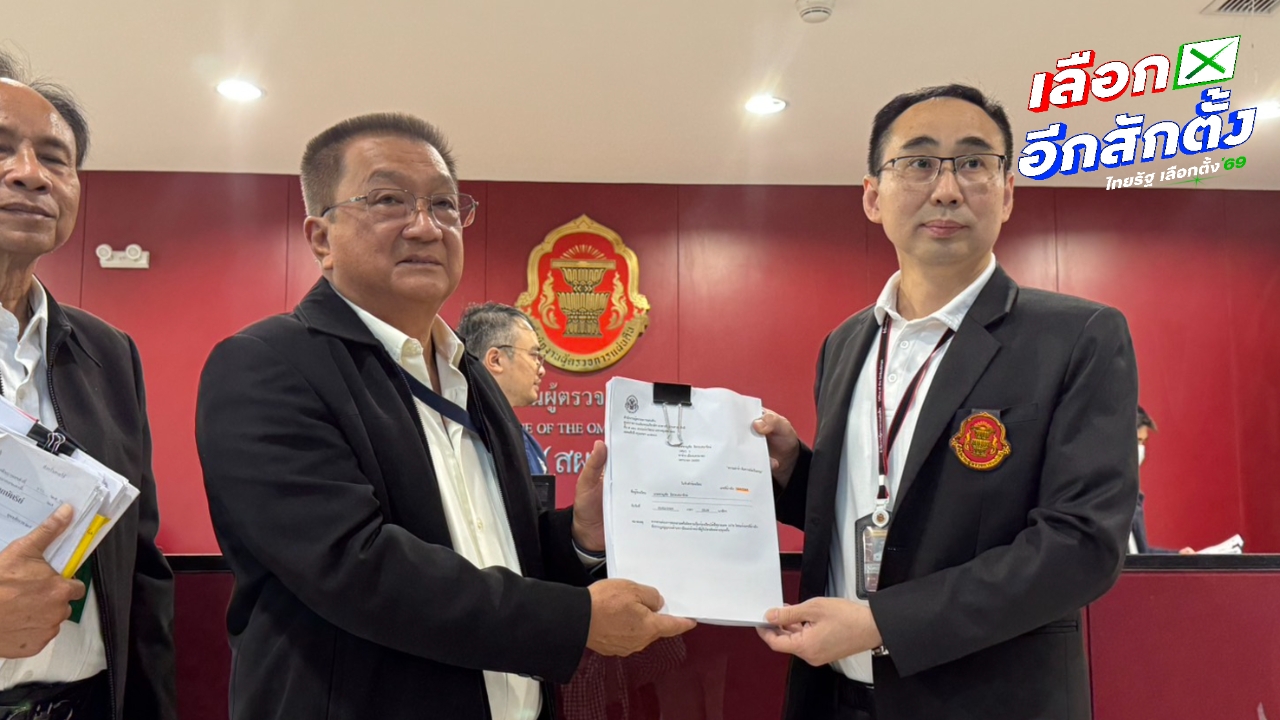
“Chanchai” filed a complaint with the Ombudsman, requesting the Constitutional Court to rule whether the 8 February election violates the Constitution due to ballots containing barcodes and QR codes that compromise secrecy, underscoring the Election Commission’s lack of transparency.
At 10:00 a.m. on 20 February 2026, Chanchai Isarasena Rak, former MP of Nakhon Nayok, as a voter whose constitutional rights were allegedly violated, submitted a petition to the Ombudsman. He asked the Ombudsman to forward the case to the Constitutional Court under Section 46 of the Organic Act on the Constitutional Court Procedures 2018, concerning the Election Commission’s conduct in organizing the general election on 8 February 2026, which raises constitutional concerns as follows.


1. On 13 December 2025, a Royal Decree dissolved the House of Representatives 2025, and the Election Commission announced 1 February 2026 as the advance voting day in constituencies, and 8 February 2026 as the general election day for MPs.
2. Regarding the election process, the ballots used for voting must comply with Article 85 of the 2017 Constitution, which clearly states that “voting must be direct and secret.”
This principle means that the voting of each eligible voter must be conducted so that no one else can know or verify how the voter cast their ballot or for which candidate, as guaranteed by Article 85 of the Constitution. The Constitutional Court’s 2006 ruling No. /2549 dated 8 May 2006 summarized that the secret ballot is essential to democratic elections. Voting must be free; if the election is not secret, it cannot be free. The secret ballot protects both individual voters and the public interest. The process must ensure no one can discover each voter’s choice.

3. It is accepted as fact that in the 2026 general election for MPs, there is empirical evidence that the ballots used contained barcodes and QR codes with unique features linking back to the original voter registration and voting order. This allows officials or persons with database access to trace which voter selected which candidate or party.
This fact is confirmed by the Election Commission’s statement admitting that ballots can be traced back to individual voters’ choices. They explained that such tracing is difficult, but it clearly enhances vote-buying effectiveness. Candidates or parties purchasing votes can trace back to the voter list to intimidate, coerce, or pressure voters to comply with vote-selling agreements. Otherwise, the non-confidential voting data becomes a binding tool to enforce such agreements. This process severely undermines democracy, intensifies election fraud, and allows unilateral access to voting data through barcode or QR code technology, destroying checks and balances. Printing ballots with identifiable features is legally ineffective and contradicts democratic intent. If voters fear breaches of secrecy, the election cannot reflect their true will but rather coercion.

Chanchai added that 5. Elections are a critical democratic mechanism based on the universal principle of a “free and secret ballot.” Both the Election Commission and the Constitution guarantee secrecy to protect voters’ true intentions. Violations of freedom of political expression via non-secret ballots allow others to know or guess voters’ choices, making voters fear pressure from influential figures, employers, community leaders, or political groups. This undermines independent decision-making and violates constitutionally protected political rights and freedoms.
Allowing vote tracing that breaches secrecy leads to intimidation, coercion, and entrenched patronage systems that corrupt election integrity and fairness. It damages election legitimacy and public confidence, which is a vital political asset. If voters believe their ballots are not confidential, it leads to disputes, complaints, and prolonged political conflicts in Thai society, affecting overall stability. Ballot secrecy is a fundamental guarantee of political rights and freedoms; thus, non-secret elections violate voters’ rights and freedoms.

6. The petitioner requests the Ombudsman to urgently investigate these issues to clarify the following:
6.1 Non-transparent vote counting: after announcing results, there were unclear markings and overlapping tally sheets. Officials had to physically reach into areas to mark tallies, a practice unknown in other countries, suggesting dishonest and unfair intentions and a lack of transparency.
6.2 The tally marks did not match the official summary documents. This clearly indicates misconduct by counting officials, suggesting dishonesty and unfairness resembling coordinated wrongdoing.
6.3 The number of ballots for constituency and party-list MPs were unequal, a suspicious discrepancy (ballot mismatch). Each voter should receive two ballots—green for constituency MP and pink for party-list MP—and the counts must match. The mismatch at nearly every polling station contradicts facts and legal principles.
6.4 Media reports show some polling booths were arranged so others could observe from behind which candidates voters marked, violating ballot secrecy.
Finally, 7. Non-secret elections severely impact citizens’ rights and freedoms, leading to harassment and violations. When voting results are disclosed, voters may be tracked, pressured, or threatened by influential people, employers, or officials, causing fear of harm or loss if they choose opposition. The core of elections—free decision-making—is compromised. Without secrecy, voters tend to select according to “social or authority expectations” for survival or vote-selling benefits since results can be verified. This distorts democracy, as election results no longer reflect the genuine will of the people, undermining government legitimacy and destroying the foundation of equal voting rights free from interference. In this case, voters’ rights were directly violated, causing harm. Thus, under Section 46 of the Organic Act on Constitutional Court Procedures 2018, the petitioner requests the Ombudsman to forward this petition to the Constitutional Court under Section 7(11) of the same Act to determine that the Election Commission’s organization of the 2026 general election under the 2025 Royal Decree dissolving the House, including advance and general voting dates, was unconstitutional under Article 85. The election was not conducted by secret ballot, resulting in dishonest, unfair, and non-transparent outcomes incompatible with democratic governance as defined by the Constitution. Prompt action is requested to protect the petitioner’s and public rights and freedoms.
Chanchai stated that he is ready to clarify and support his petition with evidence, including sample ballots and voter registration lists from the 2011 election, to assist the Constitutional Court’s review.