

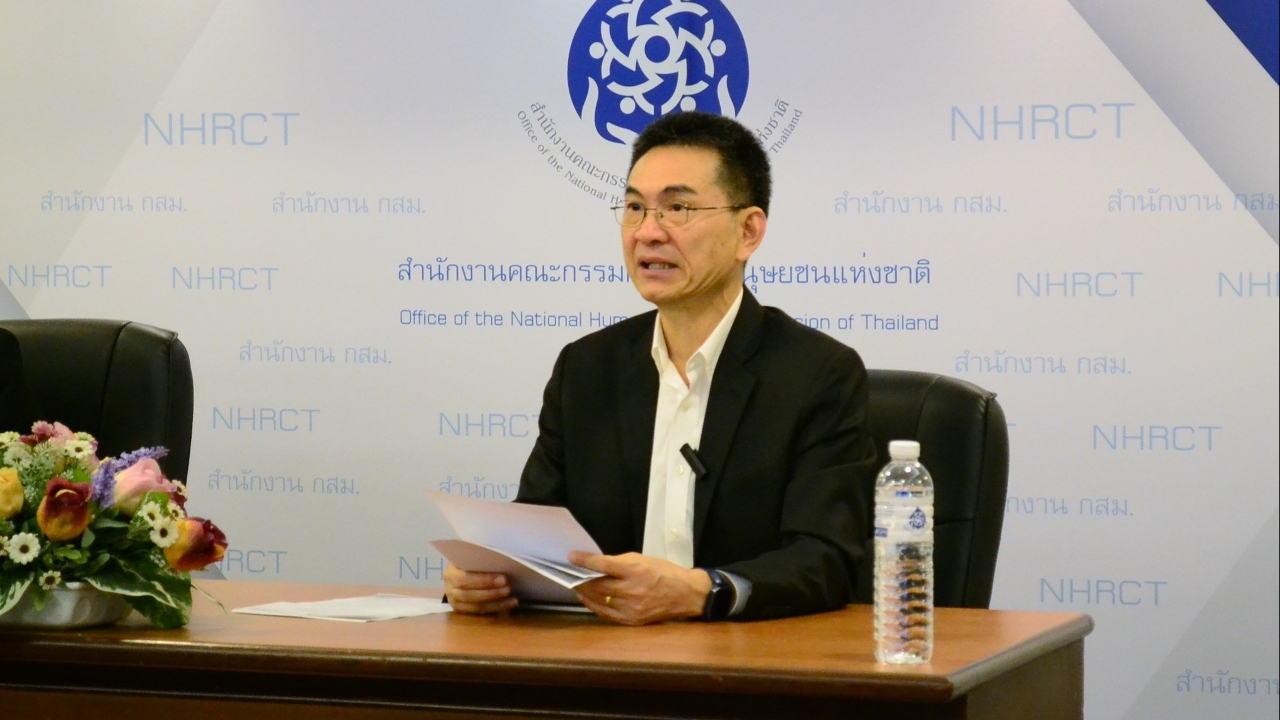
The National Human Rights Commission collaborates with the Army and Navy to raise standards for new military training by drafting "Do’s & Don’ts" guidelines focused on safe training and respect for human dignity.
At 10:30 a.m. on 20 Feb 2026 GMT+7, Mr. Wasan Phailiklee, a member of the National Human Rights Commission (NHRC), stated that the NHRC prioritizes enforcing the Prevention and Suppression of Torture and Enforced Disappearance Act, B.E. 2565 (2022), alongside the Convention Against Torture and Other Cruel, Inhuman or Degrading Treatment or Punishment (CAT) and the International Convention for the Protection of All Persons from Enforced Disappearance (ICPPED). The commission views security agencies such as the Army, Navy, and Air Force as responsible for complying with these laws. Accordingly, the NHRC has continuously collaborated with all military branches to promote understanding and good practices based on human rights principles and prevention of torture and mistreatment. This includes preventive visits to new recruit training centers across the Army, Navy, and Air Force, human rights training for new recruit instructors in the Army and Navy, and inspections of military prisons under the Army, all receiving positive cooperation.
Most recently, the NHRC Office collaborated with the Army and Navy to draft "Do’s & Don’ts" guidelines for training new recruits and conscripts. This supports military operations by preventing torture and improper treatment within training units, and elevates training standards to align with human rights principles and the absolute prohibition of torture. The focus is on safe training standards combined with fostering discipline and operational readiness. The initial key points of the "Do’s & Don’ts" draft guidelines are summarized as follows.
The "Do’s" include four main points: (1) Respect human dignity by treating trainees equally, with honor and without discrimination, in accordance with key laws such as the Prevention and Suppression of Torture Act, the Criminal Code, and the Military Discipline Act of 1933. (2) Create a safe, violence-free environment emphasizing developmental training that builds physical strength and endurance following scientific and safety principles, while providing fair and confidential complaint channels. (3) Administer disciplinary punishments appropriately according to standards set by the Ministry of Defense, with supervisors overseeing punishments at all times and assessing physical and mental conditions after each punishment. (4) Implement psychological care measures by providing confidential counseling and allowing reasonable communication with family without obstruction.
The "Don’ts," strictly prohibited, include six points: (1) No use of any form of violence, such as hitting, kicking, punching, beating, or forcing trainees to be naked, and no verbal abuse that undermines human dignity. (2) Violence must not be incorporated into training methods; it is forbidden to normalize violence in instruction or discipline, or organize activities that violate trainees' rights or dignity. (3) No secret confinement or solitary isolation without necessity; detaining or punishing trainees in hidden areas without surveillance cameras or where incidents cannot be reviewed afterward is prohibited. (4) The seniority system must not be abused for improper command or harassment; senior trainees or assistant instructors must not wield authority over trainees for punishment, control, or coercion unless explicitly authorized by regulations. (5) Blocking communication with family or complaint channels is forbidden. (6) Forcing trainees to perform tasks unrelated to training without valid reason is prohibited, such as exploiting trainees for personal benefit or assigning work beyond their capacity that risks health, unrelated to military duties or training.