

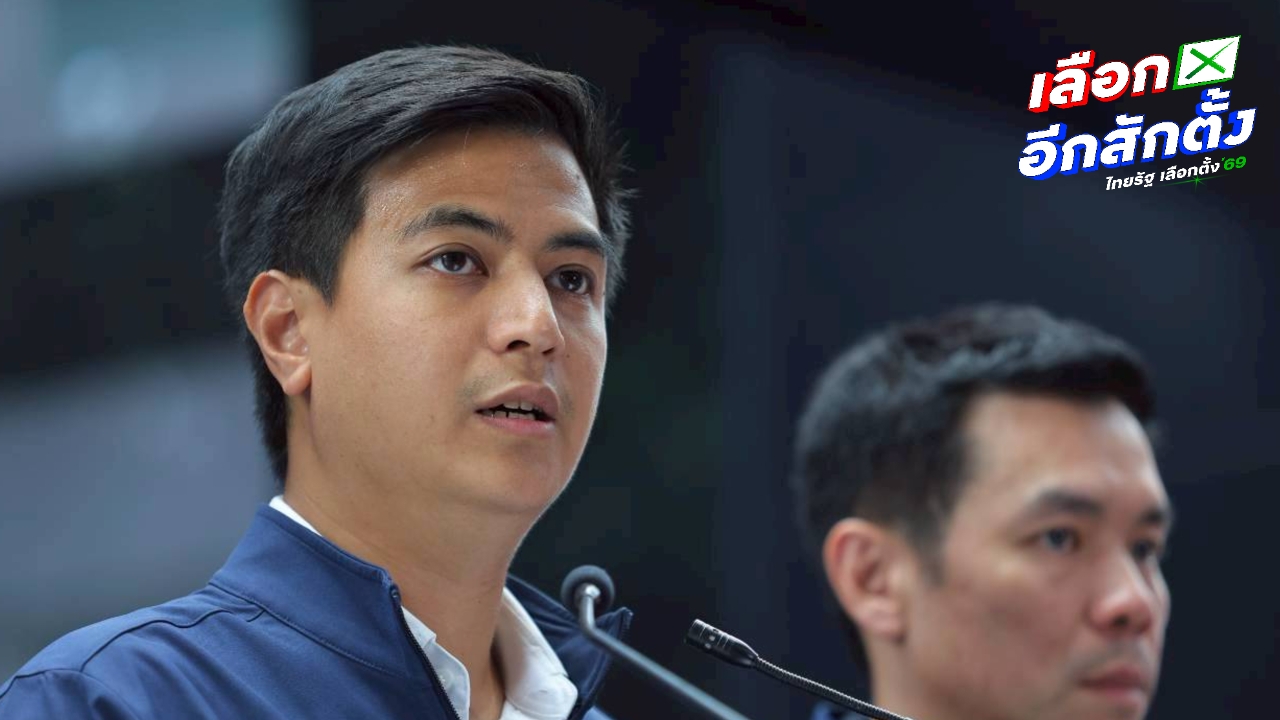
Prasit invites close observation of the re-voting on 22 February, pointing out 5 things that must be watched. If they are not the same, it shows the Election Commission implicitly acknowledges problems with the 8 February election, indicating it was not conducted in secrecy.
On 21 February 2026, Mr. Prasit Watcharasindhu, spokesperson for the Prachachon Party, posted a message regarding the re-voting scheduled for tomorrow (22 Feb). He called on all citizens to closely observe and monitor the re-voting taking place at certain polling stations (such as Bangkok, Constituency 15, Polling Station 9) tomorrow.
If the Election Commission insists that the general election held on 8 February was entirely proper and conducted in secrecy, then what we see on Sunday, 22 February, must be exactly the same as what we saw on 8 February. That is to say,
1. Ballot papers must have the same barcode/QR code as before. At minimum, the party-list MP ballot (pink) must have a barcode unique to each ballot paper specifying a precise “ballot code” (not just the “book code” or “station code”).
2. When receiving the ballot from officials, voters must be able to see the “ballot code” on the stub of their own ballot (e.g., Axxxxx0001).
3. If two voters line up one after another to receive ballots, the “ballot codes” on their respective stubs must be sequential codes or numbers (e.g., Axxxxx0001 & Axxxxx0002).
4. When receiving the ballot from officials, the official must write the “sequence number” (meaning the voter’s number in the voter registry, not the order of receiving the ballot) on the ballot stub.
5. During vote counting at the polling station, officials must hold up ballots and announce the votes in front of observers in a way that does not intentionally conceal the barcode/QR code.
If any of these conditions are not met on 22 February, it indicates that the election procedures on 8 and 22 February differ, which may imply the Election Commission implicitly accepts that the 8 February election had problems.