

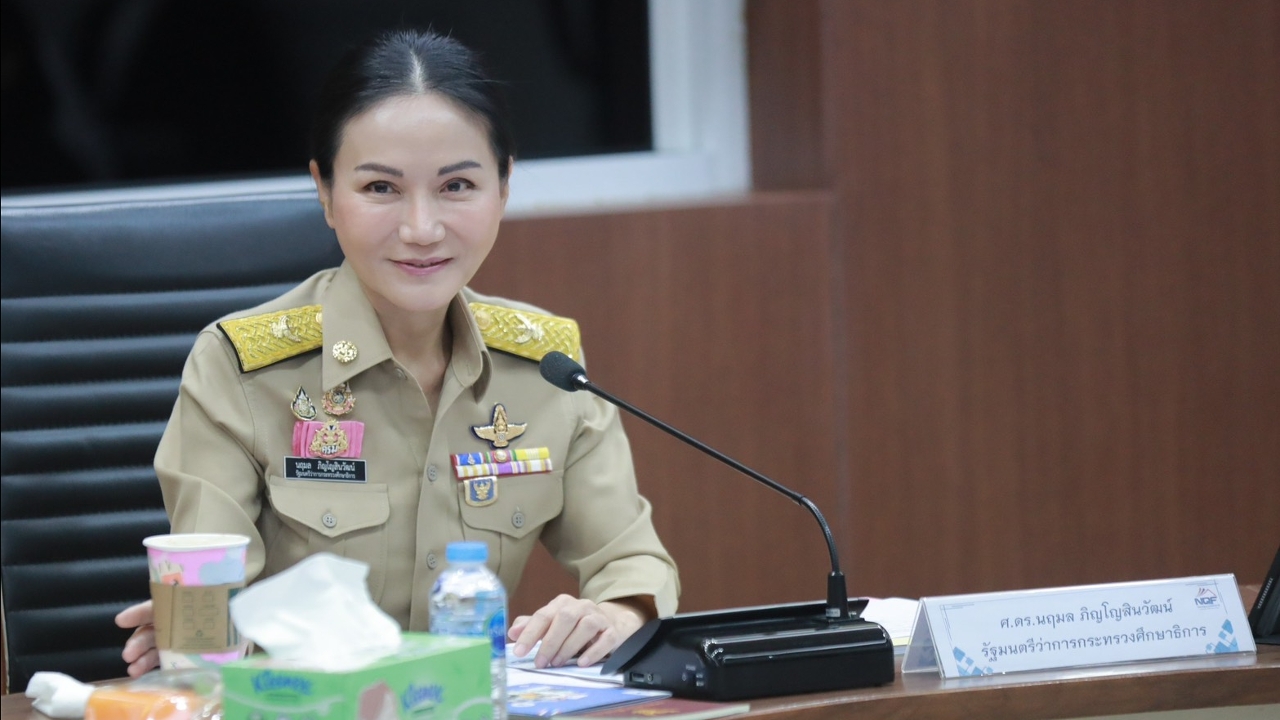
Narumon discussed the National Qualifications Framework, approving draft criteria for course accreditation and level comparison to the NQF, supporting the Credit Bank, enhancing four-language competencies, and linking professional standards with the labor market.
On 23 Feb 2026 GMT+7, Dr. Narumon Pinyosinwat, Minister of Education, was assigned by Deputy Prime Minister Thammanat Prompao to chair the first National Qualifications Framework Committee meeting of 2026. The meeting was attended by Education Ministry executives and representatives from relevant agencies at the Kamhaeng Plangkoon Meeting Room, 3rd floor, 56th Anniversary Building, Office of the Education Council Secretariat.
Dr. Narumon stated that the meeting considered approval of the draft criteria and methods to assess curriculum conformity and level comparison under the National Qualifications Framework. This establishes the framework, guidelines, and processes for course accreditation and registration aligned with the NQF standards, facilitating credit transfer and accumulation in the Credit Bank system. The assessment covers three aspects: curriculum design and level setting, measurement and evaluation, and quality assurance. Related considerations include agency information, course or subject titles, background or principles (if any), objectives, learning outcomes, curriculum structure, alignment with NQF learning outcomes, and consistency with professional or other standards.
Additionally, the meeting approved principles for benchmarking foreign language competencies (English, Japanese, Korean, and Chinese) according to the NQF levels, to serve as a guideline for comparing language proficiency levels with the NQF. The Education Council was tasked with incorporating committee feedback for revision before circulating it to relevant agencies for acknowledgment, prior to official announcement.
The committee also acknowledged the continuation of the National Qualifications Framework Committee by Cabinet resolution dated 7 Oct 2025 GMT+7, which approved the retention of 15 committees previously appointed by the former Cabinet, effective from 4 Oct 2025 GMT+7. The committee is chaired by the Deputy Prime Minister overseeing education qualifications and professional standards, with the Minister of Education as vice-chair and 33 members. Their mandate includes policy and strategy formulation for advancing the NQF, promoting professional standards, supporting education aligned with professional standards, developing systems for credit transfer and recognition of learning and experience, building databases, and linking the NQF with ASEAN and international reference frameworks.

Regarding advancing the NQF and the National Credit Bank, the meeting noted progress in linking educational systems with labor market standards to create learning opportunities for both formal and non-formal learners to transfer experience and promote lifelong learning. This supports alignment with the ASEAN Qualifications Reference Framework (AQRF), enhancing workforce competencies to meet domestic and international labor market demands. Since 2011, under the committee's supervision, policies and strategies have been developed, raising awareness of the NQF's benefits among agencies. However, enforceable regulations remain absent. Efforts to accelerate professional standards development to improve education quality continue, with responsible agencies reviewing and updating standards to be current and internationally relevant, covering occupational fields with education programs in the country.
“The meeting received updates on progress within the ASEAN Qualifications Reference Framework committee, including development of approaches to elevate the AQRF as a regional framework. Key issues include digital credential recognition, quality assurance promotion, benchmarking the AQRF with other regional and third countries’ frameworks, and advancing AQRF Criterion 11. Thailand presented practices for implementing Criterion 11 by identifying AQRF levels in national qualification certificates and executing tasks assigned by the AQRF committee. Thailand will host a meeting to develop practices for Criterion 11 in August 2026 and will also host the 17th AQRF committee meeting in Bangkok the same month. The Education Council will coordinate with relevant agencies to co-host these meetings.” Dr. Narumon concluded.
