

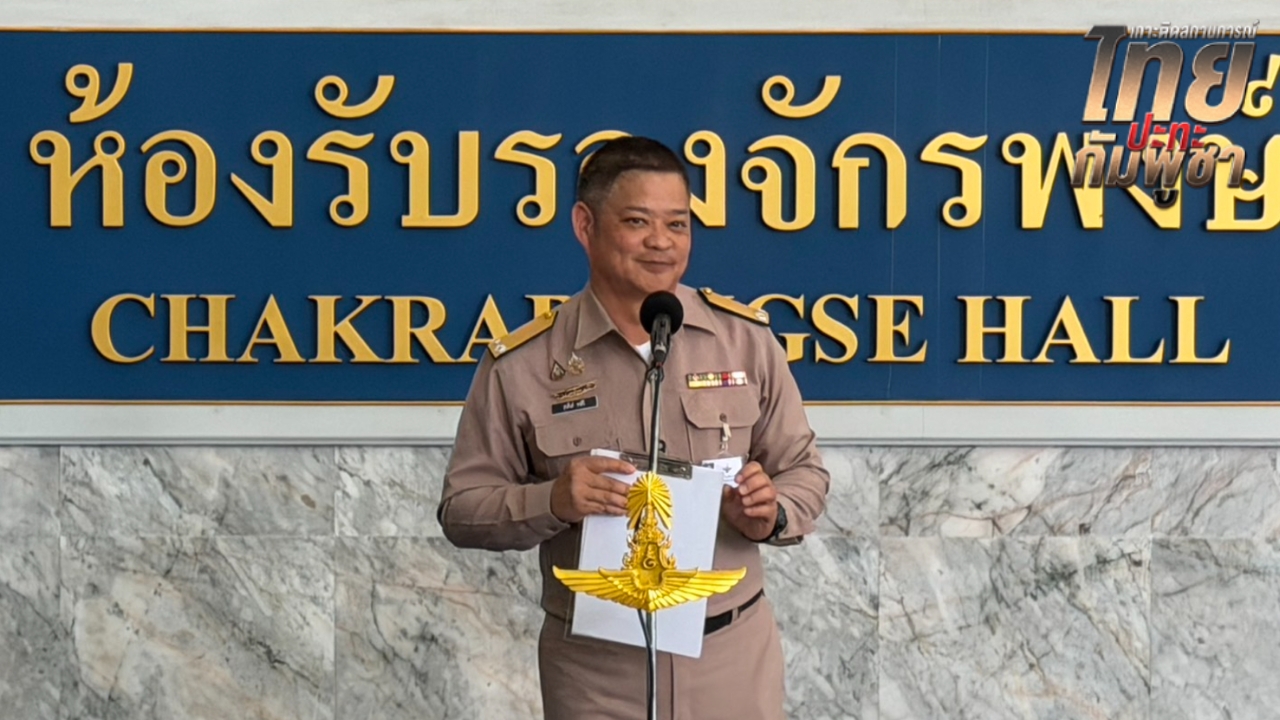
The Defense Ministry spokesperson revealed that the Defense Council meeting approved five border measures between Thailand and Cambodia, including building electronic fences and permanent fences, progressing to establish a new threat protection unit, and ordering all military branches to prepare for drought and forest fires.
On 23 February 2026, at the Air Force Headquarters meeting room, 3rd floor, Air Force Command, Rear Admiral Surasak Kongsiri, Defense Ministry spokesperson, announced the outcomes of the Defense Council Meeting No. 2/2026. The meeting adopted key resolutions covering security measures, resource management, environmental problem-solving, ethics promotion, as well as the development of the Thai military’s structure and capabilities.
The meeting approved that units directly under the Defense Ministry and the armed forces implement five border security control measures: maintaining forces as per situation needs; constructing electronic fences with CCTV systems; building permanent fences where border lines are clear; allocating some land for veterans to cultivate and help maintain; and developing suitable areas as eco-tourism sites. This represents a shift from solely military force use toward integrating cooperation across all sectors, both inside and outside the Defense Ministry, to ensure effective, situation-appropriate, and sustainable border management. The Thai-Cambodian border area is prioritized first, with other areas to proceed as ready. The Defense Ministry’s Office of the Permanent Secretary is assigned to monitor, supervise, and coordinate with related agencies.
Regarding drought measures for 2025/2026, following the Cabinet’s acknowledgment of water management plans—especially measures to improve water use efficiency, conserve water, and reduce loss—the meeting instructed Defense Ministry units and armed forces to plan and implement concrete water usage measures in military camps and government offices. They are to monitor water use to suit conditions without affecting security missions or troop readiness, while continuously promoting awareness among personnel and their families about water conservation.
For addressing forest fires, haze, and particulate matter in 2026, the meeting ordered strict adherence to measures emphasizing proactive actions during preparation and operational phases. The focus is on surveillance, control, and reduction of sources in risk areas, supporting personnel, vehicles, and resources to relevant agencies as coordinated or requested. It also involves integrating information, communication, and alerts with government agencies and local administration to raise public awareness and cooperation. Continuous monitoring aligned with government policy is mandated.
On promoting and overseeing ethical standards, the meeting urged Defense Ministry units and armed forces to strictly adhere to the 2021 Ministry of Defense Code of Ethics and Ethical Conduct. Emphasis was placed on loyalty to national institutions, honesty, transparency, accountability, prioritizing the public interest over personal gain, avoiding conflicts of interest, and serving as role models. Ethics committees in each agency are tasked with supervising, overseeing, and promoting personnel conduct concretely to build the Defense Ministry’s credibility.
Additionally, the meeting acknowledged plans for the opening ceremony of the Defense Ministry Permanent Secretary’s Memorial at the Defense Ministry Permanent Secretary Office in Si Samarn on 31 March 2026, and the 3rd annual "Defense Ministry United Walk-Run with a Devoted Heart" event at the Ministry of Defense headquarters on 26 April 2026. These activities reflect loyalty, pride, unity, and strengthen good relations between the Defense Ministry and the public. All units were requested to publicize these through all channels to encourage personnel, families, and the public to participate fully.
The Defense Ministry spokesperson stated that the meeting also approved establishing the Joint Capabilities Command (JCC) to address new threats such as electromagnetic operations, information warfare, aerial operations including unmanned aerial vehicles and counter-UAVs, and space operations. This aims to equip the Thai military with joint operational capabilities across all domains.
Regarding progress in ASEAN Observers’ operations on the Thai-Cambodian conflict situation—following the August 7, 2025, agreement establishing the General Border Committee mechanism, which later evolved into the ASEAN Observers—the meeting noted past limitations in coordination and information sharing. It proposed creating standard operating procedures for the observers to ensure neutral, transparent information presentation and systematic, effective coordination oversight.
Meanwhile, the meeting acknowledged restructuring the Tosamintrathirat Hospital, or the Air Force Hospital (Si Kan), into a tertiary care hospital to serve local people under the Ministry of Public Health’s policy of "50 districts, 50 hospitals." Plans include expanding beds from 130 to 300 and upgrading medical services. The new facility is scheduled to open by 1 October 2026.