

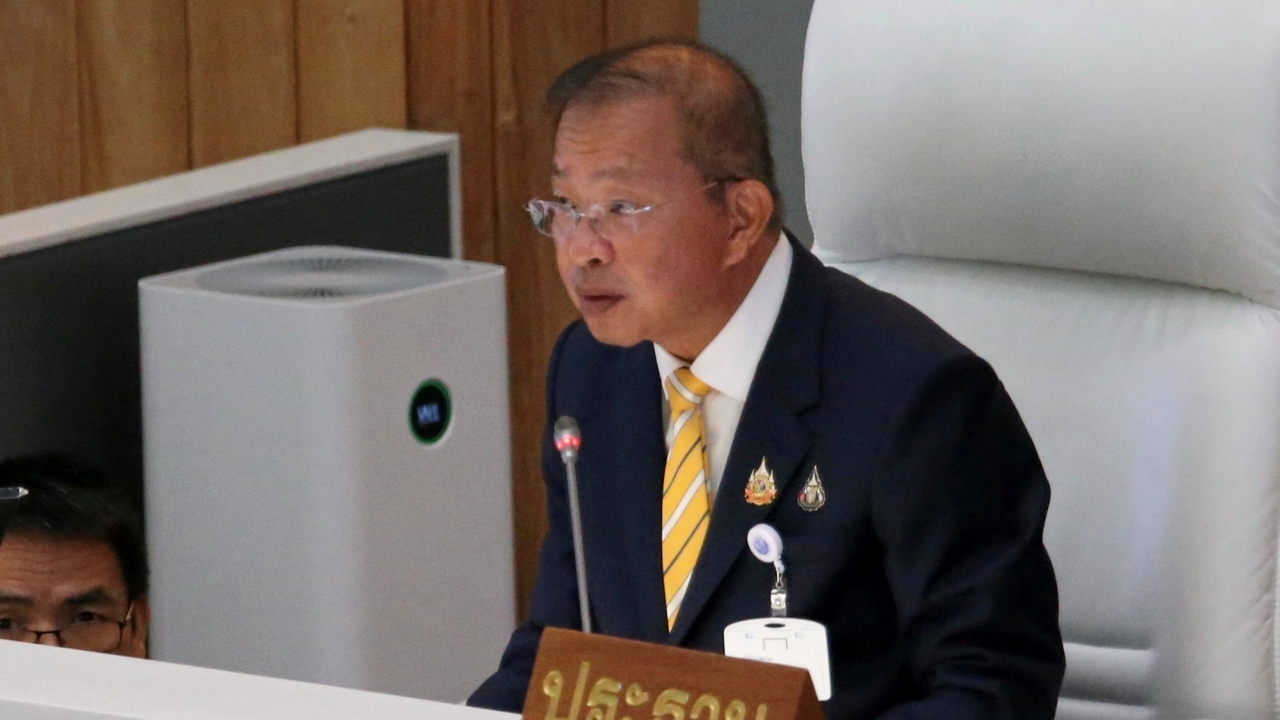
The President of the Senate rejected the motion submitted by Tevarit Maneechai to delay the appointment of two new Election Commissioners to prevent conflicts of interest, citing concerns that senators might neglect their duties as mandated by the constitution.
On 25 February 2026, the Senate Secretariat sent a letter to Mr. Tevarit Maneechai.Senator.The letter informed him of the Senate President's decision regarding the motion requesting the Senate to delay consideration and approval of nominees for the position of Election Commissioner to prevent conflicts of interest, in accordance with Senate Meeting Rules B.E. 2562 (2019), Article 35.
The Senate President reviewed the matter and noted that the Royal Decree dissolving the House of Representatives B.E. 2568 (2025) was issued on 12 December 2025, resulting in the absence of a House of Representatives. Under Section 126 of the constitution, during such a period when the House is dissolved, the Senate may not hold meetings, except in two important cases.
These are 1. performing duties under Sections 17, 19, 20, 21, or 177; and
2. performing duties to consider appointments of persons to positions as provided by the constitution, with the Senate President submitting a royal request to convene a joint parliamentary extraordinary session.
Accordingly, the Senate President submitted a request for a royal proclamation to convene a joint extraordinary parliamentary session out of necessity for state interests, requiring the Senate to meet to consider appointments as mandated by Section 126(2) of the constitution. There were three such matters: 1) consideration of approval for nominees to the Election Commissioner position under Section 222; 2) approval of nominees for Ombudsman under Section 228; and 3) approval of nominees for Auditor General under Section 238. The King graciously granted the royal proclamation calling for this extraordinary session of parliament B.E. 2569 (2026), directing the Senate to conduct meetings under Section 126(2) for these purposes starting 26 February 2026. A royal decree subsequently closed this extraordinary session from 27 February 2026.
Given these facts, the motion submitted by Mr. Tevarit is not a matter the Senate can consider during the absence of the House of Representatives due to its dissolution under Section 126 of the constitution. The interpretation and application of this provision must be strictly confined to what the constitution permits. Furthermore, the motion, if accepted and put to a vote, could cause the Senate to neglect its constitutional duties and contravene the royal proclamation calling the extraordinary parliamentary session B.E. 2569 (2026). Therefore, in the first Senate meeting (extraordinary session) on Thursday, 26 February 2026, the Senate proceeded only with matters involving appointments as prescribed in Section 126(2) and as outlined by the Senate President's royal request.
.....
Regarding Mr. Tevarit's view that during the first Senate meeting (extraordinary session) on 23 May 2023, other agenda items unrelated to direct approval of individuals were included—specifically, the agenda acknowledging the Senate President's approval to extend the timeline for the standing committee to verify the background, conduct, and ethics of nominees for the National Anti-Corruption Commission—this is a matter the Senate President merely informed the meeting of, not a matter for deliberation. At that time, the Royal Decree dissolving the House of Representatives B.E. 2566 (2023) was in effect, outside the ordinary parliamentary session. The Senate President exercised authority to extend the committee's review period. Hence, the Senate was duly notified under Rule 100. The reason for this notification during the Senate meeting was that the committee had completed its review and submitted a report for consideration under the urgent agenda item 1: approval of the nominee for the National Anti-Corruption Commission, which was included in the meeting agenda, as well as other notifications the President intended to deliver in the Senate meeting agenda on Thursday, 26 February 2026. Therefore, at that Senate meeting, the Senate could not consider Mr. Tevarit's motion.Agenda item.that the President was to notify the meeting about in the Senate meeting agenda on Thursday, 26 February 2026. Therefore, at that Senate meeting, the Senate could not consider Mr. Tevarit's motion.