

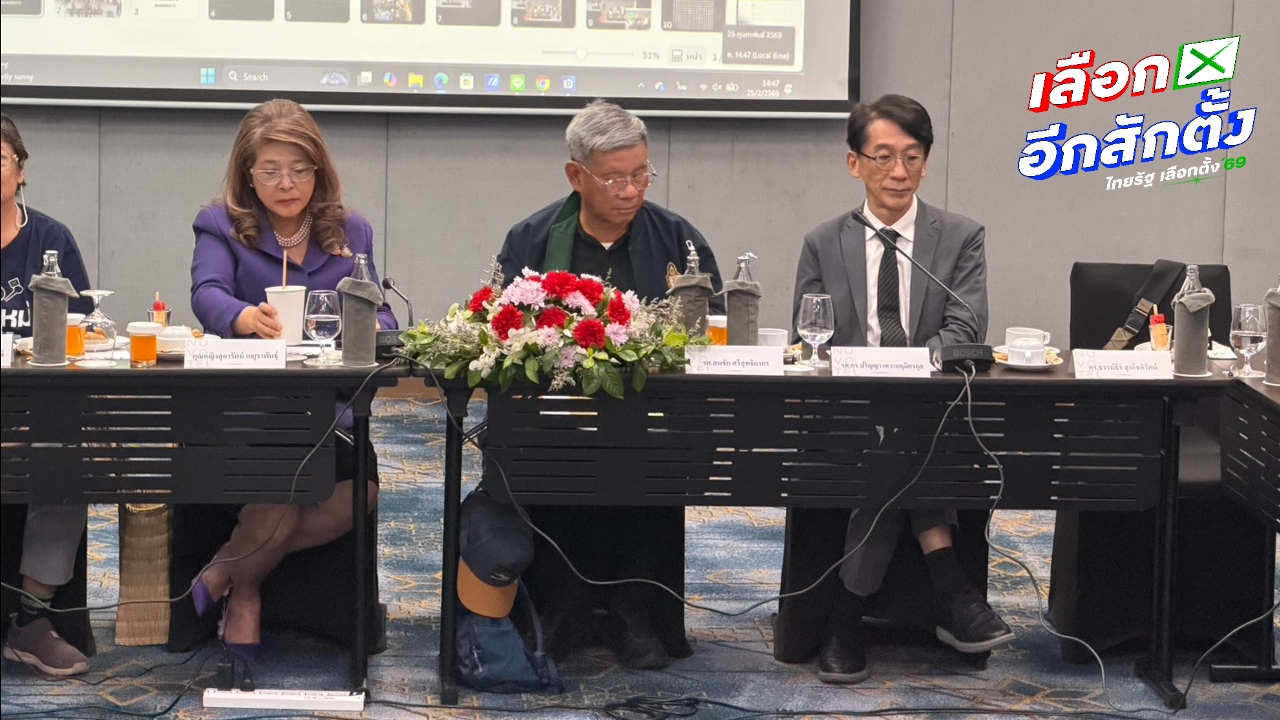
Parinya questions whether the Election Commission is confident that the election was honest and fair after taking 17 days to certify the results. He is puzzled that society still does not know the final number of voters who participated. Meanwhile, Khunying Sudarat is preparing to file legal charges.
At 3:00 p.m. on 25 Feb 2026 at Novotel Bangkok Hotel, the Committee for Democracy Campaign organized a meeting of democratic organizations, academics, and civil society networks to investigate the 2026 election fraud. They jointly set strategies to monitor election fraud, scrutinize the Election Commission, propose reforms, and amend the constitution to reform independent organizations.
Ms. Laddawan Tantivitayapitak, Chairperson of the Committee for Democracy Campaign and Secretary-General of P-Net, said that after the 8 Feb election, the Election Commission had time to clarify complaints but appeared to neglect them. The Commission certified results for 396 constituencies amid numerous complaints, raising questions about how honest and orderly the election actually was.
She asked if the Commission is truly confident that the election was honest and fair.
Mr. Parinya Thewanaritkul from Thammasat University's Faculty of Law referred to Section 127 of the 2018 Election Act, which requires the Election Commission to certify constituency MP results only after preliminary checks and reasonable belief that the election was honest and fair. He questioned whether the Commission had conducted sufficient checks to be confident. The Commission has yet to answer concerns about barcodes and QR codes not included in the TOR. Preventing ballot forgery is the Commission’s responsibility, but barcodes and QR codes with running numbers are not marks but tracking tools revealing who voted for whom, even if the original ballot stub is missing.
He also raised issues with ballot discrepancies both in party-list and constituency votes. The constitution allows 60 days for the Commission to thoroughly verify the honesty and fairness, but this election took only 17 days. This is very short compared to the 37 days taken in the 2023 election, despite ongoing public doubts about barcodes, QR codes, and ballot discrepancies.
He pointed out irregularities in certifying results before informing voters.
A major issue remains that the Election Commission has not officially announced how many Thai people voted on 8 Feb 2026. This is abnormal because voter turnout is usually the first figure announced by the Commission. For example, in the previous election, former Commission Chair Ittiporn Boonprakong announced a 75% turnout to clarify the numbers of valid and invalid ballots and remaining ballots. This time, that information is missing. We only know that some ballots were destroyed, leading to reprinting in some polling stations, even though about 94% of vote counting results have been announced.

"Today, the Commission certified results for 396 constituencies, but we still do not know how many people voted or how many ballots remain. The Commission must clear these doubts before certifying. Rushing certification means that any objections to the fairness or honesty of the election will be handled by the Supreme Court, similar to the Senate vote-rigging case, where certification gave the Commission the power to decide whether to send the case to the Supreme Court."
He revealed that the Senate vote-rigging case has not been sent to the Supreme Court even after 1 year and 7 months.
Parinya continued that after 1 year and 7 months, the Commission has yet to submit any Senate vote-rigging cases to the Supreme Court; only failed Senate candidates have been sent. He questioned whether this election would be treated the same way, which would be detrimental to democracy. People can have differing political views and choose different candidates, but the process must end with all ballots being counted fairly and transparently. The public must trust the fairness of the vote counting.
He asked again: How many Thai people actually voted?
Therefore, the first question the Commission must answer is how many voters participated. Are the ballot discrepancies in certified constituencies still present? If there are doubts, verification can be done via barcodes and QR codes. Citizens have the right to file complaints with the Commission, but the Commission should not wait for challenges before investigating. These checks should happen before certification, and even after certification, as the next step is certifying party-list MPs to enable the first parliamentary session.
He stressed that the Commission should ally with the public, not sue them.
"The Commission must understand that no one here gathered without reason. If the election was honest and fair, the Commission must ensure that and take the public as allies, not sue them as has been done. We are ready to be allies to uphold an honest and fair election," Parinya said. .
Parinya also called on the new MPs and Senators to amend several sections of the Election Act, including allowing citizens to sue directly if the Commission fails to act, and details concerning ballots.
He expressed concern over the sharp decline in public trust in the Election Commission.
Then Khunying Sudarat Keyuraphan, representing civil society election monitors, said that public concerns about the honesty and fairness of the election have arisen. While the Commission's speed in certifying results in 17 days is commendable, confidence and trust can only be restored if public doubts are resolved. The call is not out of dissatisfaction with the Commission but a demand that it act honestly and fairly, which affects faith in democracy and international credibility.
She sees the Commission's performance as incomplete.
The Commission must clearly answer how many voters participated, how many ballots remain after claimed destruction, the official count results, and how ballot discrepancies are handled. Despite barcodes and QR codes, the Commission has not proven to the public that votes are secure and safe. Otherwise, its duties are incomplete and fail to ensure an honest and fair election.
She questioned who ordered the printing of barcodes.
She spoke with several business sectors concerned that if ministers could see who voters chose, it would cause problems. Civil servants also fear this, showing a broad impact. The final question is whether the TOR specified printing barcodes and QR codes, and if not, who ordered the printing. The printing company is also under scrutiny.
She said the only remaining option is to file a corruption lawsuit in court.
"Regarding next steps, after certification, it becomes difficult for citizens to verify. Although there is a channel to petition the Supreme Court, we must first ask the Commission to investigate, which may resemble the Senate vote-rigging case. Therefore, the remaining channel is to file a petition at the Anti-Corruption Court to investigate whether the election was honest and fair," Khunying Sudarat said. .
